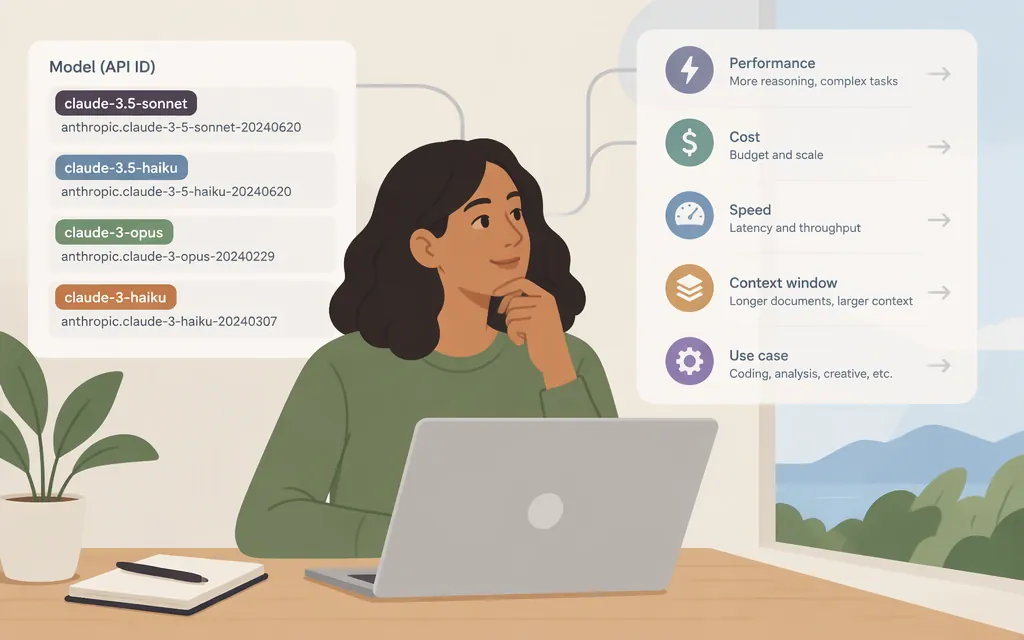
Anthropic model names and API IDs
A Claude model’s display name (such as Claude Sonnet 5.5) is different from its API model ID (such as claude-sonnet-5-5). Anthropic’s model pages identify these five name-and-ID pairs:
| Model name | Claude API model ID | Anthropic’s broad workload description |
|---|---|---|
| Claude Haiku 5.5 | claude-haiku-5-5 |
High-volume work, including summarization, subagents, and browser use |
| Claude Sonnet 5.5 | claude-sonnet-5-5 |
Coding, agents, and professional work at scale |
| Claude Opus 5.5 | claude-opus-5-5 |
Agentic coding and knowledge work |
| Claude Fable 5.2 | claude-fable-5-2 |
Demanding technical work, including coding, finance, and science |
| Claude Mythos 5.2 | claude-mythos-5-2 |
Demanding technical work, including coding, finance, and science; access is limited to organizations verified through Anthropic’s programs |
The names and IDs above are documented for Anthropic’s platform; this is not a complete catalog or confirmation that every model is available to every API user. In particular, Anthropic says Mythos 5.2 is available only to organizations verified through its programs. Check the model pages and the Models API documentation for the model and access relevant to your integration.
Anthropic’s Models news archive reports model names and broad launch descriptions, but an announcement does not by itself establish production API availability. Its visible announcements include Fable 5.2 and Mythos 5.2, as well as Haiku 5.5, Sonnet 5.5, and Opus 5.5.
How to choose a Claude model
Use the descriptions below as starting points, not as a head-to-head ranking:
- Consider Haiku 5.5 for high-volume work such as summarization, subagents, or browser use, as described in Anthropic’s launch announcement.
- Consider Sonnet 5.5 for coding, agents, and professional work at scale, based on Anthropic’s launch description.
- Consider Opus 5.5 for agentic coding and knowledge work, as described in Anthropic’s announcement.
- Consider Fable 5.2 or Mythos 5.2 for demanding technical work, including coding, finance, and science. Mythos has a stated organizational verification requirement; see Anthropic’s model page.
These are Anthropic’s broad descriptions, not independent benchmark results. For a consequential choice, evaluate eligible models on representative tasks and compare quality, latency, and cost for your workload. This guide omits price comparisons because the available excerpts do not establish every model’s rates and billing conditions consistently.
Check API availability and lifecycle separately
Use Anthropic’s Models API documentation to check which models are available for API use and their identifiers. A documented ID alone should not be read as proof of an active lifecycle status or access for your organization.
For lifecycle status, consult Anthropic’s model deprecation documentation. Availability and retirement schedules can differ on partner-operated platforms such as Amazon Bedrock and Google Cloud’s managed service, so check the relevant provider’s documentation if you use one of those channels. Anthropic’s news archive has also described a post-retirement, request-based API exception for Opus 3; do not assume every retired-model case has identical access conditions.
A third-party model list updated April 30, 2026 says its information was LLM-generated and warns that deprecation dates are not guaranteed. For production decisions, prefer Anthropic’s model and lifecycle documentation, and verify provider-specific details for the channel you use.
Sources
Claude Haiku 5.5 — Claude Platform Docs
Claude Sonnet 5.5 — Claude Platform Docs
Claude Opus 5.5 — Claude Platform Docs
Claude Fable 5.2 — Claude Platform Docs
Claude Mythos 5.2 — Claude Platform Docs
List Models — Claude API Reference
Model deprecations — Claude Platform Docs
Introducing Claude Fable 5.2 and Claude Mythos 5.2 — Anthropic