Short answer
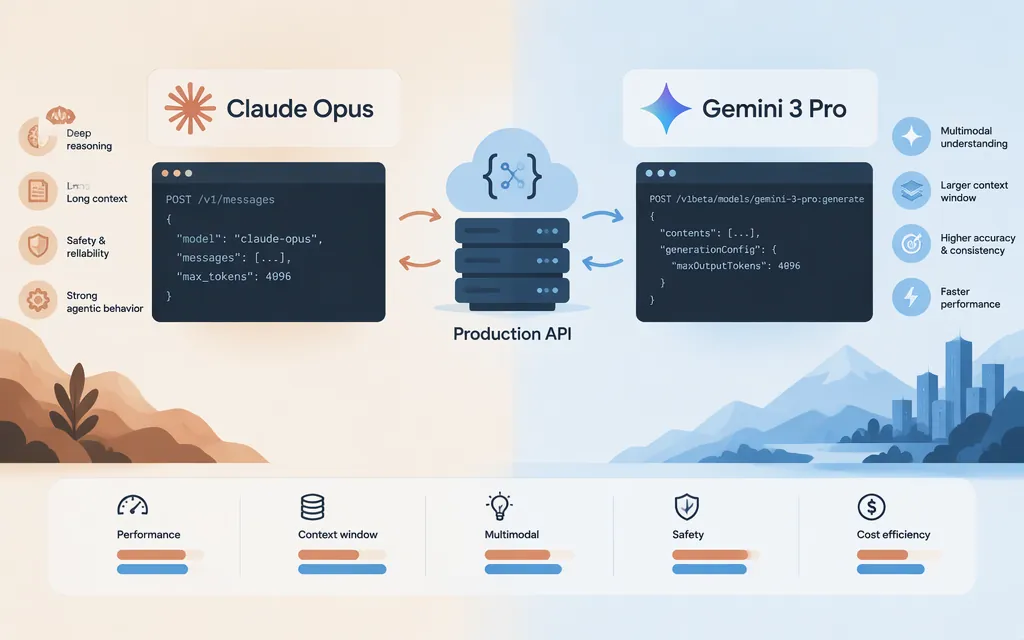
For Google’s Gemini API, the model ID gemini-3-pro-preview was shut down on March 9, 2026. That means it is not an option for a new integration on that API. This comparison covers that Google API route only; it does not establish whether Gemini 3 Pro is available through Vertex AI or other providers.
Older articles comparing Gemini 3 Pro with Claude Opus often refer to Claude Opus 4.5 or 4.6. Keep those versions distinct: their benchmark claims and prices are not evidence about today’s models. For a current direct-API shortlist, compare Claude Opus 5.5 with Gemini 4 Argon—but treat provider descriptions as positioning, not proof that one will perform better on your workload.
What the historical comparison establishes
Google’s Gemini API documentation lists gemini-3-pro-preview as shut down and gives the date as March 9, 2026. Its historical model specifications list text, image, video, audio, and PDF inputs, plus a 1,048,576-token input limit and 65,536-token output limit. Those figures describe the discontinued API model; they are not a route to use it now.
For a version-specific historical price reference, Anthropic’s Opus 4.6 announcement says claude-opus-4-6 was available through the Claude API at $5 per million input tokens and $25 per million output tokens. The announcement describes its 1-million-token context option as beta. These figures are for Opus 4.6, not Opus 5.5.
Current direct-API shortlist and listed rates
The table compares current candidates on their respective provider APIs. Rates are USD per million tokens. They are not a quality ranking or a like-for-like performance result.
| Candidate and API model ID | Input | Output | API details relevant to shortlisting |
|---|---|---|---|
Claude Opus 5.5 — claude-opus-5-5 |
$4 | $20 | Anthropic lists the model as active and available through the Claude API. It lists a 1-million-token context window, a 128,000-token maximum output, and cache reads at $0.20 per million tokens. |
Gemini 4 Argon — gemini-4-argon |
$2 through Nov. 30, 2026; $4 thereafter | $10 through Nov. 30, 2026; $20 thereafter | Google lists the model as available through the Gemini API. Its documented inputs include text, images, video, audio, and PDF. The 1,048,576-token context limit is shared by input and output; the default synchronous maximum output is 65,536 tokens, with long decode documented separately. |
Google describes Gemini 4 Argon as its latest model for coding, reasoning, and agents; Anthropic describes Opus 5.5 for long-running agentic coding and knowledge work. Those are each provider’s descriptions, not independent head-to-head findings. Google’s introductory rate is listed through November 30, 2026; verify pricing and applicable terms before budgeting. (See the official provider pages listed in Sources.)
Cost illustration: Suppose usage across a workload totals 1 million input tokens and 200,000 output tokens, aggregated across requests that individually fit the applicable API limits. At the listed rates, the token charges are $8 for Opus 5.5; for Argon, $4 at the introductory rate or $8 at the listed later rate. This is arithmetic from the published per-token rates—not a claim that one request can contain those token totals. It excludes caching, batch pricing, and other charges; Opus cache reads have a separately listed rate.
Which should you shortlist?
- Shortlist Opus 5.5 if your tasks resemble Anthropic’s stated focus: coding agents, refactoring, or knowledge work. The provider’s positioning is a reason to test it, not evidence it will win your evaluation.
- Shortlist Gemini 4 Argon if you need the documented Gemini API to accept image, video, audio, or PDF inputs, or if its shared context limit fits your workload. Confirm that your complete input, thinking, and output usage fits the unified limit.
- Do not treat either as the universal winner. A benchmark, a single prompt, and an agent run through a particular CLI or tool harness measure different things. Older comparisons also mix Opus versions and may report Gemini 3 Pro results that no longer describe an available Gemini API model.
A practical production evaluation
- Select representative tasks and the same inputs and acceptance criteria for both candidates.
- Keep tools, retrieval sources, and retry rules consistent where possible. Include multimodal inputs only if they reflect your actual workload.
- Score correctness and constraint-following. For agent tasks, record failed tool calls and human corrections as well.
- Measure end-to-end latency and actual API charges from usage records, including output tokens and any applicable cache or batch pricing.
- Use enough examples to see whether results are consistent. Choose the model that meets your quality threshold at an acceptable cost, rather than relying on a result from a different task or harness.
Bottom line: Gemini 3 Pro Preview’s shutdown notice applies to the named model on Google’s Gemini API; this article does not draw conclusions about other access channels. For a new direct-API evaluation, compare the exact deployable versions—such as Claude Opus 5.5 and Gemini 4 Argon—and test them against your own acceptance criteria.
Sources
Gemini 3 Pro preview | Gemini API | Google AI for Developers
Gemini 4 Argon | Gemini API | Google AI for Developers
What's new in Gemini 4 Argon | Gemini API | Google AI for Developers