Short answer
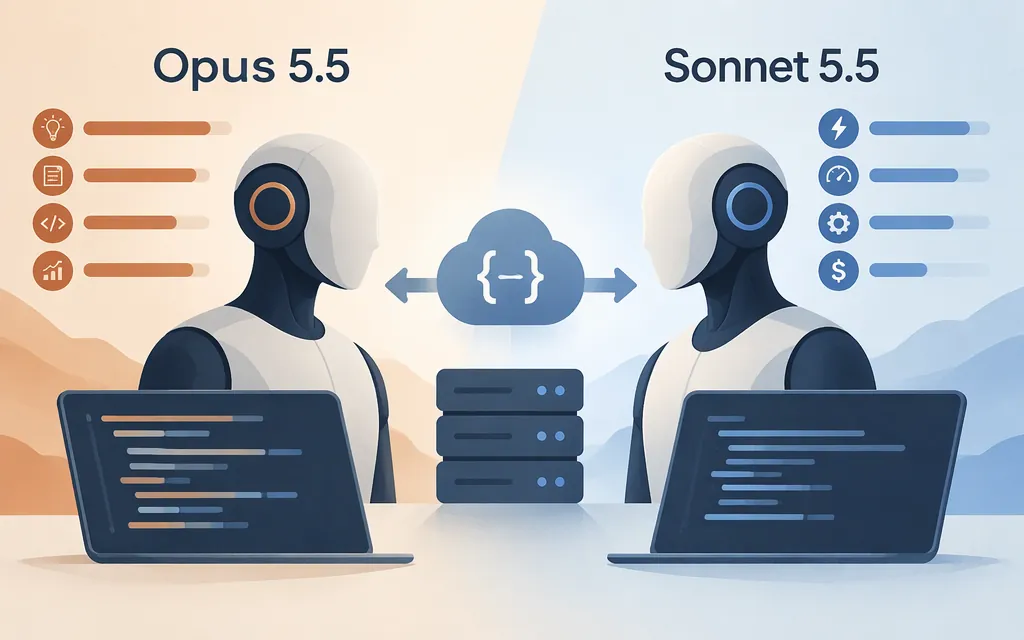
For a production API comparison, consider Claude Opus 5.5 (claude-opus-5-5) when you want to evaluate long-running agentic coding or knowledge work. Consider Claude Sonnet 5.5 (claude-sonnet-5-5) when faster comparative latency and lower per-token prices matter. Neither is a universal winner: Anthropic describes Opus 5.5 as intended for long-running agentic coding and knowledge work, and Sonnet 5.5 as a combination of speed and intelligence. Its model-selection guidance frames Opus 5.5 as a capability-first starting point for evaluation—not a recommendation that it is best for most workloads. (Model overview; Choosing a model)
This article compares Opus 5.5 with Sonnet 5.5 through Anthropic’s Claude API—not older Opus 4/Sonnet 4 comparisons or Claude consumer subscription plans. Anthropic’s model pages identify the API model IDs and list their specifications. (Opus 5.5; Sonnet 5.5)
Opus 5.5 vs. Sonnet 5.5 for production API workloads
| Decision factor | Claude Opus 5.5 | Claude Sonnet 5.5 |
|---|---|---|
| API model ID | claude-opus-5-5 |
claude-sonnet-5-5 |
| Anthropic’s stated role | Long-running agentic coding and knowledge work | A balance of speed and intelligence |
| Comparative latency in Anthropic’s lineup | Moderate | Fast |
| Standard API input price | $4 per million tokens | $2 per million tokens |
| Standard API output price | $20 per million tokens | $10 per million tokens |
| Context window / maximum output | 1 million / 128,000 tokens | 1 million / 128,000 tokens |
| Default effort | Medium | High |
Anthropic lists comparative latency as moderate for Opus and fast for Sonnet. The documented context and output limits are the same for both, so those limits alone do not distinguish them. Actual latency depends on the request and settings; measure it in your application. (Model overview)
Consider Opus 5.5 for workflows with sustained agent steps or complex coding and knowledge-work requirements. This aligns with Anthropic’s stated positioning; it does not establish that Opus will outperform Sonnet on every such task. Consider Sonnet 5.5 when latency or cost matters and it meets your quality bar—for example, in a user-facing assistant with a strict response-time target or in routine, testable code changes. These are workload hypotheses to evaluate, not reported head-to-head results. (Opus 5.5; Sonnet 5.5)
One detail matters in a comparison: the documented default effort differs—medium for Opus and high for Sonnet. If you compare the models using their defaults, record that difference. For a controlled comparison, use the same supported effort setting where appropriate, and report which setting you used. (Model overview; Effort)
API pricing and details that affect the choice
Anthropic’s published standard API rates are in U.S. dollars per million tokens (MTok). Opus 5.5 costs $4 per MTok of input and $20 per MTok of output; Sonnet 5.5 costs $2 per MTok of input and $10 per MTok of output. At these base rates, Opus costs twice as much for the same number of input and output tokens. Your bill depends on token usage and applicable features, not the model name alone. Check the API pricing page before budgeting or deploying, since prices and terms can change.
Worked example: Suppose one request uses 2,000 input tokens and 8,000 output tokens, without caching or other adjustments:
- Sonnet 5.5:
(2,000 × $2 + 8,000 × $10) ÷ 1,000,000= $0.084. - Opus 5.5:
(2,000 × $4 + 8,000 × $20) ÷ 1,000,000= $0.168.
At 30,000 requests with those same token counts, that is $2,520 for Sonnet versus $5,040 for Opus, before applicable discounts or other charges. This is arithmetic based on the listed base rates, not a workload cost estimate; actual token use and retries can change the result.
Batch processing can also affect API cost: Anthropic’s model pages list a 50% discount on input and output for Batch API requests. Check the applicable pricing and feature conditions before including that discount in a budget. (Opus 5.5; Sonnet 5.5)
The published model pages list both API IDs, a 1-million-token context window, and a 128,000-token maximum output. They also list different default effort settings. Don’t assume equal context capacity guarantees equal quality on a long prompt, or that the maximum output is a useful target for ordinary requests. (Opus 5.5; Sonnet 5.5)
How to evaluate and route the models
Before sending production traffic, run a head-to-head evaluation on tasks your application actually handles:
- Choose representative cases. Include routine requests and the ambiguous or difficult cases where model choice could matter. Define success criteria before testing.
- Keep the comparison fair. Use the same inputs, tools, constraints, retry policy, and output limits. Record each model’s effort setting; match it where appropriate or explicitly compare the intended production defaults.
- Measure more than correctness. Track whether each task met its acceptance criteria, failure severity, elapsed time, input and output tokens, retries, API cost, and human review time where relevant.
- Route based on observed results. Prefer Sonnet for a task category if it meets your quality and response-time targets at a useful cost. Reserve Opus for categories where your evaluation shows its results justify the higher token rates or reduce costly retries or review. If neither meets the bar, revise the workflow rather than assuming a model switch will solve it.
For example, a team testing an internal coding assistant could replay representative completed tickets against both models in a staging environment. Compare accepted changes, regressions, elapsed time, token costs, and reviewer effort. That is a proposed test—not a claim that either model has won it. Re-run the evaluation when the models, prompts, tools, or task mix change.
Bottom line: Opus 5.5 is the higher-priced option positioned for long-running agentic coding and knowledge work; Sonnet 5.5 has faster comparative latency and half the standard input and output rates. Start with the option that fits your quality, speed, and budget requirements, then let measured results on your own workload determine the production routing policy.
Sources
Models overview — Claude Platform Docs
Claude Opus 5.5 — Claude Platform Docs
Claude Sonnet 5.5 — Claude Platform Docs
Pricing — Claude Platform Docs