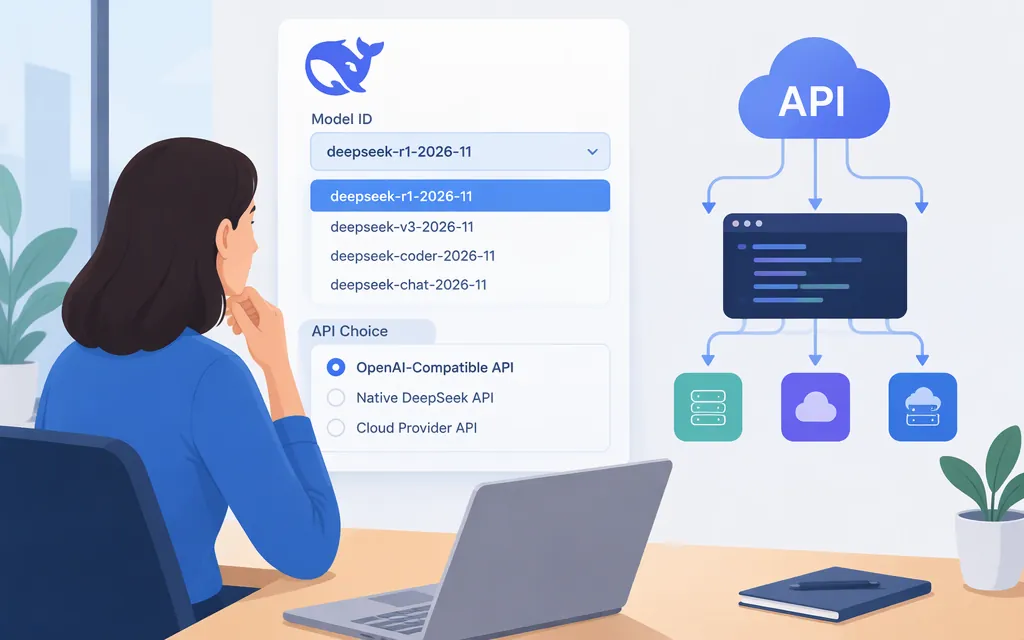
As of November 10, 2026, DeepSeek’s latest announced model is DeepSeek-V4.1-Flash-1017. For DeepSeek’s API, the documented model ID is deepseek-flash. DeepSeek’s October 17 release notice says V4.1-Flash-1017 is live on its website, app, and API; the API quickstart says deepseek-flash is served by that version.
That distinction matters: V4.1-Flash-1017 is the model version; deepseek-flash is the API identifier to use. The older names deepseek-v4-flash and deepseek-v4-flash-vision-exp are documented as retired names that remain accepted and route to V4.1-Flash-1017 at the Flash price.
Which DeepSeek API model should you choose?
For a production integration with DeepSeek’s own API, deepseek-flash is the clearest documented starting point when you need text and image input, thinking and non-thinking modes, or tool calls. DeepSeek’s current model and pricing page lists a 1M-token context window and a maximum output of 384K tokens for Flash.
| Your requirement | Documented option | What the current documentation says |
|---|---|---|
| Text chat, coding, or agent workflows | deepseek-flash |
Maps to V4.1-Flash-1017; tool calls are listed as supported. |
| Tasks where you want reasoning | deepseek-flash with thinking enabled |
Flash supports thinking and non-thinking modes; this is a mode choice, not a separate model ID. |
| Questions about images, screenshots, or charts | deepseek-flash |
Vision is listed as supported. The vision guide names JPEG, PNG, GIF, and WebP image formats. |
| Considering the Pro option | deepseek-v4-pro |
The current pricing table maps it to DeepSeek-V4-Pro-0813. It lists thinking modes and tool calls, but not vision; its listed token rates are higher than Flash’s. See the routing caveat below. |
Important Pro caveat: DeepSeek’s September 10 announcement said that, starting September 14, requests using deepseek-v4-pro would route to V4.1-Flash at Flash rates until V4.1-Pro launched. The current pricing table separately lists deepseek-v4-pro as DeepSeek-V4-Pro-0813, with Pro-specific rates and vision marked unsupported. The available official documentation does not explain whether the temporary routing arrangement ended or how it relates to that current table. So the table documents a Pro version and feature/pricing entry, but the evidence here does not conclusively establish what model deepseek-v4-pro currently serves. Don’t treat the September notice alone as proof that Pro is still only an alias—or the table alone as proof that routing has changed.
The Flash recommendation is based on its confirmed current model mapping and documented image support, not a claim that it is best for every workload. The official material cited here does not provide a current, methodologically detailed comparison that would justify ranking Flash against a separately available Pro model.
Production details to check
Model ID and compatibility
DeepSeek’s quickstart gives deepseek-flash as the model name and lists https://api.deepseek.com as the OpenAI-format base URL and https://api.deepseek.com/anthropic as the Anthropic-format base URL. Check that the SDK features and request parameters your application needs are supported before moving production traffic.
DeepSeek documents GET https://api.deepseek.com/models for listing currently available models and metadata, including context window, output limit, supported modalities, effort levels, and API capabilities. It is a useful check when you need to confirm the available options for your integration.
Context, output, images, and tools
The current model and pricing page lists 1M tokens of context and 384K maximum output for deepseek-flash. It lists tool calls and vision as supported. For image input, DeepSeek’s vision guide specifies JPEG, PNG, GIF, and WebP; check that guide’s request and image limits if your application sends images.
Official API pricing
DeepSeek lists model prices in USD per 1 million tokens, separating cache-hit input, cache-miss input, and output. The current page lists these rates:
| Model and token type | Off-peak | Peak |
|---|---|---|
| Flash — input, cache hit | $0.003 / 1M tokens | $0.006 / 1M tokens |
| Flash — input, cache miss | $0.15 / 1M tokens | $0.30 / 1M tokens |
| Flash — output | $0.60 / 1M tokens | $1.20 / 1M tokens |
| Pro — input, cache hit | $0.022 / 1M tokens | $0.044 / 1M tokens |
| Pro — input, cache miss | $0.66 / 1M tokens | $1.32 / 1M tokens |
| Pro — output | $1.98 / 1M tokens | $3.96 / 1M tokens |
The pricing page defines peak hours as 01:00–04:00 and 06:00–10:00 UTC, Monday through Friday, excluding Chinese public holidays. All other times—including weekends and Chinese public holidays—are off-peak. The page says off-peak rates are half of peak rates and that prices may change, so check the current pricing page before estimating costs.
Bottom line
If you mean the latest announced DeepSeek model, the answer is DeepSeek-V4.1-Flash-1017. If you are integrating with DeepSeek’s API, the documented identifier is deepseek-flash. Its model mapping and image support are clearly documented. DeepSeek also lists deepseek-v4-pro as DeepSeek-V4-Pro-0813 with different rates and no vision support, but an earlier temporary-routing notice leaves its current routing unclear in the documentation reviewed here. Verify the current model listing and pricing before choosing Pro for production.