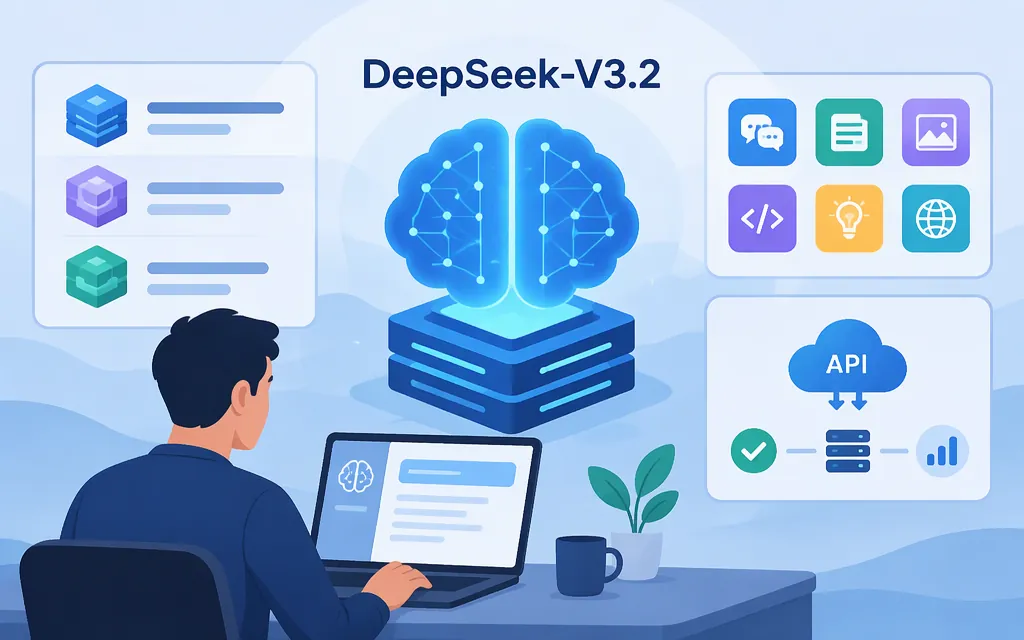
Direct answer: what does “deepseek ai/deepseek-v3 2” refer to?
The phrase most likely refers to DeepSeek-V3.2, but it is not enough to identify a current API model ID. Keep three names distinct: V3.2 is the announced successor to V3.2-Exp; V3.2-Speciale is a separate, reasoning-focused variant. DeepSeek’s December 1, 2025 launch post said V3.2 was available on its App, Web, and API, while Speciale was API-only at that time. That is a dated availability statement—not confirmation of present-day access. (DeepSeek release announcement)
For direct DeepSeek API use, the current published Models & Pricing page lists deepseek-flash and deepseek-v4-pro, rather than V3.2. DeepSeek documents its model-list endpoint as the place to retrieve currently available model identifiers and metadata. So, as of November 10, 2026, don’t assume that an older V3.2 name is a supported direct API ID; check the live catalog for your chosen provider. The pricing page says prices are per million tokens and can change. (DeepSeek model-list documentation)
Capabilities: what the evidence supports
DeepSeek positioned V3.2 and Speciale as reasoning-first models for agent workflows. Its launch announcement explicitly says standard V3.2 supports tool use in both thinking and non-thinking modes. It separately states that Speciale did not support tool calls for its launch offering, which used a temporary endpoint that expired on December 15, 2025 at 15:59 UTC. These are release-scoped statements, not confirmation of what a provider may offer now. (DeepSeek release announcement)
DeepSeek’s technical report describes DeepSeek Sparse Attention (DSA) as a way to reduce attention computation while preserving performance in long-context scenarios. The independent technical overview by Sebastian Raschka describes DSA as a learned process that scores previous tokens and selects a subset for attention. This helps explain the architecture, but it is not a measurement of latency, throughput, or cost on a specific service. Evaluate those on the provider and workload you plan to use. (Technical report; Raschka’s technical overview)
The API documentation explains that tool calls are requests for your application to run external functions: the model does not execute those functions itself. It documents tool use in thinking mode from V3.2; use the selected model’s current API documentation for the actual integration behavior. (DeepSeek tool-call documentation)
V3.2 or V3.2-Speciale?
- Evaluate standard V3.2 for a mixed workload involving general responses, reasoning, or tools. DeepSeek’s launch documentation says standard V3.2 supports tool use in both thinking and non-thinking modes. Confirm that the provider and model ID you plan to use still support the tool-calling behavior your application needs. (DeepSeek release announcement)
- Evaluate Speciale as a reasoning-output candidate when longer responses are acceptable. The launch documentation said its temporary offering had no tool calls and expired December 15, 2025. If your workload depends on tools, do not assume Speciale is compatible: confirm current tool support and access directly with the provider before considering it. (DeepSeek release announcement)
Treat these as starting hypotheses, not a universal ranking. For reasoning-only tasks, compare answer quality and output tokens on representative prompts. For tool-dependent tasks, test only variants whose current provider documentation confirms tool-call support; record successful tool execution and completion time. Compare quality and cost together—the strongest answer may not be the best fit if its extra output or operational requirements outweigh the improvement.
What to verify before production API use
The launch post is not an implementation guide. Although it described standard V3.2 as using the same API usage pattern as V3.2-Exp, that does not establish that an old model name or endpoint is currently available. The post also records that Speciale’s temporary endpoint expired on December 15, 2025 at 15:59 UTC. Don’t build a current integration around that expired endpoint. (DeepSeek release announcement)
Before deploying any V3.2-family model, check the chosen provider’s current documentation and confirm:
- The exact supported model ID and whether the intended variant is currently accessible.
- The endpoint, authentication, request/response format, and tool-calling behavior—including whether tool calls are supported for that specific variant.
- Context and output limits, rate limits, and any version or compatibility requirements.
- Current prices and billing units, including any different treatment for cached input.
- Data-use, retention, and other operational terms that apply to that provider.
Then test representative requests in that provider’s environment. Model architecture or a launch announcement does not establish a provider’s present availability, service limits, price, or data policy. If you want to call DeepSeek directly, start with its current model catalog and pricing page; for a third-party host, verify that host’s listing and terms instead.
Sources
Tool Calls | DeepSeek API Docs
Lists Models | DeepSeek API Docs
Models & Pricing | DeepSeek API Docs
DeepSeek-V3.2: Pushing the Frontier of Open Large Language Models