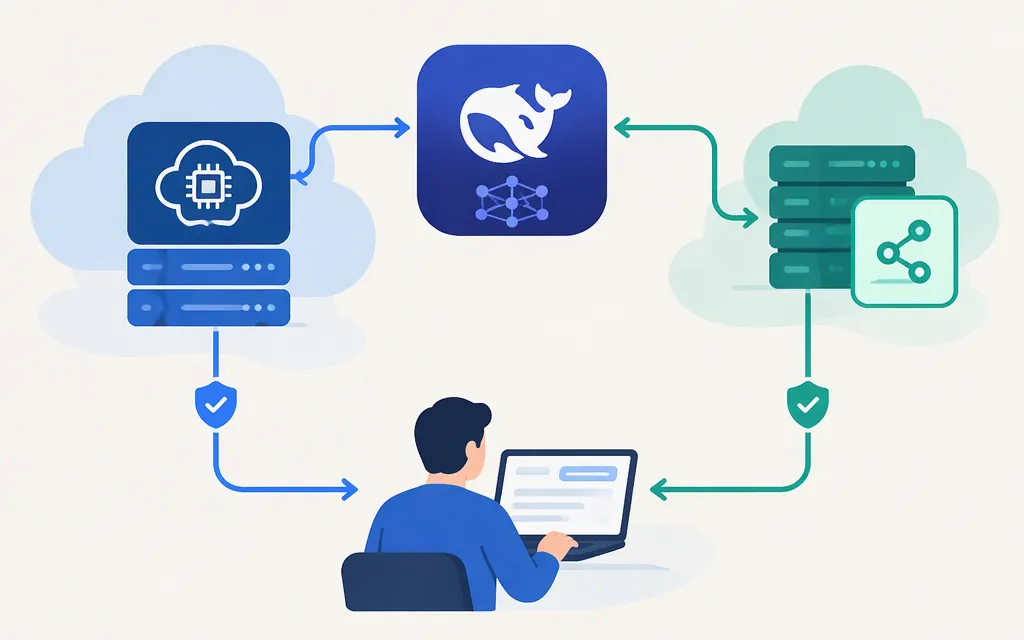
As of November 9, 2026, DeepSeek’s API announcement says the legacy deepseek-reasoner alias was retired on July 24, 2026. During the transition, DeepSeek said that alias routed to V4 Flash thinking. That retirement date does not establish when every hosted DeepSeek R1 route stopped serving the model. DeepSeek’s current API quick start lists V4 models, not R1. [1]
Amazon Bedrock still documents a DeepSeek-R1 route, but marks R1 Legacy with an end-of-life date of March 30, 2027. AWS says new customers can’t start using Legacy models, and existing customers may lose access after 15 days of inactivity. Bedrock is therefore an option only for customers who already have retained R1 access. [2][3]
Which DeepSeek R1 API route should you use?
- Already have retained R1 access on Amazon Bedrock? AWS documents the US cross-Region inference profile ID
us.deepseek.r1-v1:0and the in-Region model IDdeepseek.r1-v1:0. These are Bedrock identifiers, not DeepSeek-direct API model names. Check that your account can still invoke R1 and that the AWS Region you choose supports the profile. [2][3] - Don’t have Bedrock R1 access? Aiberm’s model page lists its own R1 offering under the ID
deepseek/deepseek-r1. It labelshttps://aiberm.orgfor Mainland China andhttps://aiberm.comfor international use, and shows an OpenAI-compatible Chat Completions request. These are Aiberm’s provider-specific details—not a direct DeepSeek API route. Confirm availability and terms with Aiberm before relying on it. [9][10][11] - Want DeepSeek’s own API? Its current quick start lists V4 models, not R1. V4 is an alternative, not an R1 alias. [1]
Make a first R1 request through Amazon Bedrock
Check access before setting up the code. This example is for an existing Bedrock customer who still has R1 access. The AWS role or user needs permission to call bedrock:InvokeModel. [3][4]
One local-development option is an AWS IAM Identity Center profile. In a terminal with the AWS CLI installed, configure and sign in to a profile, then install Boto3:
aws configure sso --profile bedrock-r1
aws sso login --profile bedrock-r1
python -m pip install boto3
This requires access to your organization’s IAM Identity Center. Select the AWS account and permission set your administrator provided; ask the administrator to ensure it includes bedrock:InvokeModel and that your account retains R1 access. Boto3 can use the configured profile. [5][6]
AWS’s DeepSeek parameter guide documents a JSON request with a prompt string and inference parameters; its response example places generated text at choices[0].text. The plain question below is an illustrative prompt. The example has not been run or tested here. [7]
Set AWS_REGION to a Region that currently supports the selected inference profile for your account. The model ID below is the US cross-Region inference profile; don’t assume that every source Region supports it. Check AWS’s current model availability information before running the example. [2]
import json
import os
import boto3

session = boto3.Session(profile_name="bedrock-r1")
client = session.client(
    "bedrock-runtime",
    region_name=os.environ["AWS_REGION"],
)

response = client.invoke_model(
    modelId="us.deepseek.r1-v1:0",
    contentType="application/json",
    accept="application/json",
    body=json.dumps({
        "prompt": "What is 17 × 23? Show the result briefly.",
        "max_tokens": 2048,
        "temperature": 0.6,
        "top_p": 0.9,
    }),
)

result = json.loads(response["body"].read())
print(result["choices"][0]["text"])
If the request succeeds, the code prints the generated text from choices[0].text. This uses AWS profile credentials and a Bedrock inference-profile ID—not a DeepSeek API key or Bearer-token header. The prompt is a plain illustrative input; this example does not establish that every prompt format is appropriate for every use case. [5][7]
Output-limit note: AWS’s model card lists an 8K maximum output. Its parameter guide says the API accepts up to 32,768 tokens but response quality significantly degrades above 8,192. For a conservative request, keep max_tokens at or below 8,192; treat 32,768 as the guide’s stated API ceiling, not a recommended setting. [2][7]
A third-party R1 request for readers without Bedrock access
Aiberm’s model page shows a minimal OpenAI-compatible Chat Completions request. It lists deepseek/deepseek-r1 as its model ID and uses https://aiberm.com for international use. Aiberm’s authentication documentation says to create and manage keys under Console → API Tokens. [9][10]
export AIBERM_API_KEY="your-aiberm-api-key"

curl https://aiberm.com/v1/chat/completions \
  -H "Authorization: Bearer $AIBERM_API_KEY" \
  -H "Content-Type: application/json" \
  -d '{
    "model": "deepseek/deepseek-r1",
    "messages": [{"role": "user", "content": "Hello"}]
  }'
This is an Aiberm request, not a direct DeepSeek request. For its general, non-streaming Chat Completions example, Aiberm’s quick start shows the response text at response.choices[0].message.content. That example uses a different model, so treat this as the documented general response path—not an R1-specific response sample. The R1 listing does not itself confirm that every new account can access the model, and the retrieved pages do not establish R1-specific eligibility or restrictions. Confirm access and the response format for this model with Aiberm before building response handling around it. [9][10][11][12]
Production checks before choosing R1
- Account eligibility and lifecycle: Confirm whether your account can access the exact route. AWS says new customers can’t adopt its Legacy R1 model and existing customers may lose access after 15 days of inactivity. Bedrock lists March 30, 2027 as R1’s end-of-life date; plan and test a migration rather than relying on the route long term. [2][3]
- Region and routing: For Bedrock, verify that your selected Region supports the inference profile, and review AWS’s current routing details against your residency requirements. Don’t assume cross-Region inference is an in-Region data-routing guarantee. [2]
- Limits and quotas: AWS lists a 128K-token context window and 8K maximum output; its parameter guide separately describes an API ceiling of 32,768 output tokens and warns that quality degrades above 8,192. Confirm current account quotas and rate limits with AWS before estimating capacity. [2][7]
- Cost and data terms: Check the provider’s current price for the exact model and route, along with its data-handling terms. Aiberm’s page lists prices, but no effective date; AWS’s cited model and parameter pages don’t establish your account’s current price or deployment-specific data requirements. Don’t reuse third-party rates as Bedrock prices. [2][8][9]
- Model fit: Test quality, latency, errors, and total cost on representative prompts. Documentation of an endpoint does not establish that R1 is suitable for a particular production workload.
Bottom line
Bedrock documents an R1 request format, but its R1 listing is Legacy and isn’t open to new customers. Existing customers with retained access can use the Bedrock example after confirming permission and supported-Region requirements. For another provider route, Aiberm lists R1 under deepseek/deepseek-r1 and documents a basic authenticated request. Its general quick start shows where non-streaming Chat Completions text appears, but that example uses a different model; confirm R1 access and its response format with Aiberm before integrating. DeepSeek’s current API quick start lists V4 models, not R1, and V4 is not R1. [1][2][3][9][10][11][12]
Sources
Amazon Bedrock model lifecycle (Legacy)
Configure IAM Identity Center authentication with the AWS CLI
DeepSeek models: request and response parameters on Amazon Bedrock
Authentication | Aiberm API Documentation
Chat Completions | Aiberm API Documentation