The short answer
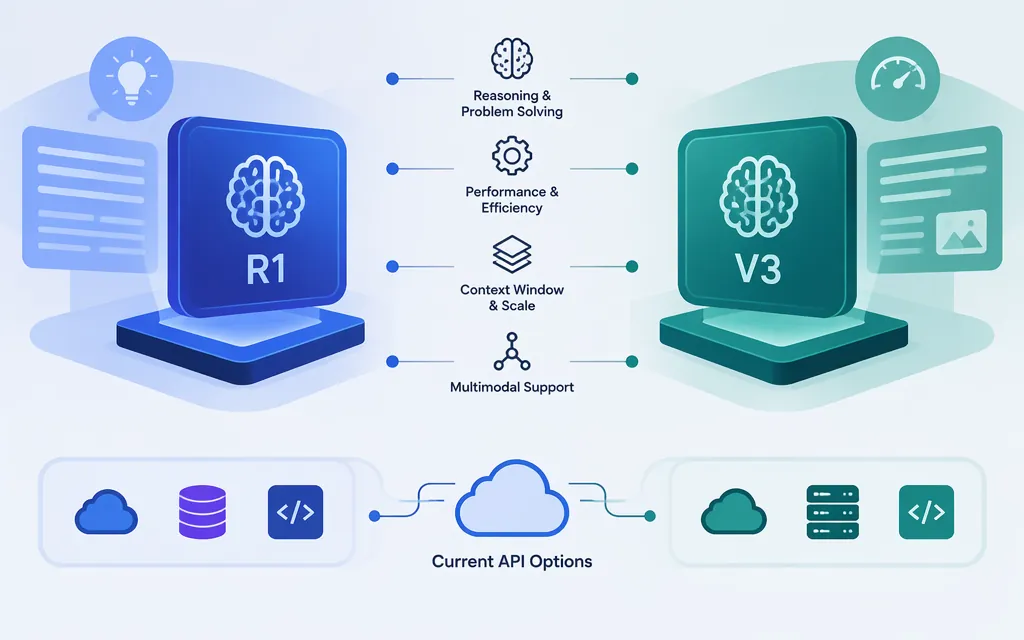
Original DeepSeek R1 and DeepSeek V3 differ mainly in their training and intended emphasis—not simply because one is a raw base model and the other is not. DeepSeek describes R1 as trained from DeepSeek-V3-Base. Its released V3 model, meanwhile, went through supervised fine-tuning and reinforcement-learning stages after pretraining. A technical overview by Sebastian Raschka describes the original R1 and V3 as sharing an architecture while differing in training recipe. (DeepSeek-R1 repository, DeepSeek-V3 repository, Raschka’s technical overview)
For workload selection below, V3 means the released DeepSeek-V3 model, not the separate V3-Base checkpoint used as R1’s foundation. R1’s reasoning-oriented training makes it a candidate to evaluate for multi-step, checkable problems; V3 is a candidate for a broader mix of language tasks. These are starting hypotheses, not a universal performance ranking.
DeepSeek R1 vs V3 at a glance
| Released DeepSeek V3 | DeepSeek R1 | |
|---|---|---|
| What it is | The released V3 model, post-trained after pretraining | A reasoning-focused model trained from DeepSeek-V3-Base |
| Main distinction | General-purpose model with supervised fine-tuning and reinforcement-learning stages | Reasoning-oriented post-training, including reinforcement learning |
| Possible evaluation starting point | A varied mix of language tasks | Multi-step reasoning tasks, such as math or code problems that can be checked |
| What the evidence does not establish | That V3 always wins at writing, speed, or cost | That R1 always wins at reasoning, math, or coding |
DeepSeek’s V3 and R1 repositories describe their respective training foundations and stages. The workload suggestions here are not head-to-head test results. (DeepSeek-R1 repository, DeepSeek-V3 repository)
What differs—and what doesn’t
R1 uses V3-Base as its foundation; released V3 is not the same checkpoint
DeepSeek’s R1 repository says R1 was trained based on DeepSeek-V3-Base. DeepSeek’s V3 repository says the released V3 model was pretrained and then went through supervised fine-tuning and reinforcement learning. So avoid using “V3” and “V3-Base” interchangeably: one is the released V3 model; the other is the base checkpoint named as R1’s foundation. (DeepSeek-R1 repository, DeepSeek-V3 repository)
R1’s training emphasizes reasoning. The R1 materials describe reinforcement-learning stages; Raschka’s technical overview describes reinforcement learning with verifiable rewards and gives math and code as examples of tasks whose answers can be checked. That training orientation can help explain why R1 is worth evaluating on such tasks, but it does not guarantee a correct answer. (DeepSeek-R1 repository, Raschka’s technical overview)
Related architecture does not mean identical behavior or API terms
R1’s repository directs readers to the V3 repository for architecture details. Raschka’s technical overview characterizes original R1 and V3 as sharing an architecture while differing in training recipe. That is a model-family comparison, not evidence that hosted API calls will have the same outputs, latency, pricing, or availability. Later V3-family versions should also be treated as separate comparisons. (DeepSeek-R1 repository, DeepSeek-V3 repository, Raschka’s technical overview)
Which should you choose for a workload?
Use the training distinction to decide what to test—not as proof of a winner:
- Multi-step, checkable tasks: Include R1 in your evaluation when success depends on reasoning steps and you can verify the result, for example with a math answer key or code tests.
- A varied language workload: Include the released V3 model as a candidate when your application handles a broad mix of requests. The sources here do not show that it beats R1 on writing, support chat, or routine coding.
- Quality-sensitive decisions: Run both exact model versions on representative prompts, with the same scoring criteria. Measure task success and unacceptable errors; do not treat a confident tone or lengthy explanation as proof of correctness.
For a production comparison, record the model version, provider, prompt and output conditions, response time, and token usage. This is a suggested evaluation approach, not a test performed for this article. The sources cited here do not establish a universal R1-versus-V3 quality or latency winner.
Production API: current DeepSeek options
DeepSeek’s current model and pricing documentation lists deepseek-flash and deepseek-v4-pro, and gives https://api.deepseek.com as the OpenAI-format base URL. The documentation maps these API names to DeepSeek-V4.1-Flash-1017 and DeepSeek-V4-Pro-0813, respectively. These are the currently listed API options in that documentation—not API identifiers for the original V3 or R1 checkpoints. (DeepSeek Models & Pricing)
An API changelog entry gave July 24, 2026 as the planned discontinuation date for the legacy names deepseek-chat and deepseek-reasoner. That date has passed, but the cited material does not establish whether requests using those names are now rejected. The current model and pricing page documents the newer names above. For a new integration, use the model IDs and behavior specified in the current documentation for your provider; do not assume a legacy name selects original R1 or V3. (DeepSeek API changelog, DeepSeek Models & Pricing)
Current first-party API prices
DeepSeek lists prices per 1 million tokens, separated by input cache status and output tokens. The documentation displays the rates with a $ symbol. Peak rates apply during 01:00–04:00 and 06:00–10:00 UTC, Monday through Friday, excluding Chinese public holidays. All other times—including weekends and Chinese public holidays—are off-peak. (DeepSeek Models & Pricing)
| Current API model | Input, cache hit (off-peak / peak) | Input, cache miss (off-peak / peak) | Output (off-peak / peak) |
|---|---|---|---|
deepseek-flash |
$0.003 / $0.006 | $0.15 / $0.30 | $0.60 / $1.20 |
deepseek-v4-pro |
$0.022 / $0.044 | $0.66 / $1.32 | $1.98 / $3.96 |
These are prices for the currently listed API models, not a like-for-like price comparison of original R1 and V3. The cited table displays $ but does not spell out an ISO currency code in the retrieved text. DeepSeek says prices may change, so confirm the current table and billing terms before budgeting. (DeepSeek Models & Pricing)
The current API documentation says both listed models support thinking and non-thinking modes, with thinking enabled by default. The mode guide gives model-specific top_p behavior: for deepseek-flash, top_p takes effect only in thinking mode, with an effective range of 0.95–1.0; in non-thinking mode it is fixed at 1.0. For deepseek-v4-pro, top_p is ignored in thinking mode (fixed at 0.95 when tool calling is enabled, otherwise 1.0) and takes effect in non-thinking mode. Check the guide for the API format and model you plan to use. (DeepSeek Models & Pricing, DeepSeek Thinking Mode guide)
How to make a production comparison
Before selecting a model, confirm these details for the provider and version you will actually deploy:
- Exact model ID and version: Do not infer a current API model from a historical model name.
- Quality on your workload: Compare candidates on representative prompts with the same scoring rubric.
- Latency and throughput: Measure under expected prompt lengths, output lengths, concurrency, and provider conditions. Training differences alone do not establish API latency.
- Cost on matching units: Compare input with input and output with output; account for cache-hit status and any time-based pricing that applies.
- API features and limits: Check the provider’s current documentation for supported modes, context and output limits, rate limits, availability, and any restrictions relevant to your application.
Bottom line: R1 is the reasoning-focused model trained from V3-Base; released V3 is a separately post-trained, general-purpose candidate. Test the exact versions against your workload. For a new DeepSeek API integration, use the current documented API model IDs and compare their documented prices and features rather than assuming the original R1 and V3 labels are still available through the API.