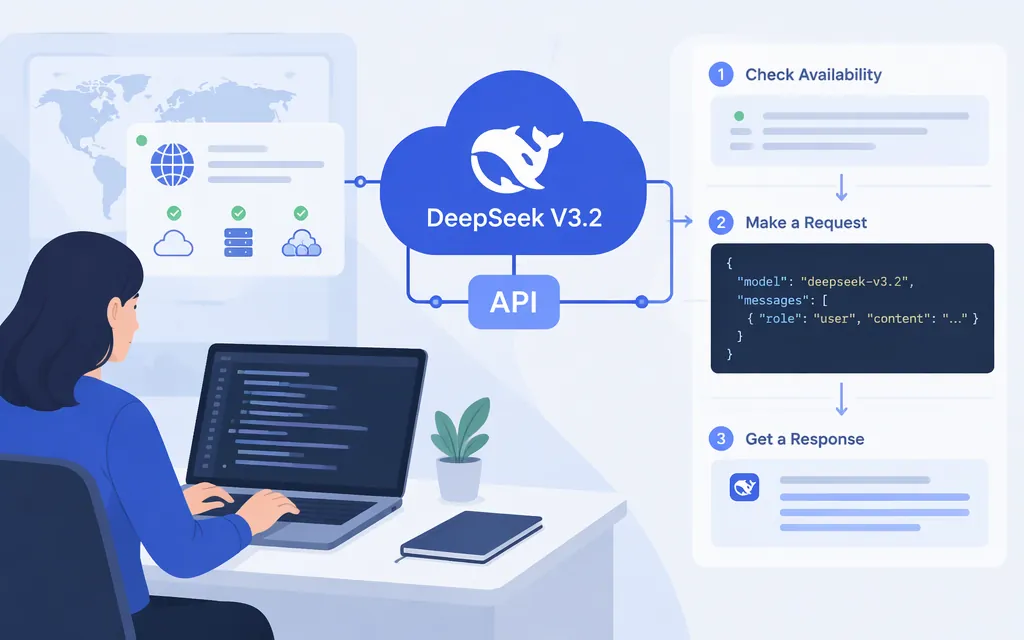
Short answer: As of November 9, 2026, DeepSeek’s public API guide and pricing page list deepseek-flash and deepseek-v4-pro, not V3.2. The guide maps deepseek-flash to DeepSeek-V4.1-Flash-1017. So don’t treat an older V3.2 or V3.2-Exp example as a current, verified V3.2 integration. If you specifically require V3.2, confirm that the provider explicitly maps an available API ID to that version before using it. (api-docs.deepseek.com)
Check available model IDs—and verify the version separately
DeepSeek documents GET https://api.deepseek.com/models as a way to list models currently available through the API. Its documented response includes an ID and metadata such as display name, context window, output limit, modalities, effort levels, and API capabilities. (api-docs.deepseek.com)
You can query it with your API key:
curl https://api.deepseek.com/models \
  -H "Authorization: Bearer $DEEPSEEK_API_KEY"
Treat the result as a check of available API IDs and their documented metadata—not proof that an ID is an immutable version pin. The documented fields do not themselves establish that an ID is backed by V3.2. DeepSeek’s current guide explicitly maps deepseek-flash to DeepSeek-V4.1-Flash-1017, while its public models and pricing page lists deepseek-flash and deepseek-v4-pro. Neither currently listed entry is identified there as V3.2. If you need that exact release, look for an explicit provider statement mapping the ID to V3.2; don’t infer it from a returned ID alone. (api-docs.deepseek.com)
Select and record the model ID and version mapping documented by your provider. Avoid calling this “pinning” unless the provider documents that the identifier is immutable.
Why older V3.2 examples need caution
DeepSeek announced V3.2 API availability on December 1, 2025. That release announcement is historical information, not confirmation that the model remains available through the API today. The announcement also gave V3.2-Speciale a temporary endpoint that expired on December 15, 2025; do not reuse it. (api-docs.deepseek.com)
An older third-party V3.2-Exp tutorial pairs model="deepseek-chat" in its sample code with a statement that the base URL defaults to V3.2-Exp, without explaining how the model name and routing relate. Since the current DeepSeek guide documents different model IDs, don’t present that old snippet as a verified current V3.2 call. (api-docs.deepseek.com)
Example: call DeepSeek’s currently documented model
If your goal is to make a first request to DeepSeek’s official API—not specifically to V3.2—the current guide shows an OpenAI-compatible Python client using deepseek-flash. DeepSeek identifies that ID as served by V4.1-Flash-1017. This is a current-model example, not a V3.2 example. (api-docs.deepseek.com)
Create an API key through DeepSeek’s platform. The API uses Bearer authentication; the example below reads the key from the DEEPSEEK_API_KEY environment variable. (api-docs.deepseek.com)
export DEEPSEEK_API_KEY="your_api_key_here"
python -m pip install openai
import os
from openai import OpenAI

client = OpenAI(
    api_key=os.environ.get("DEEPSEEK_API_KEY"),
    base_url="https://api.deepseek.com",
)

response = client.chat.completions.create(
    model="deepseek-flash",
    messages=[
        {"role": "system", "content": "You are a helpful assistant."},
        {"role": "user", "content": "Reply with a short greeting."},
    ],
)

print(response.choices[0].message.content)
The request uses Chat Completions. The example reads the assistant’s reply from response.choices[0].message.content; the endpoint, model ID, and client pattern follow DeepSeek’s current first-call guide. (api-docs.deepseek.com)
Current capabilities and pricing for deepseek-flash
DeepSeek’s current pricing page lists a 1-million-token context length, a maximum output of 384,000 tokens, JSON output, and tool calls for deepseek-flash. These are specifications for that currently listed model—not V3.2 specifications. (api-docs.deepseek.com)
The page lists prices in U.S. dollars per 1 million tokens:
| Usage | Peak | Off-peak |
|---|---|---|
| Input tokens, cache miss | $0.30 | $0.15 |
| Input tokens, cache hit | $0.006 | $0.003 |
| Output tokens | $1.20 | $0.60 |
DeepSeek defines peak hours as 01:00–04:00 and 06:00–10:00 UTC, Monday through Friday, excluding Chinese public holidays. All other hours—including weekends and Chinese public holidays—are off-peak. These rates and schedule apply to deepseek-flash, not V3.2. The pricing page notes that prices may change, so check it before estimating current spend; it does not list a V3.2 price. (api-docs.deepseek.com)
Before integrating
- Check available IDs:
GET /modelslists currently available IDs and documented metadata; it does not, by itself, confirm an immutable model version. - Verify the backing release: if V3.2 is required, use an ID only when the provider explicitly maps it to V3.2.
- Keep credentials out of source control: load your API key from an environment variable or a deployment secret manager.
- Scope capabilities and costs to the model: the context, output, feature, and price details above apply to
deepseek-flash, not V3.2.
Bottom line: DeepSeek documented V3.2 API availability at launch, but its current public guide and pricing page list other model IDs. Check the live model list for availability, and require explicit provider documentation to confirm a V3.2 mapping. Otherwise, use a currently documented model and label it accurately. (api-docs.deepseek.com)
Sources
Your First API Call | DeepSeek API Docs
Lists Models | DeepSeek API Docs
Models & Pricing | DeepSeek API Docs