Short answer
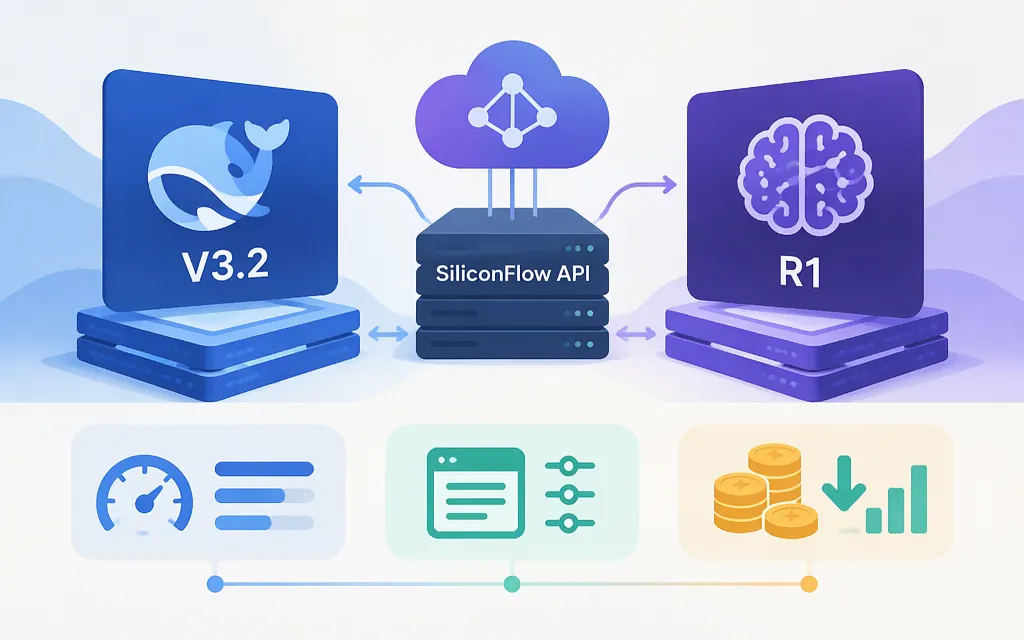
If you need standard DeepSeek-V3.2 versus full DeepSeek-R1 through one API provider, SiliconFlow’s catalog lists both offerings as available. Its documented model IDs are deepseek-ai/DeepSeek-V3.2 and deepseek-ai/DeepSeek-R1. On the provider’s displayed rates, V3.2 costs less for both input and output tokens. That is a price comparison—not evidence that it will be better for your workload. SiliconFlow’s side-by-side comparison page displays February 10, 2026, so confirm R1’s current rate before budgeting. (siliconflow.com)
For model selection, DeepSeek describes V3.2 as balancing inference and length, and says it supports tool use in both thinking and non-thinking modes. R1’s release emphasizes reinforcement learning for math, code, and reasoning. Those descriptions suggest workloads to evaluate; they do not establish a head-to-head winner. (api-docs.deepseek.com)
| Decision point | DeepSeek-V3.2 on SiliconFlow | DeepSeek-R1 on SiliconFlow |
|---|---|---|
| Catalog model ID | deepseek-ai/DeepSeek-V3.2 |
deepseek-ai/DeepSeek-R1 |
| Provider-listed availability | Available | Available |
| Listed context | 164K tokens | 163,840 tokens in SiliconFlow’s reasoning documentation |
| Output limit | Model page lists 164K max tokens; confirm the effective request limit | SiliconFlow’s reasoning guide lists 16,384 max response tokens and a 65,536-token maximum reasoning chain |
| Tool use | Model page marks tools supported; DeepSeek documents tool use in thinking and non-thinking modes | SiliconFlow’s comparison marks tools supported; verify behavior with your request format |
| Displayed input price | $0.27 per million tokens | $0.50 per million tokens on the comparison page dated Feb. 10, 2026 |
| Displayed output price | $0.42 per million tokens | $2.18 per million tokens on the comparison page dated Feb. 10, 2026 |
The limits and feature entries are provider-specific, not universal model guarantees. SiliconFlow’s comparison table lists 164K max tokens for R1, while its reasoning guide specifies a 16,384-token maximum response and a separate 65,536-token reasoning-chain limit. For R1 output planning, use the more specific reasoning documentation and confirm the active limit in the API reference. (siliconflow.com)
Make sure you mean standard V3.2—not V3.2-Exp or Speciale
These names refer to distinct releases. DeepSeek’s announcement identifies standard V3.2 as the successor to V3.2-Exp and separately names V3.2-Speciale. The announcement describes V3.2 as balancing inference against length and says it supports tool use in both thinking and non-thinking modes. It does not make these versions interchangeable. (api-docs.deepseek.com)
For R1, this comparison uses the full model listed as deepseek-ai/DeepSeek-R1, not an R1 distilled model. SiliconFlow’s API quick start shows that exact model ID in an API request example. (docs.siliconflow.com)
Which fits your workload?
- Evaluate V3.2 first if your application depends on tool-using agents or on choosing between thinking and non-thinking modes. DeepSeek documents those modes for V3.2, and SiliconFlow lists tool support for its V3.2 offering. This is a fit hypothesis, not a measured performance result. (
api-docs.deepseek.com) - Evaluate R1 first if your workload centers on multi-step reasoning, math, or code. DeepSeek’s R1 release positions it around reinforcement learning and those task areas; a matched test is still needed to show whether it performs better on your prompts. (
api-docs.deepseek.com) - For mixed agent and reasoning workloads, test both on the same prompts, tool definitions, and output budgets. The available sources do not provide a version-matched V3.2-versus-R1 benchmark or comparable latency results.
What the API and cost evidence establishes
SiliconFlow’s current model pages list both standard variants as available and identify their catalog IDs. Its documentation explains that users can check each model’s pricing and maximum usage limits on the model page. Those are SiliconFlow offerings; they do not establish availability, limits, or prices at another host. (siliconflow.com)
For cost, SiliconFlow displays $0.27 input and $0.42 output per million tokens for V3.2 on its model page. The side-by-side comparison displays $0.50 input and $2.18 output per million tokens for R1 and shows the date February 10, 2026. The comparison page does not establish that those R1 rates are still current or state an R1 cached-input rate. V3.2’s model page lists a $0.135 per million-token cache-read price; do not assume the same cached-input terms for R1. (siliconflow.com)
At those displayed rates, a workload with 1 million input tokens and 100,000 output tokens comes to about $0.312 for V3.2 and $0.718 for R1: input cost plus output cost, before any other provider charges. Treat the R1 figure as an illustration from the dated comparison, not a verified current quote. Confirm the live rates and billing conditions before estimating production spend.
For DeepSeek’s own API, the current pricing documentation lists deepseek-flash and deepseek-v4-pro, not V3.2 or R1. Its changelog announced that the legacy names deepseek-chat and deepseek-reasoner were scheduled for discontinuation on July 24, 2026; the current documentation does not establish whether that scheduled discontinuation was completed. Do not assume deepseek-reasoner still routes to R1. (api-docs.deepseek.com)
A quick evaluation before switching traffic
Treat this as a proposed test, not a completed evaluation:
- Use the exact SiliconFlow model IDs and the same representative prompts, input data, tool definitions, and comparable output budgets.
- Include routine requests, reasoning-heavy tasks, and tool calls if agents matter to your product.
- Score correctness and task completion; record tool-call success, output tokens, latency, and billed cost.
- Recheck live model limits and prices before rollout, and repeat the comparison if the provider changes a model version or serving configuration.
Bottom line: SiliconFlow documents a usable same-provider comparison of standard V3.2 and full R1, with distinct model IDs and provider-specific limits. Its displayed price comparison favors V3.2, but the R1 rates are shown on a page dated February 10, 2026—not confirmed as current. Choose based on a same-provider evaluation, and verify current pricing before budgeting.
Sources
DeepSeek-V3.2 – SiliconFlow model page
DeepSeek-R1 – SiliconFlow model page
DeepSeek-R1 vs DeepSeek-V3.2 – SiliconFlow model comparison
Reasoning – SiliconFlow documentation
Quick Start – SiliconFlow documentation
DeepSeek-V3.2 Release – DeepSeek API Docs
DeepSeek-R1 Release – DeepSeek API Docs