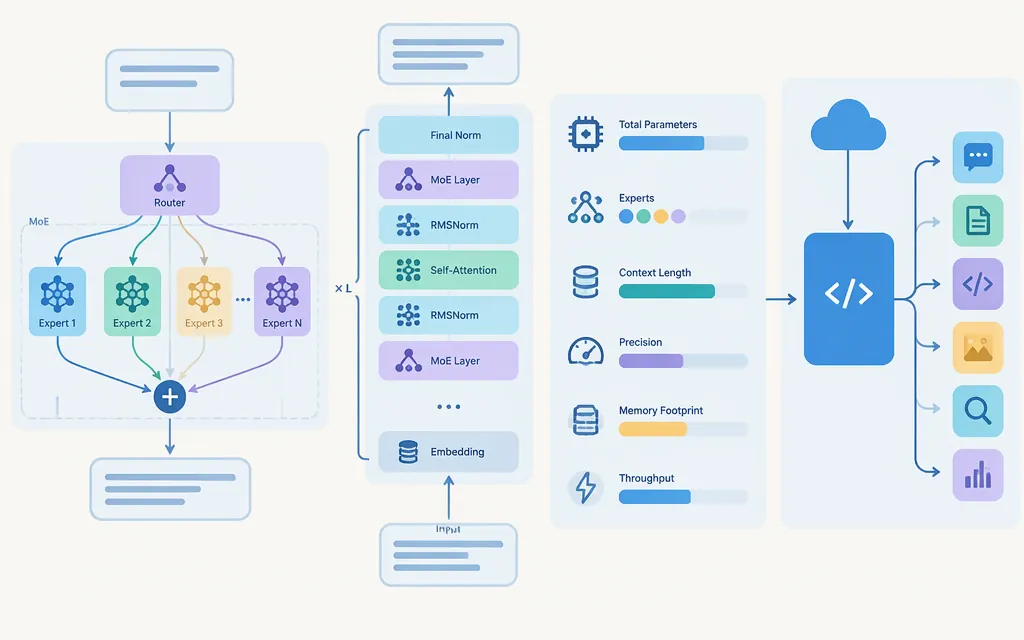
DeepSeek-V3 architecture at a glance
DeepSeek-V3 combines a sparse Mixture-of-Experts (MoE) design with Multi-head Latent Attention (MLA). DeepSeek’s technical report describes 671B total parameters, with 37B activated per token, and identifies both DeepSeekMoE and MLA as core architectures. It also reports that the model can handle inputs up to 128K tokens. (DeepSeek-V3 Technical Report)
| Specification | DeepSeek-V3 documentation |
|---|---|
| Total parameters | 671B |
| Activated per token | 37B |
| Routed experts | 256 routed experts and 1 shared expert per MoE layer; 8 routed experts activated per token |
| Transformer structure | 61 layers; the official inference configuration specifies 3 dense layers |
| Attention | Multi-head Latent Attention (MLA) |
| Reported input context | Up to 128K tokens, according to the technical report |
The total-parameter and activated-per-token figures describe different things. Sparse MoE routing activates selected experts for each token; the attention mechanism is a separate part of the architecture. Neither parameter count alone establishes the memory, price, or latency of a hosted API. (DeepSeek-V3 Technical Report; official inference configuration)
How DeepSeek-V3’s MoE and MLA work
MoE handles sparse expert computation; MLA handles attention and its key-value cache. In each MoE layer, a router selects 8 of 256 routed experts for a token, alongside the layer’s shared expert. This selective expert activation is the MoE mechanism; it is distinct from attention compression. The official 671B inference configuration lists 61 layers and 3 dense layers, with the rest using MoE. (official inference configuration)
MLA reduces the attention key-value (KV) cache by representing keys and values in a compressed latent form. During token generation, the model can cache that compact representation rather than storing full key-value vectors for every attention head. DeepSeek’s V3 report identifies MLA as part of V3 and links it to efficient inference; the DeepSeek-V2 technical report, which introduced the same mechanism and whose architecture V3 says it adopts, describes compressing the KV cache into a latent vector. This is an inference-memory design benefit—not the reason V3 activates 37B rather than all 671B parameters for a token. (DeepSeek-V3 Technical Report; DeepSeek-V2 Technical Report)
The reports describe architectural strategies, not guaranteed savings for every hosted deployment. Actual memory use, throughput, and cost depend on the provider’s serving implementation and terms.
What the published specifications do—and do not—establish
The technical report and official repository document the headline parameter counts and major architecture components. The V3 report states that the model can handle inputs up to 128K tokens. That is a model-reported input capacity; it does not establish the context or output limits of a particular hosted API. (DeepSeek-V3 Technical Report; official DeepSeek-V3 repository)
Keep model versions distinct. DeepSeek-V3, DeepSeek-V3-0324, and later V3-family releases should not be assumed to share every specification or serving feature. Confirm limits and capabilities against the exact model identifier being considered.
Choosing DeepSeek-V3 for a production API workload
Architecture can guide a shortlist, but API fit depends on the exact model and provider. A secondary model comparison positions V3 for general-purpose tasks such as writing, translation, content creation, and Q&A, while positioning R1 for more reasoning-intensive tasks. Treat that as a starting point for evaluation, not as a guarantee about current provider offerings or performance on your workload. (BentoML model comparison)
DeepSeek’s currently published API documentation lists deepseek-flash and deepseek-v4-pro; it says deepseek-flash is served by DeepSeek-V4.1-Flash-1017. Those listed API models do not establish an official hosted DeepSeek-V3 model ID. (DeepSeek API quick start; Models & Pricing)
Token Forge Cloud’s public homepage describes production APIs for DeepSeek, but does not specify a DeepSeek-V3 model identifier. The materials cited here therefore do not establish whether Token Forge Cloud offers original V3 or a named V3 variant, or what limits and features would apply. Confirm the exact model and terms with the provider before selecting it; do not infer API availability or behavior from V3’s architecture. (Token Forge Cloud)
Use this decision path:
- If you want DeepSeek’s official API, compare the models and capabilities currently listed in its API documentation, then test the relevant model against representative prompts.
- If you specifically need DeepSeek-V3, confirm that the provider offers the exact version you need, along with its input and output limits, supported API features, pricing, and service terms. Do not assume a V3-compatible API format means V3 is an available model.
- If your workload requirements are not yet clear, compare candidate models using representative examples. Measure task quality, latency, failure modes, and token use in your own setup; these are evaluation suggestions, not reported V3 test results.
For example, a team choosing a model for translation can compare translation quality and formatting on its own language pairs. A team building a multi-step reasoning workflow can test task completion and failure handling. The MoE label alone cannot determine which API will be faster or cheaper.
Bottom line: DeepSeek-V3’s architecture pairs sparse MoE expert activation with MLA’s compressed KV-cache approach. The technical report specifies 671B total parameters, 37B activated per token, 8 routed experts activated per token in MoE layers, and inputs up to 128K tokens. For production, verify the exact version and limits the provider currently documents; architecture alone does not establish API availability or behavior.
Sources
DeepSeek-V2: A Strong, Economical, and Efficient Mixture-of-Experts Language Model
DeepSeek-V3 671B inference configuration
DeepSeek-V3 official repository
The Complete Guide to DeepSeek Models: V3, R1, V4 and Beyond
DeepSeek API: Your First API Call