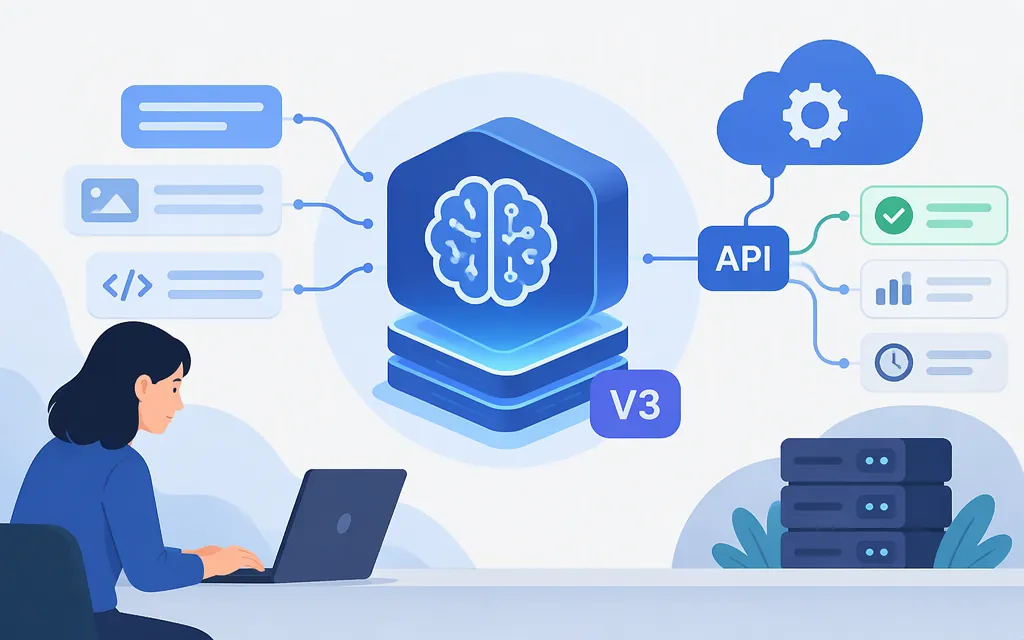
Short answer: DeepSeek-V3 is the model described in DeepSeek’s December 26, 2024 announcement: a mixture-of-experts (MoE) model with 671 billion total parameters and 37 billion activated parameters, trained on 14.8 trillion tokens, according to DeepSeek. Those figures describe the announced model’s scale—not whether it will perform well on your task. The current DeepSeek API documentation lists deepseek-flash and deepseek-v4-pro, not the original V3 as a selectable model. The docs identify deepseek-flash as DeepSeek-V4.1-Flash-1017. Don’t assume an old V3 API name or integration still calls V3.
What does “DeepSeek V3” refer to?
This guide uses DeepSeek-V3 to mean the release covered by DeepSeek’s original announcement—not every later model with “V3” in its name. DeepSeek’s announcement reports 671B MoE parameters, 37B activated parameters, and training on 14.8T high-quality tokens. It also links to a model repository and research paper. The announcement alone does not establish how the model performs on a particular workload, and its broad “fully open-source” wording does not specify license permissions. Check the model’s actual license before relying on rights to redistribute or self-host it.
The version distinction matters for API selection. DeepSeek’s current API documentation lists deepseek-flash and deepseek-v4-pro; it identifies deepseek-flash as DeepSeek-V4.1-Flash-1017. The documented list-models endpoint, GET https://api.deepseek.com/models, is the place to check the model identifiers and available metadata for the API. These current listings do not establish that the original V3 is currently selectable through that API.
What the V3 announcement claims—and what it doesn’t show
DeepSeek’s V3 announcement claims a generation rate of 60 tokens per second, described as three times faster than V2, and says API compatibility was intact. The page does not give the benchmark setup, hardware, workload, or definition of compatibility. Treat both statements as historical announcement claims, not a speed guarantee or proof an existing integration will work unchanged.
The announcement also says to “look forward to multimodal support.” That future-looking statement does not establish that the original V3 supported image input. If your workload needs images or another modality, verify support for the exact current model and API method you plan to use.
Parameter count, training volume, and a headline speed figure are not substitutes for task-level evaluation. Before choosing a model, test representative prompts and measure the things that matter for your application: answer quality, latency under your request sizes, required features, and how often failures need intervention. Set acceptance criteria in advance; for example, require correct handling of a defined test set and a latency ceiling that suits your product. This is a proposed evaluation method, not a claim that V3 or another model has passed it.
Production API checks before you integrate
The original announcement’s phrase “API compatibility intact” is not an integration guide. It does not specify a current V3 endpoint, model identifier, authentication steps, request and response formats, supported features, or operational limits. DeepSeek’s current API quick start describes OpenAI- and Anthropic-compatible formats, but compatibility at the format level should not be mistaken for proof that a particular old model name or request works today.
Before building around a DeepSeek model:
- Confirm the exact model ID and version in the current official model-and-pricing documentation or model list endpoint. Check that it is the model you intend to test—not a newer model served under a familiar legacy name.
- Confirm the API path and required features in the current documentation for that model: request format, response format, streaming or tool behavior if needed, and any relevant limits.
- Run a smoke test using your real integration path. Send a representative request, inspect the returned content and usage data, and test any required feature before rollout. A successful basic text request does not establish that every feature or production condition is supported.
- Recheck the model mapping before launch. DeepSeek’s docs state that the
deepseek-flashname currently serves DeepSeek-V4.1-Flash-1017. If your requirement is specifically the original V3, don’t treat that current identifier as an equivalent V3 release.
Practical choice: If you need the original V3 specifically, first establish that your chosen distribution channel still provides the exact V3 release and identifier. If you simply want a current model through DeepSeek’s hosted API, evaluate the currently documented model options instead, using your own task tests. Neither path warrants a production recommendation without workload-specific results.
DeepSeek V3 API pricing: historical announcement vs. current rates
DeepSeek’s V3 announcement lists these rates “from Feb 8 onwards”: $0.27 per million input tokens for a cache miss, $0.07 per million input tokens for a cache hit, and $1.10 per million output tokens. The announcement does not state the year for February 8 or confirm that these rates remain in effect. Treat them as announcement-era figures, not current V3 API prices.
The current official pricing page lists prices for deepseek-flash and deepseek-v4-pro, with rates that vary by cache status and peak versus off-peak time. It identifies deepseek-flash as DeepSeek-V4.1-Flash-1017; therefore, those rates are not V3 prices. For deepseek-flash, the listed rates per million tokens are:
- Cache-hit input: $0.003 off-peak; $0.006 peak
- Cache-miss input: $0.15 off-peak; $0.30 peak
- Output: $0.60 off-peak; $1.20 peak
DeepSeek defines peak hours as 01:00–04:00 and 06:00–10:00 UTC, Monday through Friday, excluding Chinese public holidays. All other hours are off-peak, including weekends and Chinese public holidays in full. DeepSeek also says product prices may vary and it reserves the right to adjust them, so check the pricing page before budgeting or launch. (api-docs.deepseek.com)
Illustrative estimate—not a quote for V3: At the listed deepseek-flash off-peak rates, 1 million cache-miss input tokens plus 200,000 output tokens would cost $0.15 + (0.2 × $0.60) = $0.27. This excludes cache hits and any other charges. Confirm off-peak eligibility and current rates on the official pricing page, and use the rate for the exact model and API channel you will call.
Selection checklist
- Release: Am I evaluating original DeepSeek-V3, or a later V3-family release?
- Availability: Does the channel I plan to use currently expose that exact release and identifier?
- Task fit: Does it pass a representative test set against my quality, latency, and failure-tolerance requirements?
- Integration: Have I tested the actual documented endpoint, request, response, and required features?
- Cost: Have I estimated input, cache-hit or cache-miss, and output usage using the current price for that exact model and API channel?
- License, if self-hosting: Have I checked the actual license and permissions rather than relying on a general “open-source” description?
Bottom line: DeepSeek’s original V3 announcement is useful for identifying what DeepSeek said about that release. It is not evidence that V3 remains a selectable production API model or that its announced price and speed claims still apply. Check the current model identifier and price, then decide based on a representative test of your own workload.
Sources
Introducing DeepSeek-V3 | DeepSeek API Docs
Models & Pricing | DeepSeek API Docs