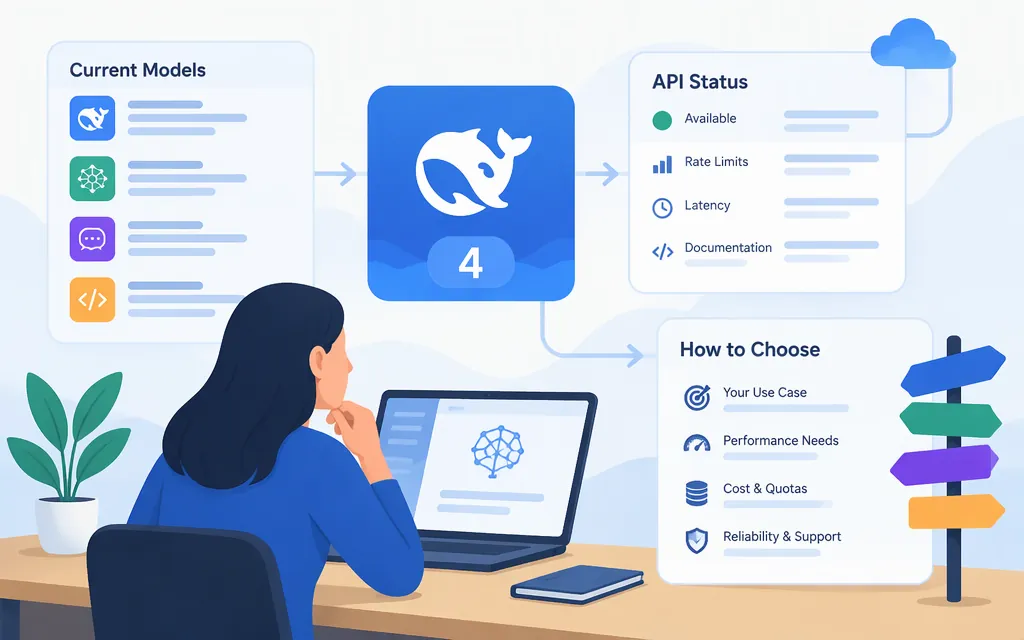
Short answer: DeepSeek V4 began as a preview family with Pro and Flash variants. The current API pricing table lists deepseek-flash as DeepSeek-V4.1-Flash-1017 and deepseek-v4-pro as DeepSeek-V4-Pro-0813, with separate prices. An earlier DeepSeek notice described Pro-name requests as temporarily routed to Flash; because that notice conflicts with the current model-and-price table, verify the served model in your account if routing matters to your deployment or budget. (DeepSeek API pricing)
What “DeepSeek V4” refers to now
DeepSeek’s April 2026 preview announcement introduced V4-Pro and V4-Flash and described a 1-million-token context window. Those are launch-era family details; for an API integration, use the current model names and versions documented in the API materials. (DeepSeek V4 Preview announcement)
The current pricing table identifies these API models and versions:
deepseek-flash— DeepSeek-V4.1-Flash-1017.deepseek-v4-pro— DeepSeek-V4-Pro-0813.
The documentation also says the legacy names deepseek-v4-flash and deepseek-v4-flash-vision-exp are accepted but served by V4.1-Flash-1017 and billed at the Flash price. (DeepSeek API pricing)
Pro status: DeepSeek’s earlier notice said requests using the Pro name would route to V4.1-Flash until V4.1-Pro launched. The current pricing table instead lists deepseek-v4-pro as a separate model, with version Pro-0813 and its own rates. That is evidence that the current API documentation recognizes a Pro route, but the pages do not explain when or how the earlier routing notice was superseded. Confirm the served model and billing in your account before relying on Pro-specific behavior. (DeepSeek API pricing)
Which model might fit your workload?
Consider Flash when its documented features match your needs
The current API table lists tool calls for Flash and supports vision for Flash, but not Pro. DeepSeek’s vision guide says Flash accepts images alongside text, and its tool-call guide documents tool use. These are supported features, not a guarantee of performance on a particular task. Test with representative prompts and tools before adopting it for production. (DeepSeek API pricing, vision guide, tool-call guide)
For long documents or large codebases, a 1M-token context limit describes capacity—not reliable recall across the entire context. Test whether the model finds relevant details from different parts of your input and follows your instructions at the lengths your workload requires. (DeepSeek API pricing)
Consider Pro only after confirming the route and task fit
The current API table lists Pro separately, but its documented features differ from Flash: Pro does not support vision in that table. Compare the models on the specific tasks you expect to run, including instruction following and any multi-step tool use you depend on. The listed model names and features do not establish which option will perform better for your workload. (DeepSeek API pricing)
A practical selection rule:
- Test Flash if image input or tool calls are important and its current API name and billing suit your use case.
- Test Pro if its documented route is available to your account and you do not need image input; confirm the actual served version and price first.
- Compare alternatives on your own tasks when reliability on long, multi-step work or specialized image handling is critical. Product features and context limits do not guarantee task performance.
- Verify deployment terms separately if you plan to download or self-host model weights. The preview announcement alone does not establish the license or terms for every later model version. (DeepSeek V4 Preview announcement)
Production API availability and current price
DeepSeek’s API documentation lists https://api.deepseek.com as the OpenAI-format base URL and https://api.deepseek.com/anthropic as the Anthropic-format base URL. The docs describe the API as compatible with both formats. Compatibility is format-level; check the feature table and relevant endpoint documentation for model-specific differences. (DeepSeek API documentation)
Pricing and model snapshot checked November 10, 2026: DeepSeek’s pricing page lists a 1M context length and a maximum output of 384K tokens. The table does not specify a separate maximum by model, thinking mode, or API format. For Anthropic-format requests, DeepSeek says the effective max_tokens limit depends on the model, thinking mode, and effort. Treat 384K as the table’s listed maximum, not a guaranteed effective limit for every request; confirm the applicable limit for your selected route and request format. (DeepSeek API pricing, Anthropic API compatibility guide)
The pricing page lists these USD rates per 1 million tokens:
| Model and billing category | Off-peak | Peak |
|---|---|---|
| Flash input, cache hit | $0.003 | $0.006 |
| Flash input, cache miss | $0.15 | $0.30 |
| Flash output | $0.60 | $1.20 |
| Pro input, cache hit | $0.022 | $0.044 |
| Pro input, cache miss | $0.66 | $1.32 |
| Pro output | $1.98 | $3.96 |
Peak pricing applies Monday through Friday, 01:00–04:00 and 06:00–10:00 UTC, excluding Chinese public holidays. All other times—including weekends and Chinese public holidays—are off-peak. Input rates depend on cache-hit status; output tokens are billed separately. DeepSeek says prices may change, so check the pricing page before budgeting. (DeepSeek API pricing)
Example: One million uncached Flash input tokens plus 100,000 Flash output tokens would cost $0.21 off-peak ($0.15 + $0.06) or $0.42 at peak ($0.30 + $0.12), using the rates listed on the pricing page as checked November 10, 2026. This estimate excludes other applicable charges and assumes the usage falls entirely in the stated pricing period. (DeepSeek API pricing)
Bottom line
For a new API evaluation, start with the current documented model name and version—not just “V4.” Flash is the documented image-capable option; the pricing table also lists a distinct Pro model and separate rates. Since the current Pro table conflicts with an earlier conditional routing notice, confirm the served model and billing in your account before relying on Pro-specific behavior. Test either model on representative workloads and use the current, cache-aware peak/off-peak rates for cost estimates. The available sources confirm DeepSeek API documentation; they do not confirm whether TokenForge Cloud currently supports a V4-series model.
For broader API context, see TokenForge Cloud’s DeepSeek API guide if it is current and applicable to your intended provider and route.