The short answer
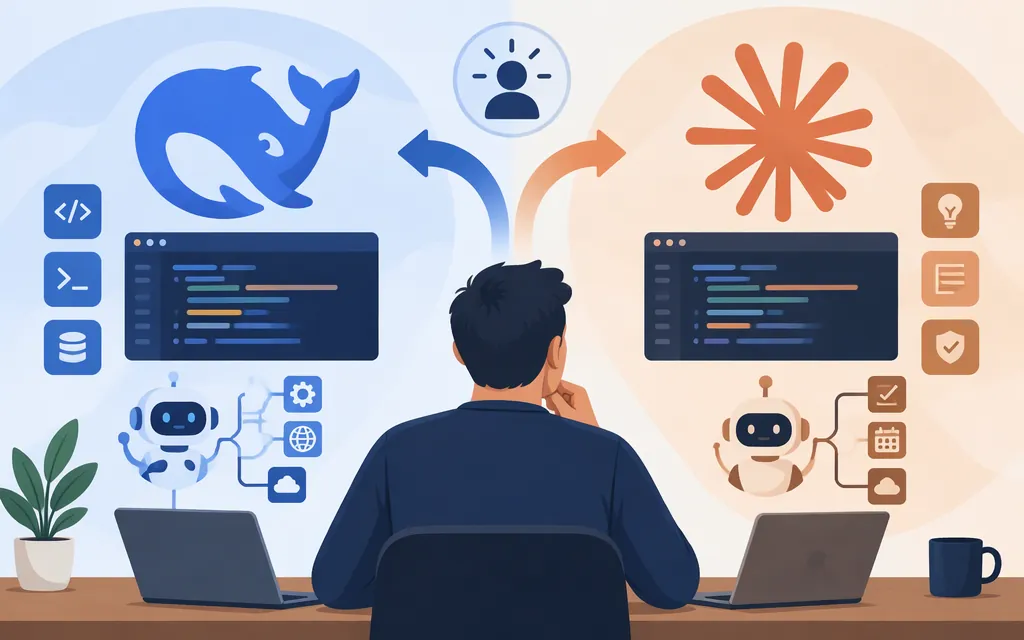
There isn’t a well-supported, universal winner for coding. First decide what you mean by “DeepSeek vs Claude”: comparing models is different from comparing coding-agent products. For models, test named versions on your own repository tasks. For agent workflows, compare DeepSeek Harness’s configurable approach with Claude Code’s ready-to-use coding tool—and verify that each fits your setup and control requirements.
A practical starting point: evaluate Harness if you want to customize the runtime, tools, or workflow. Evaluate Claude Code if its documented terminal, IDE, desktop, and web surfaces fit how you work. These are workflow-based starting points, not claims that one produces better code. DeepSeek describes Harness as open source and in public preview; Anthropic describes Claude Code as an agentic coding tool that reads code, edits files, and runs commands. (DeepSeek Harness)
Models and agents are different comparisons
| What you’re choosing | What to compare | What the comparison tells you |
|---|---|---|
| Models | Named DeepSeek and Claude models on the same task, repository, context, and tools | Which model works better for your tasks under those conditions |
| Coding agents | Products such as DeepSeek Harness and Claude Code | How the full workflow handles editing, commands, permissions, tools, and setup |
| A model inside an agent | A specific model, agent, configuration, and task together | How that complete combination performs—not which model or product is best in isolation |
This distinction matters because an agent’s tools and permission settings can affect the result as much as the model. Claude Code documentation describes a tool that reads codebases, edits files, and runs commands. DeepSeek describes Harness as a preview product for coding tasks with plugins that extend its capabilities. Neither product description is a head-to-head performance test. (Claude Code overview)
Older comparisons involve different model generations and test setups. For example, a WaveSpeed post describes a non-lab comparison of DeepSeek V4 and Claude Opus 4.5 using the same tasks and repository snapshots. It does not establish how the named models discussed in this article’s cost example—DeepSeek Flash and Claude Sonnet 5.5—compare on coding. Treat older reports as prompts for your own test, not as a current ranking. Read the WaveSpeed comparison.
Choose by coding workload
For a multi-file change, test whether each model can understand the relevant modules, follow project conventions, and keep changes coherent across files. Provide equivalent repository context to both. If you give excerpts rather than a checkout, give both the same file map and summaries.
For a narrow bug fix or test repair, focus on whether the model respects constraints: does a test-only task leave production code alone? Does the patch touch only necessary files? Passing tests matter, but so does avoiding unrelated edits.
For code generation or an algorithm change, use executable tests and explicit acceptance criteria. Record correctness and runtime where relevant; don’t use a confident explanation as a substitute for running the code.
One historical, version-specific comparison offers hypotheses for those tests. WaveSpeed’s author reports that DeepSeek V4 handled a refactor involving roughly 14 relevant files when given substantial context and a file map. The same author says Claude Opus 4.5 produced smaller diffs across five tasks, including a constrained timezone-test repair; DeepSeek also fixed that test but attempted an additional helper refactor. These are the author’s anecdotes, not established results: the post provides no full logs or quantified diff data, and its launch framing is internally inconsistent—it describes the comparison in early February 2026 while also saying “when V4 launches.” (WaveSpeed’s account)
Those observations concern DeepSeek V4 and Claude Opus 4.5, not the DeepSeek Flash and Claude Sonnet 5.5 candidates named in this article’s price example. They do not establish those candidates’ relative coding performance. Use the anecdotes to choose test cases: include both a context-heavy repository change and a tightly constrained repair. Then prefer whichever model, on your own repeated runs, completes the task correctly with less rework and review effort. If results vary by task, keep a task-specific choice rather than declaring one overall winner.
Choose an agent workflow: convenience or control?
DeepSeek presents Harness as an open-source, plugin-based system for coding and other tasks, and says users can add or build plugins. Its site labels the product a public preview. That makes it worth evaluating if you want to inspect or adapt the agent workflow; preview status is also a reason to check whether its current behavior and interfaces meet your needs. (DeepSeek Harness)
Claude Code runs in several documented surfaces, including the terminal, IDEs, desktop, and web. Its security documentation describes permission modes: in Manual mode, it starts with read-only permissions and asks before actions such as editing files or running commands; the documentation also describes sandboxing for Bash commands. Those documented controls may help you assess fit, but they do not establish that Claude Code is safer than Harness. Compare the actual controls and defaults in the environment you plan to use. (Claude Code security documentation)
A useful decision rule: evaluate Harness when customization is a requirement; evaluate Claude Code when its available surfaces and documented permission controls match your workflow. For either, start with a disposable branch or test repository, review proposed edits, and check what commands or network access the agent can use before granting broader permissions.
A fair coding and agent comparison
Run two separate evaluations if you want to know both model quality and agent performance:
- Pick representative tasks: for example, one multi-file change, one failing-test repair, one constrained patch, and one task requiring tools. Use tasks that reflect your real work.
- Freeze the inputs: pin the same repository commit, dependencies, tests, and task instructions. Give each model equivalent context.
- Separate model from agent effects: for a model-only test, disable tools for both. For an agent test, provide equivalent tools and retrieval access, then record their use.
- Repeat each task: run it at least three times as a practical variability check—not as a guarantee of statistical significance. Keep model versions and settings fixed during the comparison.
- Record outcomes: tests passed, task completed, retries, corrective prompts, changed files or diff size, elapsed time, tool failures, and token cost. Note whether a person had to intervene.
- Review the diff: check correctness, unnecessary changes, dependency assumptions, security implications, and whether the instructions were followed.
A useful summary is a row per task and model/agent combination. Report both the result and the conditions—for example, “passed in 2 of 3 runs; one corrective prompt; 8 minutes; 4 files changed.” That is a hypothetical reporting format, not a test result. Matching tools matters: a model with shell or retrieval access has an advantage over one that lacks it. WaveSpeed’s suggested controls likewise include freezing inputs, equalizing tool access, and tracking test attempts, diff size, corrections, and time to a passing test. (WaveSpeed’s comparison method)
Cost: compare billing like with like
API prices are per-token model charges; subscriptions are a different billing arrangement. DeepSeek’s official pricing table identifies the Flash API model as deepseek-flash, version DeepSeek-V4.1-Flash-1017, and lists separate input cache-miss, input cache-hit, and output rates. The example below uses its cache-miss input and output rates as listed on the pricing page retrieved November 8, 2026. DeepSeek notes that prices may vary and recommends checking the page for the latest rates before budgeting. (DeepSeek API pricing)
For a transparent example, assume 1 million uncached input tokens and 100,000 output tokens, with no additional tool charges or retries. Using the listed deepseek-flash rates:
- DeepSeek Flash (
deepseek-flash; version DeepSeek-V4.1-Flash-1017): $0.42 at peak ($0.30 input + $0.12 output), or $0.21 off-peak ($0.15 input + $0.06 output). - Claude Sonnet 5.5 API: $3.00 ($2 input + $1 output). (Anthropic API pricing)
DeepSeek’s table says off-peak rates are half of peak rates. It defines peak hours as 01:00–04:00 and 06:00–10:00 UTC, Monday through Friday, excluding Chinese public holidays; all other hours, including weekends and Chinese public holidays, are off-peak. These are rate-table conditions, not a claim about when a specific request will be billed. The estimates use the listed USD rates per million tokens and assume each provider bills the stated token counts. Actual tasks can have different token counts, cached input, retries, and tool usage, so check DeepSeek’s linked table before budgeting. Anthropic lists Sonnet API pricing separately from Claude subscriptions.
If you use Claude Code through a subscription, don’t treat the API calculation as your bill. Anthropic lists Claude Pro at $20 per month when billed monthly and includes Claude Code in the plan; usage limits apply. API usage is a separate pricing route. Compare the plan’s limits and your actual usage against pay-as-you-go API costs rather than assuming either billing option is always cheaper. (Claude plans and pricing)
Bottom line
- Choosing models? Test named versions against the same tasks. The historical DeepSeek V4 and Claude Opus 4.5 anecdotes suggest testing both multi-file work and constrained repairs; they do not establish performance for the DeepSeek Flash and Claude Sonnet 5.5 candidates named in the cost example—or a general coding winner.
- Choosing an agent? Evaluate Harness if configurable, plugin-based workflows matter to you; evaluate Claude Code if its documented surfaces and permission workflow suit your team.
- Choosing for production? Make the call from your own reproducible tests and review current controls, limitations, and release status. Don’t infer reliability or security from a benchmark, product label, or single anecdote.
- Choosing on cost? Compare actual token use and billing terms. Keep API rates separate from subscription plans, and include retries and tool calls in your own estimate.
The most useful result is not a universal winner. It’s a record of which model-and-agent setup completes your real tasks correctly, with acceptable review effort, controls, time, and cost.
Sources
DeepSeek API models and pricing
DeepSeek V4 vs Claude Opus 4.5 for Coding: Benchmark Comparison