Short answer
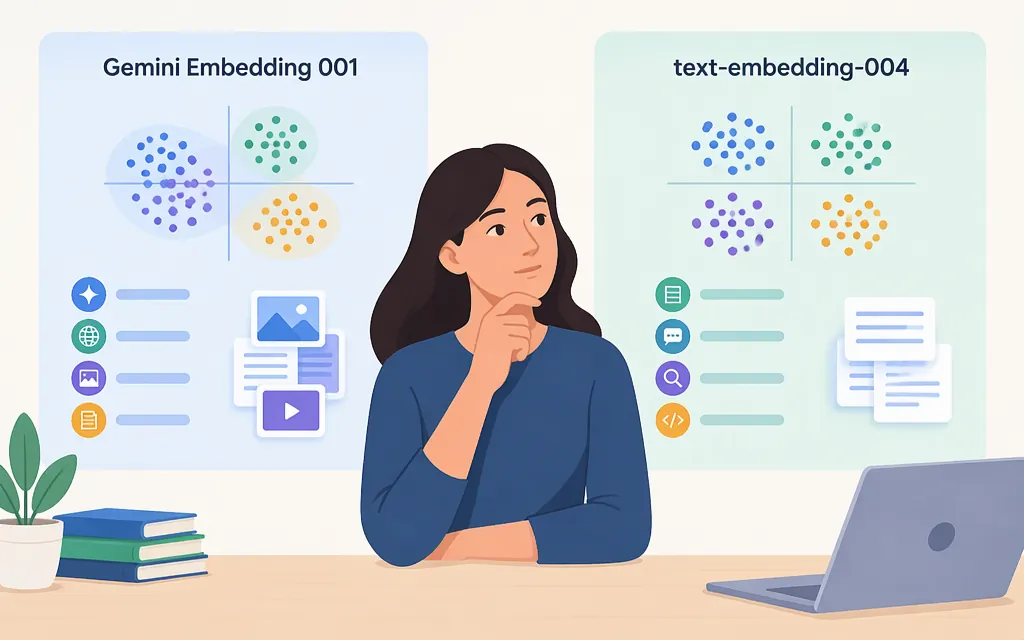
For a new Gemini Developer API integration, choose gemini-embedding-001: Google’s changelog reports that text-embedding-004 has been shut down on that API. This is a channel-specific lifecycle recommendation, not a universal quality verdict. If you are considering a Google Cloud deployment, the supplied evidence does not settle text-embedding-004’s current lifecycle for your exact Cloud product; check that product’s current model availability before choosing or migrating. Its appearance—or absence—in a particular reference table is not, by itself, proof of retirement across Cloud services. (Gemini API release notes; Google Cloud RAG Engine model guidance)
Google reports one task-specific comparison: gemini-embedding-001 scored 1.9% higher in F1 than text-embedding-004 on a 21,500-transaction financial classification dataset. That supports considering 001 for similar classification; it does not establish that it will improve retrieval on every corpus. (Google Developers Blog)
| Decision factor | gemini-embedding-001 |
text-embedding-004 |
Production implication |
|---|---|---|---|
| Status | Google’s launch announcement says it is available through the Gemini API and Vertex AI; current Gemini API documentation is cited as retaining it for text-only use. | Google reports shutdown on the Gemini Developer API. The supplied evidence does not settle current lifecycle across Google Cloud products. | For the Gemini Developer API, do not start a new integration against 004. For Cloud, verify availability in the exact service you plan to use; a reference-table omission alone does not prove retirement. (Google Developers Blog; Gemini API release notes) |
| Maximum input length | 2,048 tokens, according to Google’s launch announcement. | Google Cloud’s Agent Retrieval table lists 2,048 tokens. | The listed limits match, but they come from different product documentation; verify the applicable request limits for your serving channel. (Google Developers Blog; Agent Retrieval) |
| Output dimensions | Default 3,072; Google recommends 3,072, 1,536, or 768 for highest-quality results. | The cited Agent Retrieval table lists 768 dimensions. | Confirm the supported dimension setting in the SDK/API for your channel, and test quality at the selected size. Equal dimensions do not make different models’ vectors interchangeable. (Google Developers Blog; Agent Retrieval) |
| Performance evidence | Google reports the transaction-classification result above. | Included in that specific transaction comparison; the cited case does not establish a universal retrieval result. | Treat the result as relevant to similar classification tasks, not as a guarantee for your workload. (Google Developers Blog) |
| Gemini API price | Google’s July 14, 2025 launch announcement listed $0.15 USD per 1 million input tokens and said free and paid tiers were available. It does not identify the price tier or establish today’s rate. | No live, like-for-like Gemini API comparison: Google reports 004 shut down on that API. | Treat $0.15 as the announced launch rate, not a verified current quote or a tier-specific budget. Check current pricing for the exact service and tier. (Google Developers Blog) |
What the evidence says about quality
Google’s reported transaction result is a specific comparison: on 21,500 B2B bank transactions, gemini-embedding-001 delivered a 1.9% higher F1 score than text-embedding-004 for classification. F1 balances precision and recall, so this is most relevant when your task resembles labeling or classifying financial transactions. Google does not present the result as a universal retrieval benchmark. (Google Developers Blog)
Google’s broader launch comparison combined the highest scores from three legacy models—text-embedding-004, text-embedding-005, and text-multilingual-embedding-002—rather than presenting a clean, single-model comparison against 004. That is useful context, but it is not a direct 001-versus-004 result. (Google Developers Blog)
Practical takeaway: for a new Gemini Developer API integration, the reported 004 shutdown makes 001 the relevant choice of these two—not a promise that it will perform better on every task. For a Cloud deployment, the available evidence here does not settle 004’s current product-specific lifecycle; check that first. If your Cloud environment supports both and retrieval quality matters, compare them on the same documents, queries, chunking, relevance judgments, and retrieval settings. Use a task-appropriate metric such as recall@k or nDCG@k for retrieval, or F1 for classification. Record the exact service, model ID, dimensions, and evaluation set so the result can be reproduced.
API and implementation differences
Gemini Developer API
Google’s July 2025 launch announcement gives this minimal Python example for gemini-embedding-001 with the embed_content method: (Google Developers Blog)
from google import genai

client = genai.Client()
result = client.models.embed_content(
    model="gemini-embedding-001",
    contents="A sample sentence to embed.",
)
print(result.embeddings)
Google’s announcement lists a maximum input of 2,048 tokens, a default output of 3,072 dimensions, and recommends 3,072, 1,536, or 768 dimensions. The announcement does not show the SDK parameter for choosing a dimension, so check the current documentation for the specific SDK and channel before adding that configuration. Test retrieval quality at the dimension you deploy rather than assuming reduced dimensions preserve it. (Google Developers Blog)
Vertex AI and RAG Engine are not the same as Gemini API
Google Cloud’s current Text embeddings API reference documents gemini-embedding-001 and Vertex prediction options such as task_type and outputDimensionality. Separately, the RAG Engine guide shows how to configure a corpus with text-embedding-004; that is corpus setup, not a standalone embedding-generation example. The supplied Cloud evidence does not establish 004’s current lifecycle across every Cloud product, so check the model status for the exact service before relying on it. (Google Cloud Text embeddings API; RAG Engine model guidance)
For a new RAG Engine corpus, the cited Google Cloud guide names text-embedding-005 as its default and recommends it for that product. This is a scoped RAG Engine recommendation, not a general quality verdict between 001 and 004. The guide also says a corpus’s embedding-model association remains fixed for its lifetime. (Google Cloud RAG Engine model guidance)
Pricing and rollout
Google’s July 14, 2025 Gemini API launch announcement listed gemini-embedding-001 at $0.15 USD per 1 million input tokens and said the API offered free and paid tiers, with higher limits for production use. The announcement does not identify which tier the quoted rate applies to. At that announced rate, 1 billion input tokens would calculate to $150 for model calls, before infrastructure or storage—but treat this as an illustration using the launch-announced rate, not a verified current price or tier-specific budget. Check current pricing and terms for the service and tier you will use. (Google Developers Blog)
When changing embedding models, plan for the migration required by your deployment rather than assuming a model-name swap is enough. For Google RAG Engine, the cited guide says the model association is fixed for a corpus’s lifetime; its discontinuation guidance says a discontinued publisher model can require a new corpus and data re-import. That constraint is specific to the documented RAG Engine path, not a universal rule for every vector database or deployment. (Google Cloud RAG Engine model guidance)
Recommendation
- Starting a new Gemini Developer API integration: use
gemini-embedding-001rather thantext-embedding-004; Google reports that 004 has been shut down on the Gemini Developer API. (Gemini API release notes) - Choosing on Google Cloud: do not infer 004’s current lifecycle from its presence or absence in a reference table. Verify availability for the exact Cloud product, then compare candidates that it supports.
- Evaluating classification: consider Google’s reported 001 advantage on the 21,500-transaction dataset if your task is similar; it is not a guarantee for other domains. (Google Developers Blog)
- Evaluating semantic retrieval: run a like-for-like test on your own queries and relevance judgments; the cited classification result does not settle retrieval quality for your corpus.
- Choosing a new Google-managed RAG Engine corpus: the cited guide recommends
text-embedding-005for that product. Treat that as scoped product guidance, not as a winner in the 001-versus-004 comparison. (Google Cloud RAG Engine model guidance)
Sources
Gemini Embedding now generally available in the Gemini API
Gemini Embedding: Powering RAG and context engineering
Text embeddings API | Gemini Enterprise Agent Platform
Use embedding models with RAG Engine