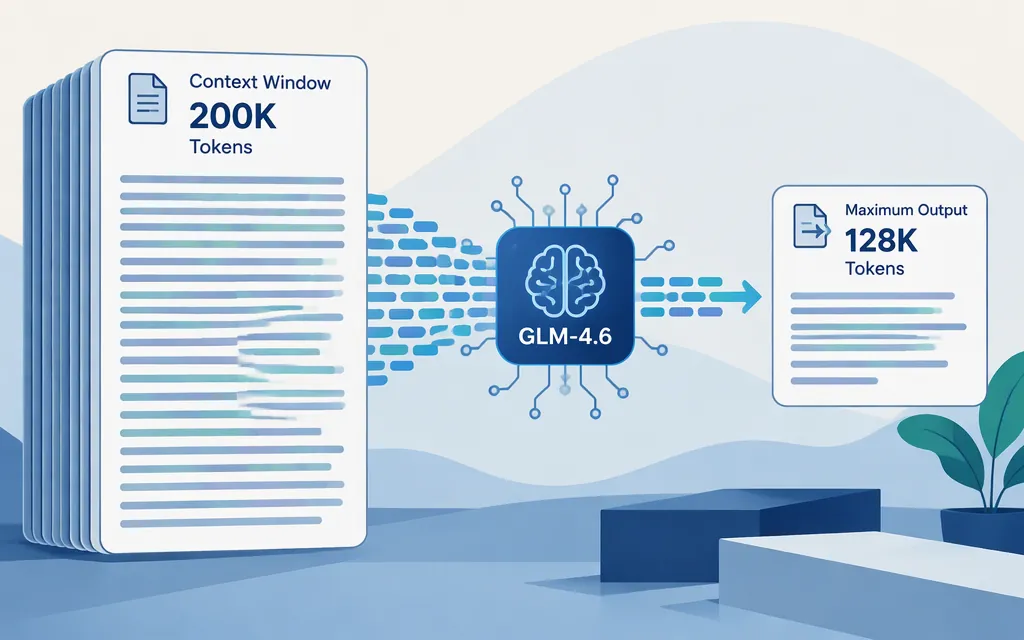
Z.ai documents GLM-4.6 with a 200K-token context length and a 128K-token maximum output. The migration guide identifies the API model as glm-4.6. These figures apply to Z.ai’s documented GLM-4.6 offering; check the relevant provider’s own limits if you use another host or integration. (docs.z.ai)
What the limits mean for API use
Z.ai lists the 200K context length and 128K maximum output as separate limits. The documentation reviewed here does not clarify whether generated output counts toward the 200K context limit, or exactly how input and output are accounted for together. So don’t treat the figures as proof that a request can use 200K input tokens plus 128K output tokens—or assume a specific shared-budget rule that the docs don’t state. (docs.z.ai)
The migration guide says to set max_tokens appropriately and lists 128K as the maximum output. For planning, leave room for the response rather than designing a request right at the context ceiling; treat that as a conservative sizing practice, not a documented accounting formula. (docs.z.ai)
Confirm the limit for your deployment
For Z.ai’s API, use the documented model identifier glm-4.6 and consult Z.ai’s GLM-4.6 model and migration documentation. If you use another provider, gateway, coding tool, or self-hosted deployment, check that deployment’s model identifier and published limits rather than assuming they match Z.ai’s. (docs.z.ai)
Also distinguish GLM-4.6 from GLM-4.6V, the vision-language model. Z.ai lists GLM-4.6V separately and describes its context window as 128K tokens in training; that is not the GLM-4.6 text model’s documented 200K figure. (z.ai)
Bottom line
For Z.ai’s glm-4.6, the documented figures are 200K context length and 128K maximum output. The documentation reviewed does not specify their input/output accounting relationship, so verify the applicable limits with your provider and leave response headroom when sizing requests.
Sources
GLM-4.6 — Z.AI Developer Documentation