Short answer
GLM-5.1 is worth shortlisting if your workload involves extended, iterative software-engineering or agent tasks—but shortlist it for a test, not on the assumption that it will outperform your current model. Z.AI positions it for long-horizon work and documents features including function calling, streaming, context caching, and a 200K context window. Those features make it relevant to some production workflows; your own task results, reliability, and latency should determine whether it fits. (Z.AI GLM-5.1 documentation)
Z.AI’s release notes list GLM-5.2 and GLM-5.3 after GLM-5.1. If you are choosing a model today rather than integrating with a system that specifically requires GLM-5.1, compare those versions too. (Z.AI release notes)
What GLM-5.1 is—and what its positioning proves
Z.AI describes GLM-5.1 as a flagship model for long-horizon tasks, including agentic coding and multi-stage engineering work. Its documentation lists text input and output, a 200K context length, a maximum output of 128K tokens, streaming, function calling, structured output, and context caching. These are documented product features and positioning—not independent evidence that it will complete your particular task accurately or faster than an alternative. (Z.AI GLM-5.1 documentation)
Z.AI’s release notes date GLM-5.1 to April 7, 2026, and describe it as designed for long-horizon tasks. The notes also make claims about sustained execution and capability alignment with Claude Opus 4.6; those claims do not by themselves establish how the model will perform on your workload. (Z.AI release notes)
How to assess fit for your workload
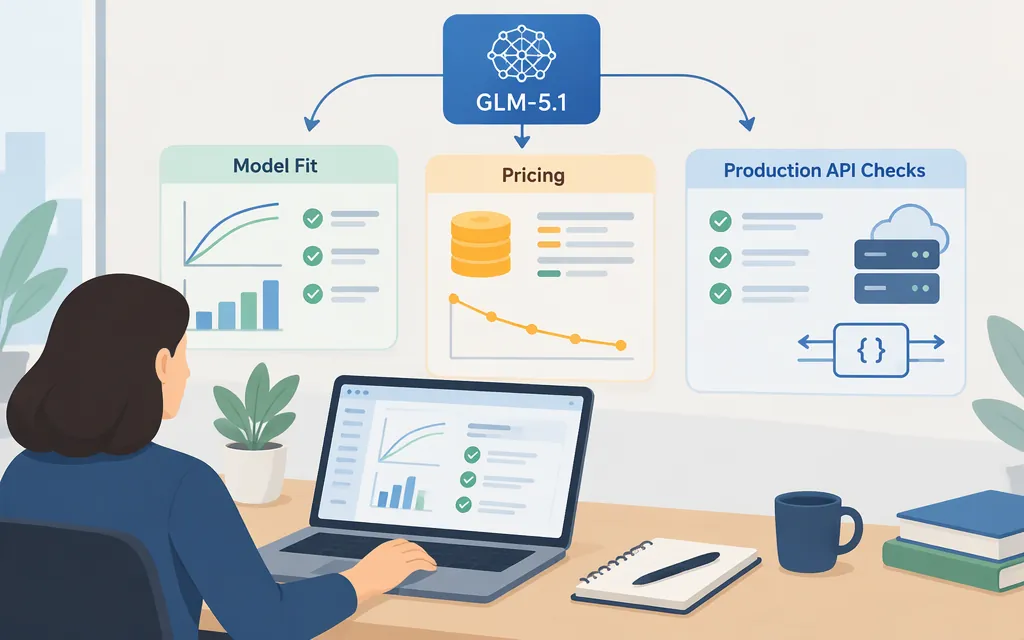
The available material supports treating GLM-5.1 as a candidate for evaluation, not declaring it a winner. Z.AI’s pages describe intended use and features, while the LLM Stats model profile contains benchmark headings but no readable scores or latency measurements in the captured text. Promotional comparisons should not replace comparable, reproducible results.
Run a small, like-for-like evaluation against the model you use now:
- Select representative tasks from your real workflow—for example, a multi-file bug fix, a feature request with tests, or a task requiring repeated tool calls.
- Hold the prompt, repository or input data, tool permissions, and success criteria constant across models.
- Check whether each run actually completes the task; verify code, tests, or other outputs rather than judging only the explanation.
- Record tool-call errors, retries, failed or incomplete runs, and end-to-end latency. Repeat tasks where outcomes vary.
- Compare the result with the added cost and any changes needed in your API integration.
This test tells you whether the model works for your particular process. It does not establish a general benchmark ranking.
Production API and cost checks
For Z.AI’s standard model API, its API reference specifies the general endpoint and HTTP Bearer authentication using a Standard API Key. Z.AI’s standard quick start also shows creating that key, but its example request uses glm-5.3, not glm-5.1. The GLM-5.1 model page describes the model, but does not confirm in the cited material that glm-5.1 is the request identifier enabled for your standard API account. Confirm the exact identifier and availability in the current API documentation or your account before building around it. (Z.AI API reference; standard quick start; GLM-5.1 documentation)
Do not assume a Coding Plan key is interchangeable with a standard API key. Z.AI says newly created keys for the standard API and Coding Plan are managed separately and are not interchangeable; the key-management guide also notes that older keys may be classified under different rules. Choose the credential and endpoint for the product you intend to use, and check your key’s classification in the account console. (Coding Plan quick start; API key management guide)
For the exact model and account you intend to use, check the current documentation for the endpoint and protocol, request and response formats, streaming and tool-call behavior, context and output limits, rate limits, and service and data terms. Z.AI documents streaming and function calling for GLM-5.1, but a production test should confirm the exact behavior your application depends on. (Z.AI GLM-5.1 documentation)
Z.AI’s published GLM-5.1 rates are USD per 1 million tokens: $1.40 for input, $0.26 for cached input, and $4.40 for output. The pricing page labels cached-input storage separately as “Limited-time Free”; verify the applicable cache-storage terms before estimating ongoing costs. (Z.AI pricing)
Illustrative calculation: for a request using 100,000 uncached input tokens and 20,000 output tokens, the listed token charges would be (0.1 × $1.40) + (0.02 × $4.40) = $0.228. This is a hypothetical estimate using the published per-million-token rates; it excludes any costs or terms not included in that calculation. Cached input would change the input portion only for tokens that qualify for the provider’s cache pricing.
The third-party LLM Stats profile reports different prices for other providers, but those figures are not a substitute for current provider documentation. It also shows provider-specific context figures that differ from its general summary. For a provider comparison, verify each provider’s current model availability, price and cache rules, context limits, and service terms directly, then compare them on the same workload.
Bottom line: shortlist, test, or wait
- Shortlist GLM-5.1 if extended coding or agent workflows are relevant and the documented features match your needs.
- Test it against your current model on representative tasks before making a quality or reliability decision.
- Compare GLM-5.2 and GLM-5.3 as well if you are not constrained to GLM-5.1;
Z.AIlists them as later releases. (Z.AIrelease notes) - Wait on production commitment until you have confirmed the exact model identifier, key type, API behavior, current limits, pricing, and applicable service terms for your account.
The cited material establishes Z.AI’s documented GLM-5.1 features and its published Z.AI price. It does not establish that another API provider is currently available on equivalent terms, or that TokenForge offers GLM-5.1.
Sources
GLM-5.1 - Z.AI Developer Documentation
New Released - Z.AI Developer Documentation
Introduction - Z.AI Developer Documentation
Quick Start - Z.AI Developer Documentation
API Key Management Guide - Z.AI Developer Documentation