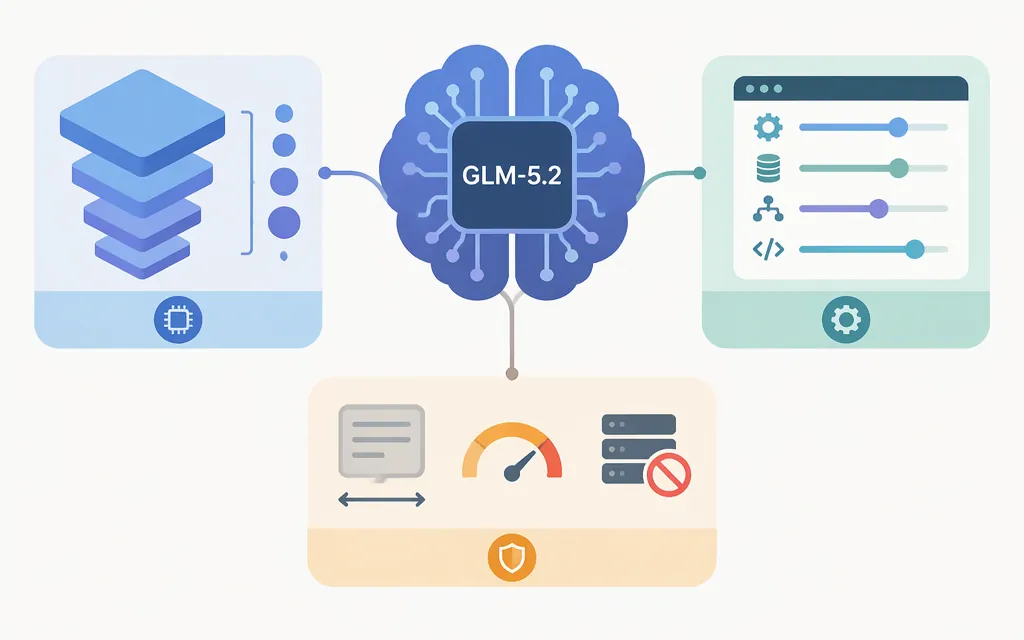
“GLM-5.2 parameters” can mean either the model’s learned weights or settings supplied with an API request. The Hugging Face listing describes GLM-5.2 as a text-generation model with 753B parameters. Z.ai separately lists a 1M-token context length and 128K maximum output. These figures describe different things; the model-size listing does not establish an active-parameter count. (huggingface.co)
GLM-5.2 parameters: model size or API settings?
Model parameters are learned values in the trained model. API parameters are request-time controls that affect a response, such as reasoning effort or whether output streams.
The available model listing gives a total of 753B parameters. The cited material does not establish an active-parameter count, so do not infer one from the total. (huggingface.co)
GLM-5.2 API parameters you can configure
Z.ai’s deep-thinking guide specifically lists reasoning_effort options for GLM-5.2. Its general parameter guide also describes common fields, but labels several defaults as model-dependent. Treat those as general API guidance—not a GLM-5.2-specific contract unless the model or endpoint documentation confirms them. (docs.z.ai)
| Setting | What Z.ai documents |
Qualification |
|---|---|---|
reasoning_effort |
For GLM-5.2: max (default and recommended), xhigh, high, medium, low, minimal, and none. Z.ai says low and medium map to high; xhigh maps to max; minimal and none stop thinking. |
These options are documented for GLM-5.2, but confirm that the specific API product and client you use accept and pass through this field. (docs.z.ai) |
thinking.type |
Z.ai describes enabled as the default for thinking and says GLM-5.2 can decide whether to think. |
The guide describes the field generally; confirm its availability for your chosen product and request schema. (docs.z.ai) |
stream |
The general parameter guide lists a Boolean default of false; the GLM-5.2 overview says streaming output is supported. |
The general default is not presented as a GLM-5.2-specific API guarantee. (docs.z.ai) |
max_tokens |
The general guide describes an integer generation limit with a model-dependent default. The GLM-5.2 overview lists maximum output of 128K tokens. | Confirm the accepted request limit and default for the exact endpoint; the overview figure does not guarantee every request can generate 128K tokens. (docs.z.ai) |
temperature, top_p, do_sample |
Z.ai’s general guide lists these as sampling controls; it gives model-dependent defaults for temperature and top_p, and true as the default for do_sample. |
The cited GLM-5.2 documentation does not establish GLM-5.2-specific accepted ranges, defaults, or restrictions for these fields. (docs.z.ai) |
Endpoint and product: is this implementation-ready?
Z.ai documents the standard Open Platform API base as https://api.z.ai/api/paas/v4, and the Chat Completions route as /chat/completions. However, the Chat Completion example uses model ID glm-5.3, not glm-5.2. The GLM-5.2 model card points readers to Z.ai API services, and Z.ai’s pricing page includes a GLM-5.2 row; neither item establishes that glm-5.2 is accepted on that specific standard Chat Completions endpoint. The exact request ID and product/endpoint pairing therefore remain unconfirmed in the cited request documentation. (docs.z.ai)
Do not assume the GLM Coding Plan is interchangeable with the standard API. Z.ai documents separate API keys and a dedicated Coding Plan endpoint; its FAQ lists GLM-5.3 and GLM-5.3-Flash as supported Coding Plan models, not GLM-5.2. (docs.z.ai)
As a result, this guide does not provide a copy-ready GLM-5.2 request or claim a validated standard-endpoint pairing. Before implementation, confirm the exact model ID, endpoint, product access, and accepted request fields in the documentation for the account you will use.
Limits and capabilities for production selection
Z.ai’s GLM-5.2 overview lists a 1M-token context length, 128K maximum output, thinking mode, streaming, function calling, structured output, context caching, and MCP. These are model-overview claims; they do not by themselves establish that every Z.ai product or endpoint exposes every feature or the same limits. (docs.z.ai)
Z.ai’s general parameter guide defines a context window as the tokens processed in an interaction, including input and generated output. But the cited material does not specify a separate GLM-5.2 input-token cap or explain how a particular endpoint accounts for input, output, and other tokens against the listed context limit. Confirm that accounting before sizing requests near the published limits. (docs.z.ai)
Fit check: Shortlist GLM-5.2 if your workload could benefit from long context, reasoning controls, streaming, or tool use. Treat the model overview and general parameter guide as selection information—not a complete production API contract. Verify the model ID, endpoint, product access, field constraints, and token accounting before building against it.
Sources
zai-org/GLM-5.2 — Hugging Face
GLM-5.2 — Z.AI Developer Documentation
Deep Thinking — Z.AI Developer Documentation
Core Parameters — Z.AI Developer Documentation
Introduction — Z.AI API Reference
Chat Completion — Z.AI API Reference
Pricing — Z.AI Developer Documentation