The short answer
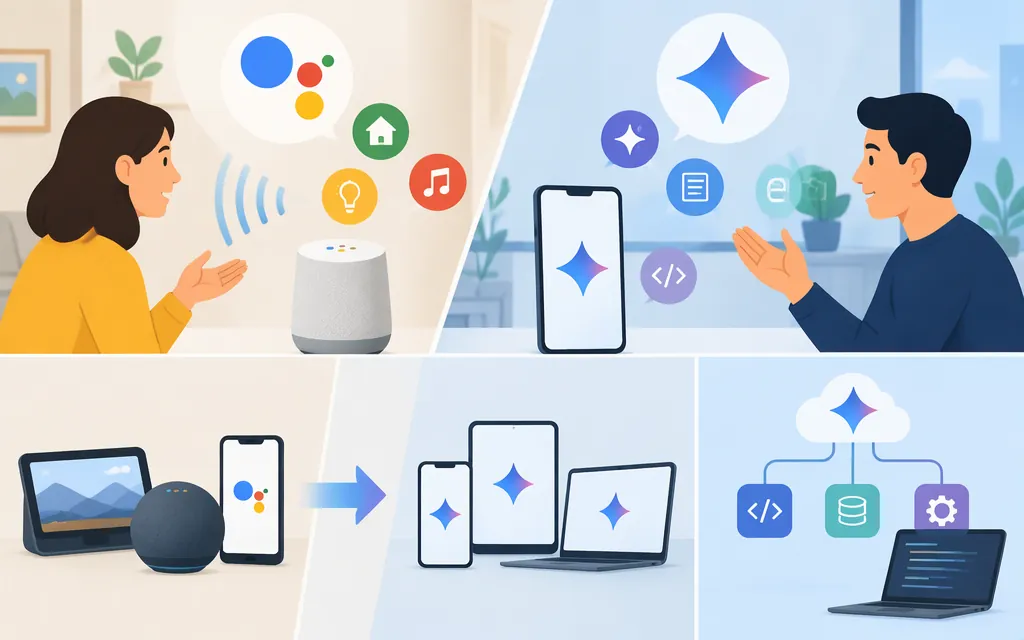
Google Assistant and Gemini are not a simple either-or choice: Google is moving its mobile assistant experience toward Gemini, while availability still depends on the device and feature. Google describes Gemini as an AI-powered assistant; its consumer app combines familiar tasks, such as setting timers, with AI features such as Gemini Live and Deep Research. For developers, the Gemini API is a separate product layer: it provides model access for an application, not Google Assistant’s ready-made user experience or device integrations.
Google Assistant vs. Gemini at a glance
| What you’re comparing | Google Assistant | Gemini |
|---|---|---|
| Consumer experience | Google’s established assistant experience. Which features remain available depends on the device and Google’s transition. | Google’s AI assistant experience. Gemini is also the name used for Google’s family of AI models. |
| Typical fit | A supported device or setup where you rely on a particular Assistant feature or integration. | Everyday assistant tasks on supported devices, along with conversational or other AI features available to your account. |
| Device caveat | Don’t assume the classic Assistant remains available on every phone or that every previous feature persists. | Features and eligibility vary by device, account, language, and location. Check support for your specific device. |
| Developer API | A consumer assistant, not what Gemini API pricing describes. | An API for adding Gemini model capabilities to your own software—not a ready-made Assistant replacement. |
Google’s March 2025 announcement described Gemini as a reimagining of the assistant experience and named familiar tasks such as playing music, setting timers, and taking action from the lock screen. It also highlighted Gemini Live and Deep Research. Those examples show that the distinction is not a strict division in which only one product can handle everyday tasks; availability can vary.
Which should you choose for everyday tasks?
Choose based on the task and the device that supports it—not on a universal claim that one assistant is better.
- For phone actions: Gemini can serve as the mobile assistant on eligible Android devices. Google documents supported actions through its Device assistance feature; setup, permissions, and device support matter.
- For a watch: Google says Assistant is available on select watches with Wear OS 3.0 or later, and Gemini on select watches with Wear OS 4.0 or later. Check with the watch manufacturer; country, language, and connectivity can also affect availability.
- For a speaker or display: Gemini for Home is being rolled out to compatible Google speakers and displays. Google says early access began for select users and availability is expanding over time; check current eligibility for your device and location.
- For conversational or research-style help: Gemini may be a better fit when you want an AI conversation, follow-up questions, or supported content-generation and research features. Access and limits depend on the feature and account.
Earlier comparisons often described Assistant as geared toward simple voice commands and Gemini as geared toward more complex AI tasks. Treat that as a qualitative description of their emphasis, not a controlled speed or accuracy test. Google’s own examples show Gemini also taking on familiar assistant tasks.
What is happening to Google Assistant?
A Google Gemini Apps Community announcement was originally posted on December 19, 2025, and updated on August 5, 2026. The updated notice said that, beginning September 4, 2026, most users would no longer be able to use or switch back to Google Assistant on their phone or tablet. It also said that when Gemini becomes the assistant on a mobile device, it will be the assistant on paired peripherals such as Wear OS watches, compatible headphones or earbuds, and vehicles running Android Auto.
That notice distinguishes an effective date from the notice’s publication and update dates. It applies to most users, not necessarily every device or account. Because September 4, 2026 has passed, don’t assume the notice alone confirms the current status of every device; check Google’s support information for your model. Watch support pages separately describe eligibility for Assistant and Gemini on select watches, while Gemini for Home has its own rollout for compatible home devices.
Can the Gemini API replace Google Assistant?
Not by itself. Gemini in a consumer app or as a device assistant is a user-facing experience. The Gemini API is for developers adding model access to their own software. API access does not automatically provide a microphone wake word, assistant settings, Google Home control, or Assistant’s existing integrations. A developer seeking those features would need to build or arrange the relevant interface, permissions, integrations, and actions separately.
Google’s developer documentation identifies Gemini 4 Argon (gemini-4-argon) as a model available through the Gemini API. That makes it one model a developer can evaluate for an application; the model’s existence does not make the API a drop-in replacement for the consumer assistant. Check the current model documentation for details applicable to your workload.
Access and cost: consumer plan versus API
Consumer subscriptions and API billing are different, so compare them separately. The prices below are for the U.S. and were checked November 8, 2026; plan terms and rates can change.
- Consumer Gemini: Google lists a free plan at $0 per month with a Google Account. Its U.S. subscription page lists Google AI Pro at $19.99 per month, including 5 TB of storage and expanded access to Gemini features. A paid plan is not required for the free plan’s listed access; features, usage limits, and eligibility differ by tier.
- Gemini API: Google lists Gemini 4 Argon at introductory rates through November 30, 2026 of $2 per 1 million input tokens and $10 per 1 million output tokens. The listed rates thereafter are $4 per 1 million input tokens and $20 per 1 million output tokens. These are API token rates, not a monthly consumer subscription. At the introductory rates, 1 million input tokens plus 100,000 output tokens would cost $3, before any other applicable charges or conditions.
Confirm the current consumer plan terms and API pricing before purchasing or deploying. Consumer features and API model charges are not interchangeable.
Bottom line
- For an Android phone: Gemini is Google’s mobile assistant experience for eligible users. Google’s updated notice set September 4, 2026 as the date after which most users would lose the option to use or switch back to Assistant; check your device’s current status rather than assuming universal rollout.
- For a watch or home device: support differs by device and rollout. Verify the requirements for the specific watch, speaker, or display.
- For developers: the Gemini API provides model access for your application, not Assistant’s complete consumer experience, controls, or integrations.
- For cost: compare free and paid consumer access separately from per-token API billing.
Sources
Here’s an update on our work to upgrade mobile Assistant devices to Gemini
Set up Gemini or Google Assistant on your watch
Learn about Gemini for Home voice assistant