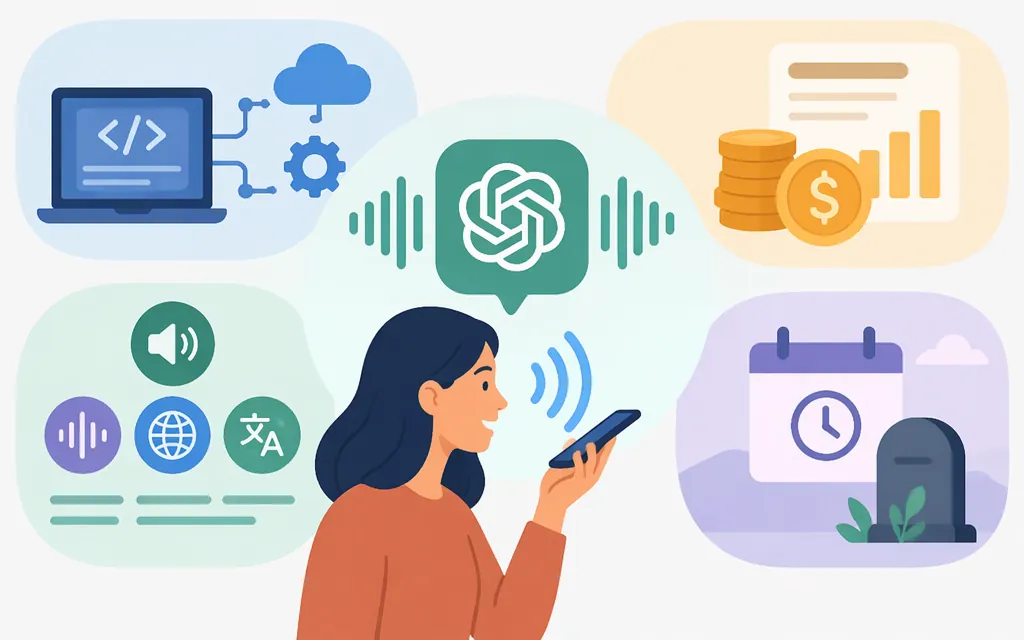
Short answer: GPT-4o mini TTS converts text into generated speech. The OpenAI Speech API guide documents voice selection, delivery instructions, and streaming. For the OpenAI API, the model is deprecated and scheduled to shut down on January 6, 2027. OpenAI recommends migrating to gpt-realtime-2.1-mini through the Realtime API—a different workflow, not a drop-in replacement for /v1/audio/speech. Azure OpenAI has a separate lifecycle schedule, so check the specific version deployed there. (OpenAI Text-to-Speech guide; Microsoft retirement schedule)
Status in this guide is current as of November 10, 2026. OpenAI API and Azure OpenAI lifecycle dates are separate.
What GPT-4o mini TTS does
GPT-4o mini TTS is a text-to-speech model: it takes text and produces audio. It is not a speech-to-text transcription model. OpenAI’s guide lists narration, spoken audio in multiple languages, and streaming as uses. It documents 11 built-in voices and an instructions field for guiding delivery, such as requesting a cheerful, positive tone. The model page lists a maximum input of 2,000 tokens. (OpenAI Text-to-Speech guide; model page)
It may fit narration, accessibility audio, or generated speech in an application when its available voices and output meet your needs. The documentation does not establish that every pronunciation or supplied passage will be rendered exactly as written. If exact wording matters, test representative material and review the audio before relying on it.
OpenAI’s usage policies require clearly telling listeners that the voice they hear is AI-generated, not a human voice. (OpenAI Text-to-Speech guide)
OpenAI API: production status and migration
For the OpenAI API, the official Text-to-Speech guide says gpt-4o-mini-tts is deprecated and will shut down on January 6, 2027. OpenAI recommends gpt-realtime-2.1-mini as the migration target, but that model is not supported on /v1/audio/speech. Migrating means adopting the Realtime API rather than simply changing the model name in an existing Speech API request. (OpenAI Text-to-Speech guide; Speech API reference)
What to do:
- Starting a new OpenAI API integration? Avoid making a model scheduled for retirement the foundation of a long-lived production service. Evaluate the recommended Realtime API path against your text, voice, and integration requirements.
- Already using
gpt-4o-mini-tts? Plan and test a migration before January 6, 2027. Confirm required voices and test whether the new workflow handles your text as expected. This is an API workflow change, not a drop-in endpoint swap.
The migration notice does not establish that the replacement behaves identically for every TTS use case. Do not assume voice equivalence or exact-text behavior; verify both with representative application tests. (OpenAI Text-to-Speech guide)
Azure OpenAI has a separate lifecycle
Do not automatically apply the OpenAI API’s January 6, 2027 date to Azure. Microsoft’s retirement schedule lists Azure gpt-4o-mini-tts version 2025-12-15 as GA, with a retirement date of June 15, 2027. It lists version 2025-03-20 as Preview, with a retirement date of October 15, 2026. Confirm the version actually deployed in your Azure resource and check its status with Microsoft before making a production decision. (Microsoft retirement schedule; Microsoft model catalog)
In short: the OpenAI API model and Azure’s versioned deployment have separate provider lifecycles. Check the provider, endpoint, and deployed model version.
OpenAI API quickstart while the model remains available
The OpenAI Speech API uses /v1/audio/speech. This Python example follows OpenAI’s documented SDK pattern, uses the documented coral voice and instructions parameter, and streams the returned audio to speech.mp3. The guide says MP3 is the default output format. (OpenAI Text-to-Speech guide)
pip install openai
export OPENAI_API_KEY="your-api-key"
from pathlib import Path
from openai import OpenAI

client = OpenAI()
speech_file_path = Path("speech.mp3")

with client.audio.speech.with_streaming_response.create(
    model="gpt-4o-mini-tts",
    voice="coral",
    input="Today is a wonderful day to build something people love!",
    instructions="Speak in a cheerful and positive tone.",
) as response:
    response.stream_to_file(speech_file_path)

print(f"Saved audio to {speech_file_path}")
This is the existing OpenAI Speech API workflow, not a Realtime API migration example. The model’s scheduled shutdown applies to the OpenAI API model. (OpenAI Text-to-Speech guide)
OpenAI API pricing and a practical budget estimate
OpenAI’s model page lists these rates in USD per 1 million tokens: (GPT-4o mini TTS model page)
| Usage | Rate |
|---|---|
| Text input | $0.60 per 1 million text tokens |
| Audio output | $12.00 per 1 million audio tokens |
The model page lists a maximum input of 2,000 tokens. The Speech API reference describes the result as audio file content or a stream of audio events; it does not document per-request input- and audio-token usage counts in that response. The public documentation cited here also does not specify whether instructions tokens are included in billable text input. Do not infer an exact character-to-audio-token conversion or assume an instruction-billing rule. (model page; Speech API reference)
For a practical workload budget, measure a representative pilot using the OpenAI API Usage Dashboard and export its usage or cost data. OpenAI documents filtering Activity data by API capability and grouping it by model; Cost data can be exported by line item. Log your own successful request counts and workload mix alongside the export. Use a dedicated project for the pilot, or otherwise ensure the project’s cost is attributable to this workload. (OpenAI usage and cost guide; monthly usage export guide)
Example using hypothetical pilot results: suppose a representative pilot costs $3.20 for 800 successful speech outputs. The observed average is $3.20 ÷ 800 = $0.004 per output. If the forecast is 120,000 comparable outputs per month, the simple estimate is 120,000 × $0.004 = $480 per month. Those pilot numbers are illustrative, not a predicted model rate. The estimate is useful only if the pilot’s text lengths, instructions, and retry pattern resemble production; use the dashboard’s actual billed cost for the pilot rather than treating a character count as a precise token meter.
You can also check the token-rate arithmetic independently. Illustrative calculation, not a usage prediction: if a request used 1,000 text tokens and 50,000 audio tokens, the charges at the listed rates would be:
- Input: 1,000 ÷ 1,000,000 × $0.60 = $0.0006
- Output: 50,000 ÷ 1,000,000 × $12.00 = $0.60
- Total: $0.6006
The 50,000 audio-token figure is hypothetical; it is not a claim about the output of a particular script or duration. Azure is billed through Azure and has its own pricing. Do not use the OpenAI API rates above as an Azure quote.
Decision checklist
- For a short-term OpenAI API need: the model can be evaluated while the Speech API remains available, but plan around the January 6, 2027 shutdown.
- For a longer-lived OpenAI integration: evaluate the recommended Realtime migration now. Budget for a different API workflow; test required voices and exact-text behavior rather than assuming parity.
- For Azure OpenAI: verify the model version deployed in your resource and its current lifecycle status. Do not treat a catalog listing as confirmation that a particular resource can deploy or continue using that version.
- For budgeting: run a representative pilot, attribute its billed cost to the workload, and scale from observed cost per successful output. Keep your own request logs because a shared project total may not identify which application generated the spend.
Sources
- OpenAI Text-to-Speech guide
- OpenAI GPT-4o mini TTS model page and pricing
- OpenAI Speech API reference
- OpenAI API usage and cost guide
- OpenAI monthly usage export guide
- Microsoft Foundry model retirement schedule
- Microsoft Foundry GPT-4o mini TTS catalog
- Microsoft description of Azure billing for Foundry models
Sources
GPT-4o Mini TTS Model - OpenAI API
Create speech - OpenAI API Reference
Reviewing API usage and costs - OpenAI Help Center
Exporting monthly usage details from the API Usage Dashboard - OpenAI Help Center