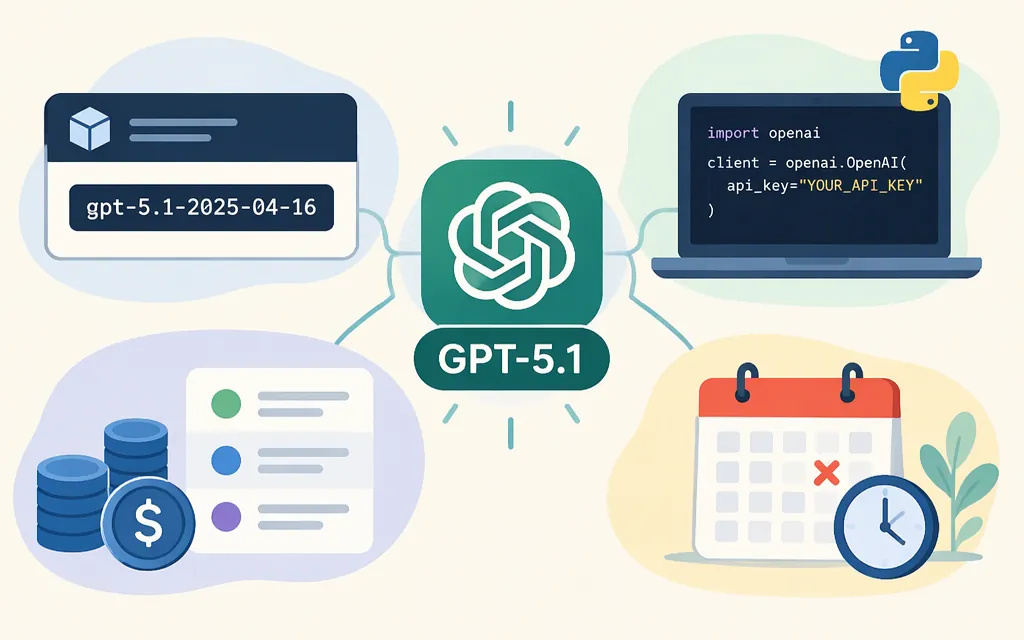
GPT-5.1 API: the short answer
OpenAI’s API model ID is gpt-5.1. You can call it with the Responses API, for example through the official Python SDK. But GPT-5.1 is deprecated: OpenAI says it is scheduled to be removed from the API on April 1, 2027. As of November 8, 2026, that date is in the future, but GPT-5.1 is a poor choice for a new production integration unless you have a specific reason to use it and a plan to migrate. (developers.openai.com)
Make a first request with Python
You’ll need an OpenAI API project with access to the model, Python 3.10 or later, and the OpenAI Python package. OpenAI’s model page lists the Free tier as unsupported; access and rate limits depend on your usage tier. (developers.openai.com)
-
Install the SDK:
pip install openai -
Set
OPENAI_API_KEYin your environment. On macOS or Linux, for a local test:export OPENAI_API_KEY="your-api-key"In Windows PowerShell, use
$env:OPENAI_API_KEY="your-api-key". For an application, keep the key on your server or in a secret manager—not in browser code or a public repository. (help.openai.com) -
Save and run this as
test_gpt51.py:from openai import OpenAI client = OpenAI() response = client.responses.create( model="gpt-5.1", input="Reply with exactly: GPT-5.1 API connection works.", ) print(response.output_text)A successful call returns a response; the printed text should be the short phrase requested in the prompt. The code uses
gpt-5.1with the Responses API and reads the SDK’soutput_textconvenience field. (developers.openai.com)
If the request fails, first check that the key is present in the environment used to run Python, that it belongs to the intended API project, and that the project can access the model. Keep any error message for diagnosis, but don’t post the API key.
Model name, API, and settings
Use gpt-5.1 for the GPT-5.1 model described here. OpenAI’s model reference lists both the Responses API (/v1/responses) and Chat Completions (/v1/chat/completions) as supported endpoints. This example uses Responses, which OpenAI’s text-generation guide uses for direct model requests. (developers.openai.com)
Don’t substitute a similarly named model ID without checking its own documentation: OpenAI lists distinct GPT-5.1 names, including gpt-5.1-chat-latest and gpt-5.1-codex. The model reference currently marks the gpt-5.1-2025-11-13 snapshot as deprecated as well. (developers.openai.com)
The model page says reasoning.effort supports none (the default), low, medium, and high. For a simple first request, leave it at the default. If you later change it, compare the response quality and latency on your own task rather than assuming a higher setting is always better. (developers.openai.com)
The same page lists a 400,000-token context window, a 128,000-token maximum output, text and image input, text output, and support for streaming, function calling, and structured outputs. These are model reference specifications—not a promise that every task fits those limits or that a particular tool workflow works without additional implementation. (developers.openai.com)
Price and planned shutdown
OpenAI’s GPT-5.1 model page lists these prices per 1 million tokens: $1.25 input, $0.125 cached input, and $10.00 output. Your total depends on token use; check the current model page before budgeting or deploying, because the model is already deprecated. (developers.openai.com)
OpenAI’s deprecations page records GPT-5.1 as deprecated on October 1, 2026, with API removal scheduled for April 1, 2027. Deprecation is not the same as shutdown: OpenAI explains that a deprecated model becomes inaccessible at its shutdown date. For a new application, select a currently supported model and test it against your workload; for an existing GPT-5.1 integration, plan and validate migration before the deadline. (developers.openai.com)
Before using the call in an application
- Keep the API key on a trusted server; never expose it in browser-side code or commit it to a repository. (
help.openai.com) - Confirm the model is available to your API project and check its current lifecycle status and rate limits. OpenAI says model shutdown dates can also be checked through the Models API. (
developers.openai.com) - Test the chosen model on representative inputs, then evaluate a supported replacement before putting a new or migrated workflow into production.
- Treat the April 1, 2027 shutdown as a real migration deadline—not a guarantee of continued access afterward. (
developers.openai.com)