Short answer
For a new production deployment, GPT-5.1 vs Gemini 3 Pro Preview is not a viable like-for-like choice. Google says the gemini-3-pro-preview API model was shut down on March 9, 2026. OpenAI marks GPT-5.1 as deprecated and lists April 1, 2027 as its removal date. OpenAI’s model page lists both gpt-5.1 and gpt-5.1-2025-11-13 as deprecated, but the published schedule does not separately state whether that date applies to each identifier. Check the exact model’s shutdown_date before planning an existing integration’s migration. (Google model page; OpenAI model page; OpenAI deprecation schedule)
For a historical API comparison, the identifiers are OpenAI’s gpt-5.1 and snapshot gpt-5.1-2025-11-13, and Google’s gemini-3-pro-preview. These are API model IDs, not ChatGPT plans or the Gemini app. Their documented feature support can show what kinds of inputs and outputs they accommodated; it does not establish which model produced better results on a workload.
Practical recommendation: Don’t select either as a new production model based on old comparison claims. Choose among currently deployable API models, verify their exact IDs and lifecycle status, and evaluate them on representative tasks.
Status reviewed November 9, 2026. “Gemini 3” here refers specifically to the Gemini 3 Pro Preview API model.
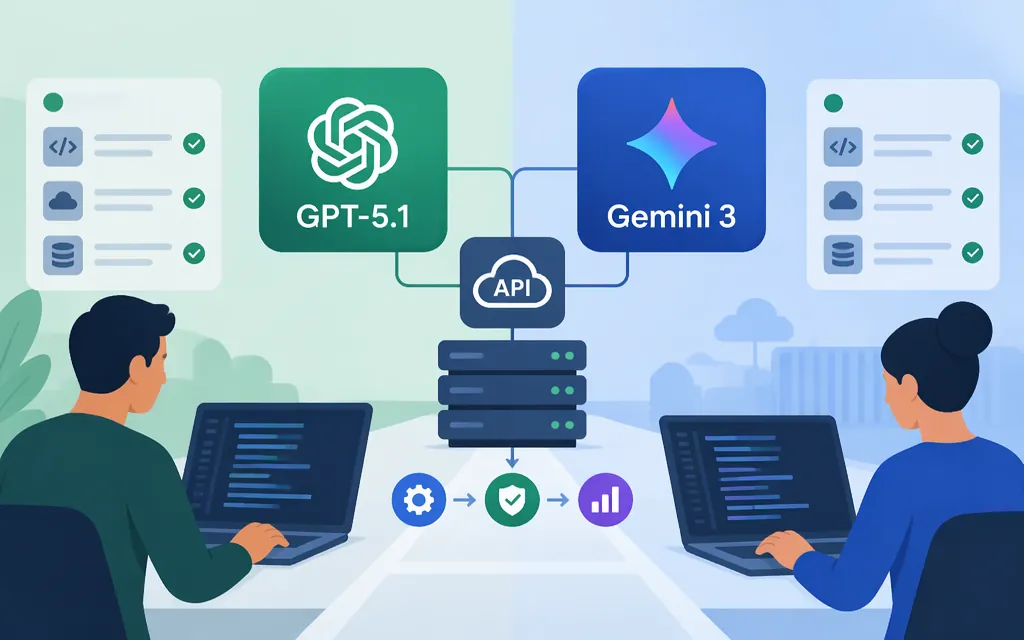
GPT-5.1 vs Gemini 3: API comparison
| Production consideration | GPT-5.1 API | Gemini 3 Pro Preview API |
|---|---|---|
| Model identifiers | gpt-5.1; snapshot gpt-5.1-2025-11-13 |
gemini-3-pro-preview |
| Lifecycle | Deprecated; OpenAI’s schedule lists GPT-5.1 for removal April 1, 2027. The schedule does not separately clarify alias-versus-snapshot applicability. | Shut down March 9, 2026; not available for new API requests. |
| Documented inputs and output | Text and image input; text output. | Text, image, video, audio, and PDF input; text output. |
| Context and output limits | 400,000-token context; up to 128,000 output tokens. | 1,048,576-token input limit; up to 65,536 output tokens. |
| Function calling | Supported. | Supported. |
| Structured outputs | Supported. | Supported. |
The feature and limit entries describe provider-documented API support for these specific variants—not equivalent quality, accuracy, or availability. (OpenAI GPT-5.1 model page; Google Gemini 3 Pro Preview model page)
What those features mean for workload fit
- Audio, video, or PDF input: Gemini 3 Pro Preview’s documented inputs included these modalities. GPT-5.1’s listed inputs were text and images. That is a difference in documented input eligibility, not evidence that the Gemini model would interpret a particular file more accurately. The Gemini API model is shut down.
- Image-based analysis: Both model pages list image input. That alone does not show which model performs better on screenshots, charts, or scanned documents.
- Tool-driven workflows and structured responses: Both list function calling and structured outputs. Those features make either variant eligible for applications that need tool calls or schema-constrained output; they do not establish that either is more reliable for coding agents or retrieval-augmented generation (RAG).
- Long-context tasks: The documented limits differ, but a larger input limit is not proof of better accuracy, lower latency, or lower total cost. Test whether your task benefits from sending more context at once versus retrieval or chunking.
- RAG and knowledge assistants: Feature support alone does not establish grounding quality or citation accuracy. Evaluate whether answers are supported by retrieved passages, cite the right evidence, and handle missing evidence appropriately.
Earlier comparison articles make broader claims about coding, reasoning, and benchmark leadership. The evidence available here does not establish those claims with reproducible, current head-to-head results. Treat such rankings as hypotheses rather than procurement evidence.
API pricing: what the historical GPT-5.1 figure means
OpenAI’s GPT-5.1 model page lists $1.25 per 1 million input tokens, $10 per 1 million output tokens, and $0.125 per 1 million cached input tokens. GPT-5.1 is deprecated, so these listed rates are not a recommendation to start a new integration. Confirm the exact model’s lifecycle and applicable price before budgeting an existing deployment. (OpenAI GPT-5.1 model page)
For an uncached illustration using those listed rates:
- 200,000 input tokens:
0.2 × $1.25 = $0.25 - 5,000 output tokens:
0.005 × $10 = $0.05 - Illustrative total: $0.30
This arithmetic excludes tools, retries, and other charges. It is not a current price comparison against Gemini 3 Pro Preview, which has been shut down. API token charges are also separate from consumer subscription prices. For budgeting, use rates for the exact API models you can deploy and account for input/output mix, caching, tools, retries, and provider billing conditions. See the OpenAI API pricing page and Google Gemini API pricing page.
How to choose a current production replacement
Evaluate the exact model IDs you can deploy now, using representative inputs and consistent tools. Score outcomes against your requirements:
- Coding agents: Run the same issues through your repository, tests, and tool permissions. Record test success, tool calls or retries, and regressions.
- Document or multimodal analysis: Use representative media only when the candidate’s current API documentation supports those inputs. Score factual coverage and evidence selection, not just fluency.
- RAG: Use questions with known answers in your corpus. Check support from retrieved passages, citation accuracy, and handling of missing evidence.
- Cost and speed: Measure input and output tokens, tool charges, retries, and end-to-end latency on the same workload. Compare cost per successful task, not just price per million tokens.
- Before launch: Check the exact model’s lifecycle, limits, rate limits, and relevant provider terms. A consumer-app feature or preview listing does not by itself establish a stable production API offering.
A two-model router may be worth evaluating if workloads genuinely differ by task or modality, but it adds routing, testing, monitoring, and fallback complexity. Measure it against a single-model baseline rather than assuming it lowers cost or improves quality.
Bottom line
For the query “GPT-5.1 vs Gemini 3,” the production answer is lifecycle first, not a winner: Google shut down gemini-3-pro-preview on March 9, 2026. OpenAI marks gpt-5.1 and its listed snapshot as deprecated, with an April 1, 2027 removal date shown for GPT-5.1; the schedule does not separately specify alias-versus-snapshot applicability. Check the exact GPT-5.1 model’s shutdown date if you maintain an integration. The documented features identify workload eligibility, not comparative task quality. Choose among currently deployable APIs using provider documentation and an evaluation built around your workload.