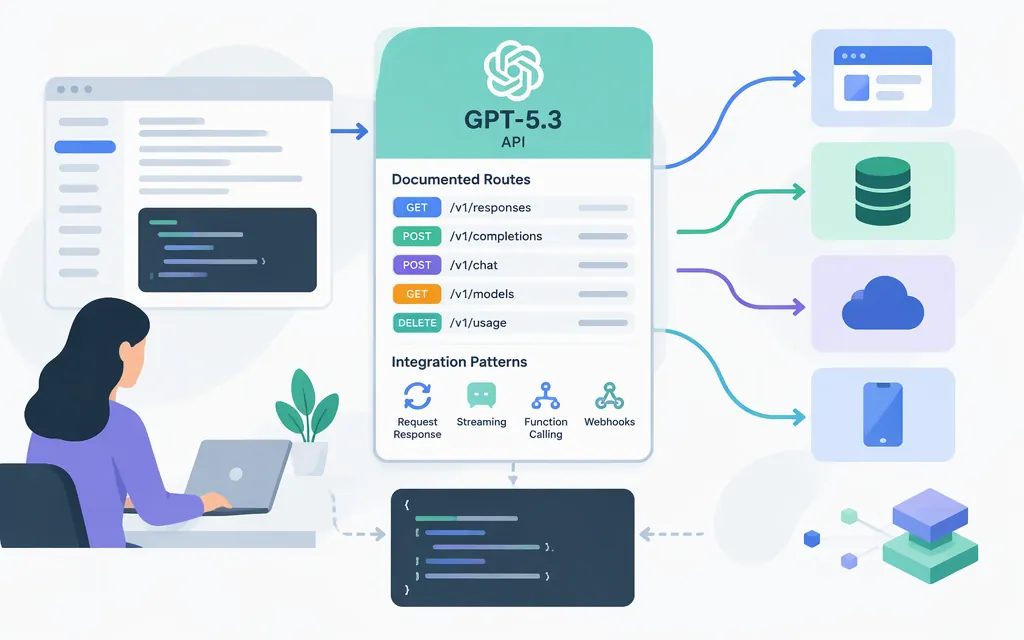
“GPT-5.3 API” can refer to different models and providers. OpenAI’s API model page lists gpt-5.3-codex and marks it Deprecated. Separately, Netlify announced a route for GPT-5.3 Instant through Netlify AI Gateway, using the model name gpt-5.3-chat-latest. These documents describe model names and request patterns; they do not establish whether either route is callable for your project today. Netlify’s route is gateway access, not direct OpenAI API access. (OpenAI model page; Netlify announcement)
Which route are you considering?
| Model and provider | What the cited documentation establishes | What it does not establish |
|---|---|---|
| GPT-5.3-Codex, OpenAI API | OpenAI lists model ID gpt-5.3-codex, the Responses API endpoint, and a Deprecated status. (OpenAI model page) |
The documentation reviewed here does not establish whether it is still callable for a particular project or give a shutdown date. Confirm current access and lifecycle guidance before depending on it. |
| GPT-5.3 Instant, Netlify AI Gateway | Netlify announced the route on March 3, 2026, using gpt-5.3-chat-latest in a Netlify Function. Netlify’s gateway documentation describes gateway configuration for supported client libraries. (Netlify announcement; AI Gateway overview) |
The sources reviewed here do not conclusively establish current availability of this specific model for every project or its applicable billing and quota details. Check your project’s current gateway availability before deployment. |
These labels are not interchangeable. Do not apply Codex’s model ID, prices, or limits to GPT-5.3 Instant on Netlify.
Call GPT-5.3 Instant through Netlify AI Gateway
Netlify’s announcement shows the OpenAI JavaScript SDK calling the Responses API inside a Netlify Function. Netlify’s AI Gateway documentation says that, by default, Netlify provides provider keys and a gateway base URL to supported client libraries in Netlify compute contexts. This is gateway access, not a direct OpenAI API call using your own OpenAI key. (Netlify announcement; AI Gateway overview)
Set up the function
Netlify’s quickstart lists a credit-based Netlify plan, a linked project, and at least one production deploy among its prerequisites. It shows installing the OpenAI SDK with npm install openai and placing JavaScript functions in netlify/functions. Check the project’s gateway availability and setup; do not assume this configuration applies on another host. (Netlify AI Gateway quickstart)
Create netlify/functions/gpt53.js:
import OpenAI from "openai";

export default async () => {
  const client = new OpenAI();
  const response = await client.responses.create({
    model: "gpt-5.3-chat-latest",
    input: "How does AI work?",
  });

  return Response.json({ text: response.output_text });
};

export const config = { path: "/api/gpt53" };
This uses the model name and Responses API call shown in Netlify’s announcement. OpenAI’s text-generation guide documents response.output_text as the JavaScript SDK accessor for generated text. The function wraps that text in a JSON field named text. (Netlify announcement; OpenAI text-generation guide)
After deploying, invoke the configured route on your Netlify site:
curl https://YOUR_SITE/api/gpt53
The function’s response is JSON with a text field. This is a documented integration pattern, but it does not prove that the model is currently enabled for your project. Netlify says AI Gateway usage is billed to your Netlify account as credits; check your plan, model availability, and applicable charges before production use. (Netlify AI Gateway overview)
Direct OpenAI request pattern for GPT-5.3-Codex
OpenAI lists gpt-5.3-codex for the Responses API and documents Bearer-token authentication. The example below shows that request pattern. Because OpenAI marks Codex deprecated, use it only if the model remains available to your API project; the example is not confirmation of current access. (OpenAI model page; OpenAI quickstart)
export OPENAI_API_KEY="your-api-key"

curl https://api.openai.com/v1/responses \
  -H "Content-Type: application/json" \
  -H "Authorization: Bearer $OPENAI_API_KEY" \
  -d '{
    "model": "gpt-5.3-codex",
    "input": "Review this function for edge cases."
  }'
That curl command returns the raw Responses API JSON. To print generated text using the documented JavaScript SDK accessor, install the SDK with npm install openai, then make the equivalent request in a Node.js script:
import OpenAI from "openai";

const client = new OpenAI();
const response = await client.responses.create({
  model: "gpt-5.3-codex",
  input: "Review this function for edge cases.",
});

console.log(response.output_text);
Here, response.output_text is the JavaScript SDK accessor; it is not being presented as a top-level field in the raw curl JSON. Keep the API key server-side, and verify project access and current deprecation guidance before making this model a production dependency. (OpenAI text-generation guide; OpenAI quickstart; OpenAI model page)
OpenAI’s GPT-5.3-Codex model page lists $1.75 per million input tokens, $14 per million output tokens, a 400,000-token context window, and 128,000 maximum output tokens. These figures apply to that Codex model page; they are not verified prices or limits for GPT-5.3 Instant through Netlify. The available documentation does not establish that the deprecated Codex route remains callable. (OpenAI model page)
Production checks
- Confirm the exact model and provider.
gpt-5.3-codexis the model ID on OpenAI’s API model page;gpt-5.3-chat-latestis the model name in Netlify’s AI Gateway announcement. These are different documented routes. (OpenAI model page; Netlify announcement) - Check present callability. OpenAI marks GPT-5.3-Codex deprecated. Netlify documents its Instant gateway route, but the sources reviewed here do not establish that either model is enabled for your specific project today. (OpenAI model page; Netlify announcement)
- Check route-specific costs and limits. OpenAI lists the Codex figures above; do not transfer them to Netlify’s GPT-5.3 Instant route. The cited Netlify announcement does not specify that route’s billing units, quotas, or model limits. (OpenAI model page; Netlify announcement)
- Use credentials appropriate to the route. Direct OpenAI requests use an OpenAI API key as a Bearer token. Netlify AI Gateway uses gateway configuration in its supported Netlify environment; check your project’s setup and plan. (OpenAI quickstart; Netlify AI Gateway overview)
Bottom line: The documentation describes a direct OpenAI Responses API request pattern for deprecated gpt-5.3-codex and a Netlify AI Gateway pattern for gpt-5.3-chat-latest. It does not confirm current project-level callability for either route. Verify access with the named provider before treating either as a production option.
Sources
GPT-5.3-Codex Model | OpenAI API
GPT-5.3 Instant now available in AI Gateway | Netlify
AI Gateway Overview | Netlify Docs