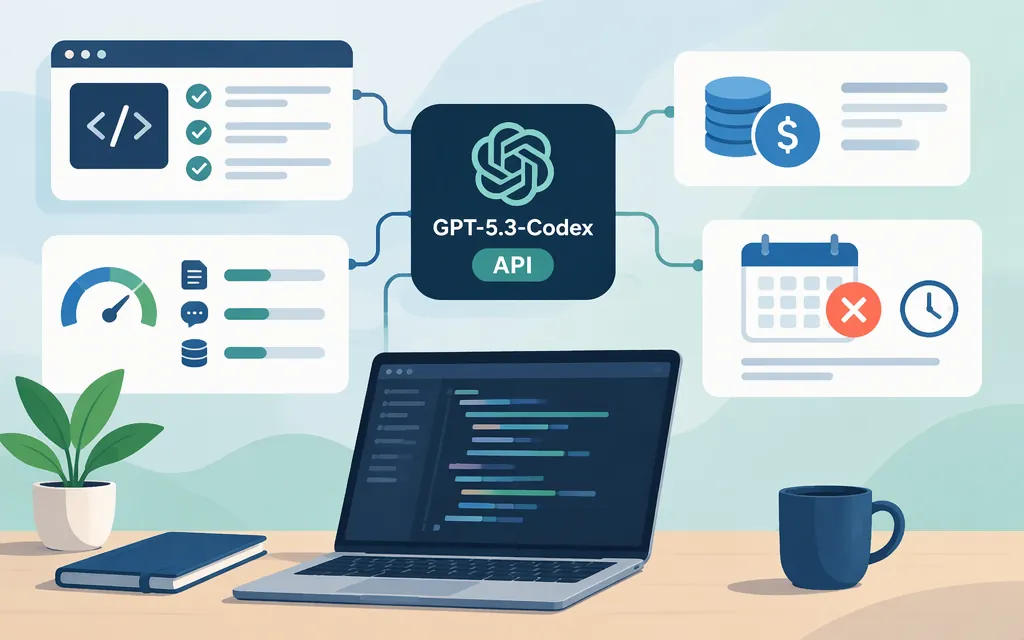
As of November 9, 2026, GPT-5.3-Codex is listed as a deprecated API model. OpenAI’s deprecation notice names gpt-5.3-codex, gives October 1, 2026 as its deprecation date, and schedules its removal from the API for April 1, 2027. The model page lists the Responses API as supported. Avoid starting a long-lived production dependency on it; if you already use it, plan and test a migration before shutdown. (OpenAI deprecations)
Can you use the GPT-5.3-Codex API?
The model is deprecated, but the official model page still lists the model ID gpt-5.3-codex and v1/responses as supported. It lists Chat Completions as unsupported. Confirm your project’s access and current rate limits before integrating. (GPT-5.3-Codex model page)
OpenAI says deprecated models become inaccessible at shutdown. Its deprecation notice recommends migrating before the scheduled date; it also says the shutdown_date field can be checked through the List models endpoint (GET /v1/models). (OpenAI deprecations)
Minimal API integration
You need an API key and a project with access to the model. The example below uses OpenAI’s Python SDK and Responses API. Keep the key in an environment variable rather than embedding it in browser code or committing it to a repository. (OpenAI API quickstart)
Install the SDK and set your key in a macOS or Linux shell:
pip install openai
export OPENAI_API_KEY="your_api_key_here"
Make a small request:
from openai import OpenAI

client = OpenAI()
response = client.responses.create(
    model="gpt-5.3-codex",
    reasoning={"effort": "medium"},
    input="Write a Python function that returns the largest number in a list.",
)

print(response.output_text)
The model documentation lists low, medium, high, and xhigh reasoning-effort settings. OpenAI’s Codex prompting guide recommends medium as a general-purpose balance for interactive coding; consider higher effort for harder tasks. (GPT-5.3-Codex model page; Codex prompting guide)
This example returns generated text. It does not give the model access to your repository, run code, or apply edits. Those actions require an application or agent harness that supplies and manages tools. Before relying on function calling or another workflow-specific capability, check its entry in the target model’s documentation; the evidence cited here does not establish that support. (GPT-5.3-Codex model page)
Pricing and limits
The model page lists these token prices: (GPT-5.3-Codex model page)
| Usage | Price |
|---|---|
| Input | $1.75 per 1 million tokens |
| Cached input | $0.175 per 1 million tokens |
| Output | $14.00 per 1 million tokens |
At those rates, 100,000 input tokens and 10,000 output tokens cost $0.315 if all input is billed at the uncached input rate: (0.1 × $1.75) + (0.01 × $14). Actual cost depends on token use and whether input qualifies for caching.
The model page lists a 400,000-token context window and 128,000 maximum output tokens. For workflows that depend on particular input modalities, streaming, function calling, structured outputs, fine-tuning, or predicted outputs, verify the applicable entries on the target model page; the evidence cited here does not establish those individual capabilities or limitations. Rate limits also depend on usage tier, so check the current limit for your project. (GPT-5.3-Codex model page)
GPT-5.3-Codex is not GPT-5.3-Codex-Spark
These are distinct model names. OpenAI described GPT-5.3-Codex-Spark as a smaller research-preview model. Spark’s preview details should not be treated as access terms, performance guarantees, or API specifications for GPT-5.3-Codex. (OpenAI’s GPT-5.3-Codex-Spark announcement)
What to do before using it in production
- For a new integration: Prefer a model that is not deprecated, and verify its model ID, endpoint, capabilities, and pricing in the current API documentation.
- For an existing integration: Test the replacement with your own prompts, tools, structured outputs, latency requirements, and cost targets. Don’t assume model names are interchangeable.
- To monitor the shutdown date: OpenAI documents the optional
shutdown_datefield on the List models endpoint (GET /v1/models). (OpenAI deprecations)
Bottom line: GPT-5.3-Codex is documented for Responses API calls, but OpenAI has deprecated it and scheduled its API removal for April 1, 2027. Use the sample only if your project has access and you have a short-term need; for a new production integration, choose a non-deprecated model and test the migration path. (OpenAI deprecations)
Sources
GPT-5.3-Codex Model | OpenAI API