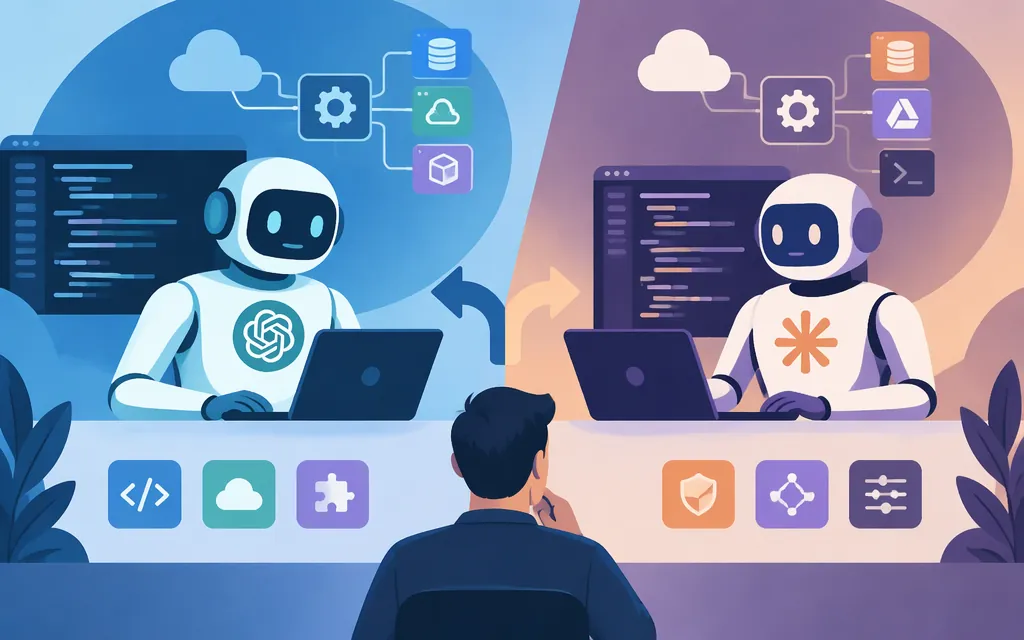
Short answer: For coding-agent use, choose based on where you want the agent to work and how you want to control its actions. Both products document local and cloud workflows. Codex describes local controls through sandbox boundaries and approvals; Claude Code provides configurable permission rules for tools and actions. Neither distinction establishes an overall winner. If you’re integrating a model into production software, compare the providers’ model APIs separately: an API call is not the same as a repository-aware coding agent.
What does “GPT Codex” mean?
Here, Codex means OpenAI’s software-development agent, including its CLI and other interfaces—not GitHub Copilot or a model API. OpenAI distinguishes Codex as a coding agent from using models in an application for code generation. (Codex CLI)
Claude Code is Anthropic’s coding agent. Anthropic also offers direct access to Claude models through its API; that is a separate route for building model-powered features. Anthropic lists its Messages API and managed-agent APIs as distinct services. (Claude Code permissions)
| If your decision is… | Compare… | Don’t assume… |
|---|---|---|
| An agent to help with a software project | Codex vs. Claude Code | That the agent’s local and cloud workflows are identical |
| A model call inside your application | OpenAI API models vs. Claude API models | That an agent subscription includes API access |
| A production coding workflow with repository access and actions | The model API plus the agent or application logic you’ll use | That a model endpoint alone inspects repositories, runs tests, or enforces approvals |
Practical workflow differences
Cloud task delegation: both have it
Codex Cloud runs a task in an isolated workspace. OpenAI says cloud tasks can continue while your computer is asleep and advises users to review changes and test results. Codex also offers local CLI and IDE workflows, so cloud execution is one option, not a description of every Codex session. (Using Codex Cloud)
Claude Code in the cloud clones a selected GitHub repository into an isolated virtual machine. Anthropic lists cloud-session access on Pro, Max, Ultra, and Team plans, and for Enterprise users with premium seats or Chat + Claude Code seats. (Claude Code cloud quickstart)
Choose by the task, not by the cloud label. Both document hosted task workflows. Compare repository setup, plan eligibility, integrations, usage limits, and how you want to review changes. For work that depends on local configuration, tools, or environment, Anthropic recommends running Claude Code locally or using Remote Control. (Claude Code in the cloud)
Local work: compare the controls you need
Both tools provide local command-line workflows, but their documented controls are framed differently:
- Codex CLI: OpenAI describes an OS-enforced sandbox that limits what local commands can access, alongside an approval policy that determines when Codex must stop and ask. The sandbox governs boundaries such as files and network access; approval governs when an action needs review. (Codex sandboxing)
- Claude Code: Anthropic documents fine-grained permission rules and modes for controlling tool actions. Its rules can distinguish actions such as file edits and shell commands, and permission settings can be shared or customized. (Claude Code permissions)
For the same requirement—controlling local file edits and command execution—both document configurable controls. Choose Codex if an OS-enforced sandbox boundary plus approval policy matches your desired control model. Choose Claude Code if its tool-specific permission rules and modes fit better. These are different mechanisms, not a like-for-like security ranking; check the settings for your chosen interface and configuration before relying on a particular boundary. (Codex sandboxing)
A quick workflow-based choice
- Choose Codex Cloud if isolated, asynchronous repository tasks and later review suit your workflow. Confirm that the task environment has the dependencies and access it needs.
- Choose Claude Code’s cloud workflow if a hosted session that clones a GitHub repository fits the task. Check plan and seat eligibility, and confirm the current review/output workflow and usage allowance for your plan before relying on them. (Claude Code cloud quickstart)
- For local work, choose by control model and configuration, not simply because one product has a CLI. Codex documents sandbox boundaries and approvals; Claude Code documents fine-grained permission rules. (Codex sandboxing)
- For a production application, compare APIs and agent infrastructure separately. Don’t treat an agent subscription, a model endpoint, and a repository automation system as interchangeable.
Production APIs are separate from coding-agent products
Both providers document direct model APIs. Those APIs let an application send model requests; the application still needs to provide any repository access, tools, execution environment, and review flow its use case requires.
OpenAI API route
OpenAI’s code-generation guide recommends starting with gpt-6-astra for most API-based code-generation tasks. The Responses API request endpoint is POST https://api.openai.com/v1/responses; a direct API-key request uses bearer authentication, such as Authorization: Bearer $OPENAI_API_KEY. Keep the key server-side rather than exposing it in client code. (OpenAI developer quickstart)
Anthropic API route
Anthropic’s direct-model route is the Messages API, at POST https://api.anthropic.com/v1/messages. One documented model ID is claude-sonnet-5-5. For API-key authentication, Anthropic documents Authorization: Bearer $ANTHROPIC_API_KEY; requests must also include an anthropic-version header. The current documentation specifies 2026-10-21 as an example version value—check the versioning page for the value applicable when you implement. (Anthropic API overview)
Anthropic documents its Claude Managed Agents APIs separately from the Messages API and identifies its Agents, Sessions, and Environments APIs as beta. If you need a managed agent rather than a direct model call, verify the current feature status and access conditions before building around it. (Anthropic API overview)
Before production, confirm the model available to your account, supported capabilities, rate limits, error handling, and data requirements in the relevant provider documentation. API access and billing are separate questions from which coding-agent workflow you prefer; verify them for the account and deployment you plan to use. (OpenAI API reference overview)
Bottom line
For coding agents, both Codex and Claude Code document cloud task workflows and local interfaces. For local control, Codex documents sandbox boundaries plus approvals, while Claude Code documents fine-grained tool permissions; pick the control model that fits your requirement, without treating either as a universal security winner. For production integrations, compare the direct model APIs separately: OpenAI’s Responses API and Anthropic’s Messages API have documented endpoints and authentication requirements, but neither endpoint by itself supplies a complete repository-aware coding agent.