Short answer
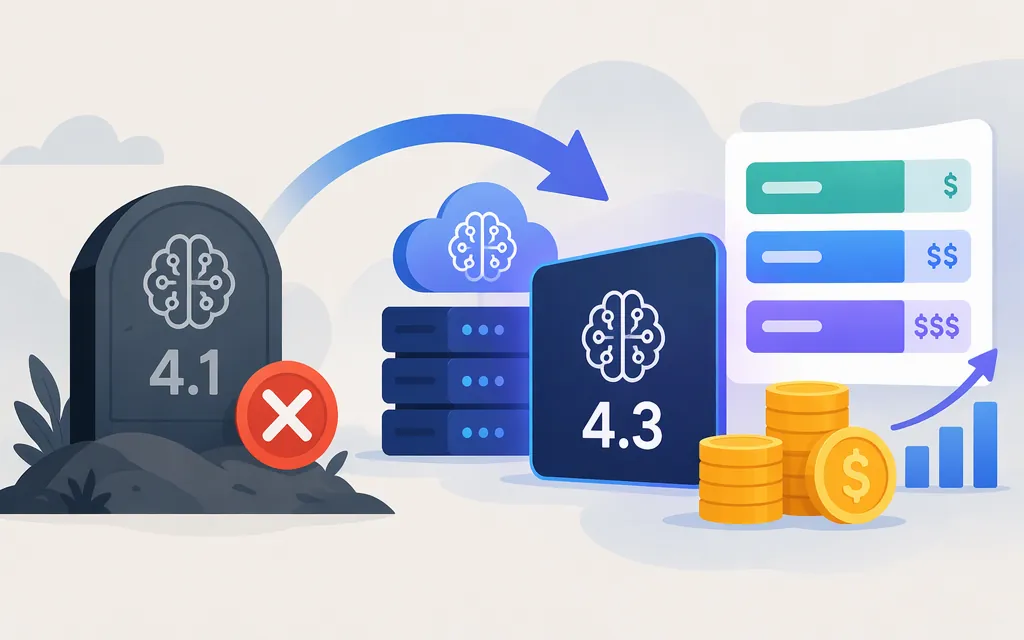
The API models described as Grok 4.1 Fast—grok-4-1-fast-reasoning and grok-4-1-fast-non-reasoning—were retired on May 15, 2026. Requests to those IDs now redirect to grok-4.3: the reasoning ID maps to low reasoning effort, and the non-reasoning ID maps to none. For a new integration, choose grok-4.3 explicitly and set the reasoning effort you want rather than relying on the redirect. (retirement notice)
Which Grok 4.1 model IDs existed?
The November 19, 2025 announcement named two Grok 4.1 Fast variants:
grok-4-1-fast-reasoning— described as the option for “maximal intelligence.”grok-4-1-fast-non-reasoning— described as the option for “instant responses.”
Those were the announcement’s descriptions, not measured latency or quality comparisons. The later retirement notice says both IDs continue to resolve through redirects to Grok 4.3, with low effort for the reasoning ID and none for the non-reasoning ID. (original announcement; retirement and redirect details)
Make a new API request with Grok 4.3
Create an account, add API credits, and create an API key from the API Keys page; store it as XAI_API_KEY. The current quickstart demonstrates the Responses API endpoint and request format. The Grok 4.3 model page lists grok-4.3 as the model ID and supports reasoning effort values including low and none. This example combines that documented request pattern with the Grok 4.3 model and an explicit reasoning setting:
export XAI_API_KEY="your_api_key"

curl https://api.x.ai/v1/responses \
  -H "Authorization: Bearer $XAI_API_KEY" \
  -H "Content-Type: application/json" \
  -d '{
    "model": "grok-4.3",
    "input": "Explain how an API retry strategy works.",
    "reasoning": { "effort": "low" }
  }'
The general quickstart’s code sample uses grok-4.7; the model-specific Grok 4.3 page documents grok-4.3 and its supported reasoning settings. (API quickstart; Grok 4.3 model documentation; reasoning settings)
For an existing integration: set the model to grok-4.3 and specify the reasoning effort explicitly. Use "low" to match the old reasoning ID’s redirect behavior or "none" to match the old non-reasoning ID’s behavior. In the Responses API request body, the setting is "reasoning": { "effort": "low" } or "reasoning": { "effort": "none" }. (retirement notice; Grok 4.3 model documentation; reasoning settings)
Current Grok 4.3 pricing and a quick estimate
The model page lists these global text-token rates for Grok 4.3:
| Token type | Price per 1 million tokens |
|---|---|
| Input | $1.25 |
| Cached input | $0.20 |
| Output | $2.50 |
For a request with 100,000 input tokens and 10,000 output tokens, the ordinary-rate estimate is $0.15: (100,000 × $1.25 ÷ 1,000,000) + (10,000 × $2.50 ÷ 1,000,000). This example assumes the prompt is below the long-context threshold and excludes cached-input pricing and separately priced tools.
Grok 4.3’s long-context rates apply when a request’s prompt reaches 200,000 tokens. At that point, the long-context rates apply to all tokens in the request, not just tokens above the threshold: $2.50 per 1 million input tokens, $0.40 per 1 million cached input tokens, and $5.00 per 1 million output tokens. Requests sent to the US regional endpoint are billed at 1.1× global token rates, a 10% premium. (Grok 4.3 model pricing; pricing thresholds and regional rates)
The 2025 Grok 4.1 Fast announcement listed historical rates of $0.20 per million input tokens, $0.05 per million cached input tokens, $0.50 per million output tokens, and tool calls from $5 per 1,000 successful invocations. The retirement notice explicitly says requests sent to a deprecated model ID after May 15, 2026 are billed at Grok 4.3 pricing—$1.25 per 1 million input tokens and $2.50 per 1 million output tokens—not at the original model’s rates. (original announcement; retirement notice and pricing impact)
What about Grok 4.1 Fast’s Agent Tools?
The original announcement’s Python example showed web_search(), x_search(), code_execution(), collections_search(...), and mcp(...). It described tools for web and X search, file search, code execution, and external MCP servers. The collection ID and MCP server URL in its example were placeholders. Since that announcement described the retired Grok 4.1 Fast integration, check current tool documentation for supported models, setup, schemas, and pricing before building around a specific tool. (original announcement; current API documentation)
Production checklist
Before shipping or estimating a workload, confirm the current documentation for:
- The model ID and reasoning effort you intend to use.
- Request and response handling for your chosen SDK or API endpoint.
- Current token pricing, including long-context and regional pricing where applicable.
- Any server-side tool charges, inputs, permissions, and limits.
- Your account’s rate limits and operational requirements.
Bottom line: Grok 4.1 Fast is retired. Its old IDs redirect to Grok 4.3, but new and updated integrations should select grok-4.3 explicitly, set reasoning effort deliberately, and budget using the applicable Grok 4.3 pricing tier.