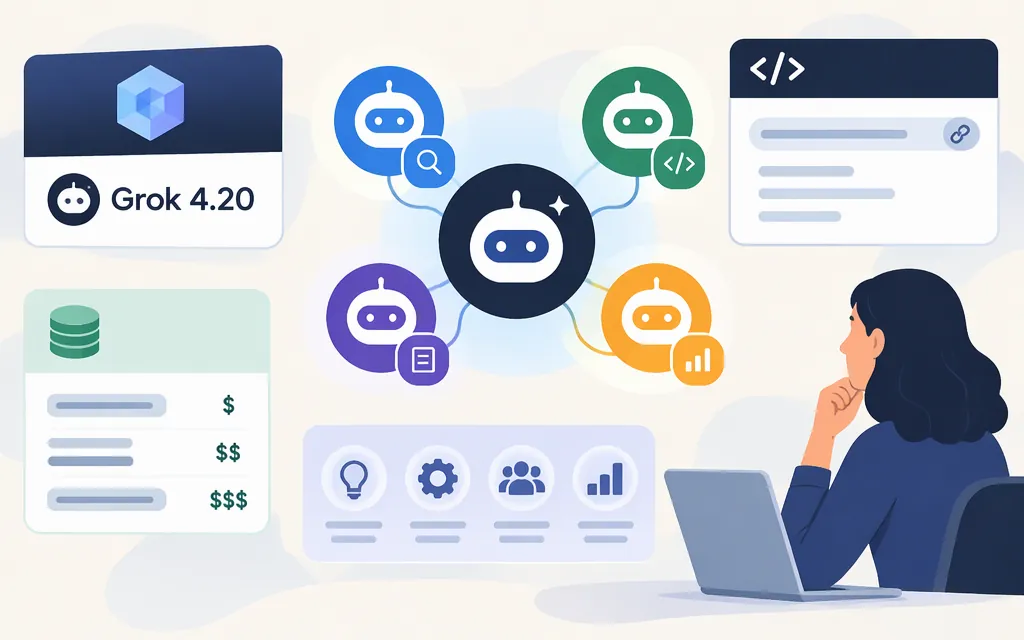
Short answer: “Grok 4.20 multi agent” refers to a model xAI lists as grok-4.20-multi-agent, with the dated model ID grok-4.20-multi-agent-0309. xAI documents using it with the Responses API at /v1/responses, and its example includes web-search tools. The multi-agent feature is marked beta, so its API interface and behavior may change. (xAI multi-agent guide)
What the multi-agent model is for
xAI describes Realtime Multi-agent Research as coordinating agents that can search multiple sources simultaneously, analyze and cross-reference findings, and synthesize answers with citations. Its documented use is deep, multi-step research—not a general guarantee that every answer will be better than one from a regular Grok model. The feature page warns that it is in beta and may change. (xAI multi-agent guide)
The model page lists grok-4.20-multi-agent-0309 as the model name and grok-4.20-multi-agent as an alias. For repeatable deployments, the dated ID identifies a specific listed model version; confirm the identifier and access available to your team before release. (xAI model page)
Production API: use the Responses API
The official multi-agent guide demonstrates this model through xAI’s Responses API. It does not establish /v1/chat/completions as the supported path for multi-agent research. A Zed community post reported a “multi agent requests are not allowed on chat completions” error, but the post is a user report, not official compatibility guidance. (xAI multi-agent guide; Zed discussion)
Here is a Python example following the request pattern in xAI’s guide:
import os
from openai import OpenAI

client = OpenAI(
    api_key=os.environ["XAI_API_KEY"],
    base_url="https://api.x.ai/v1",
)

response = client.responses.create(
    model="grok-4.20-multi-agent",
    input=[
        {
            "role": "user",
            "content": "Research recent public evidence on battery recycling and summarize the findings.",
        }
    ],
    tools=[
        {"type": "web_search"},
        {"type": "x_search"},
    ],
)

print(response)
Set XAI_API_KEY to an API key from your xAI account before running the request. This is a documentation-based example, not a test run. The xAI example includes both web_search and x_search; the guide does not establish here whether either can be omitted. (xAI multi-agent guide)
Pricing and operational trade-offs
The model page lists standard token rates of $1.25 per 1 million input tokens, $0.20 per 1 million cached input tokens, and $2.50 per 1 million output tokens. For prompts at or above the 200,000-token long-context pricing threshold, the pricing page lists $2.50 input, $0.40 cached input, and $5.00 output per 1 million tokens. Prices are in USD. The available evidence here does not establish the model’s context-window capacity. (xAI model page; xAI pricing)
Requests using xAI-hosted tools can add tool-invocation charges as well as token charges; xAI says tool costs vary with the number of calls. Compare current rates for the exact model IDs and applicable long-context conditions before estimating relative cost; the available evidence here does not establish that the multi-agent and reasoning models have matching rates. (xAI pricing)
The model pages list the multi-agent model at 9 requests per second and 2.5 million tokens per minute. The listed Grok 4.20 reasoning model—grok-4.20-0309-reasoning—is shown at 37 requests per second and 10 million tokens per minute. These are listed model limits, not a guarantee of the limits assigned to every account: xAI says limits scale with team tier, and teams can check their current per-model limits in the xAI Console. (multi-agent model page; reasoning model page; xAI rate limits)
| Choose | When it fits | What to weigh |
|---|---|---|
| Grok 4.20 Multi-Agent | The task benefits from parallel research, cross-referencing findings, and synthesizing an answer. | Beta interface; tool charges may add to token costs; the model page lists lower request and token limits than the reasoning model. |
| Grok 4.20 Reasoning | You need a reasoning model and do not need the documented multi-agent research workflow. | Compare current prices for the exact model ID and applicable context conditions; the available evidence here does not establish price parity. Its model page lists higher request and token limits. That does not establish it will be faster or more accurate for your particular task. |
This is a comparison of documented function, listed prices, and listed limits—not a benchmark. The available documentation does not establish a general quality, latency, or accuracy advantage for either option. (xAI multi-agent guide; xAI pricing)
Selection checklist
Choose the multi-agent model when parallel research and synthesis fit the task, your integration can use the documented Responses API, and beta changes and tool costs are acceptable. Consider the reasoning model when the workflow does not need multi-agent research or its listed limits better fit your traffic. Before deployment, confirm your team’s model access, account-specific rate limits, current prices for the exact model IDs, tool costs, and the consequences of beta interface changes. (xAI multi-agent guide; xAI rate limits)
Sources
Multi Agent | xAI API Documentation
Grok 4.20 Multi Agent Beta 0309 | xAI API Documentation
Grok 4.20 | xAI API Documentation
API Pricing | xAI API Documentation