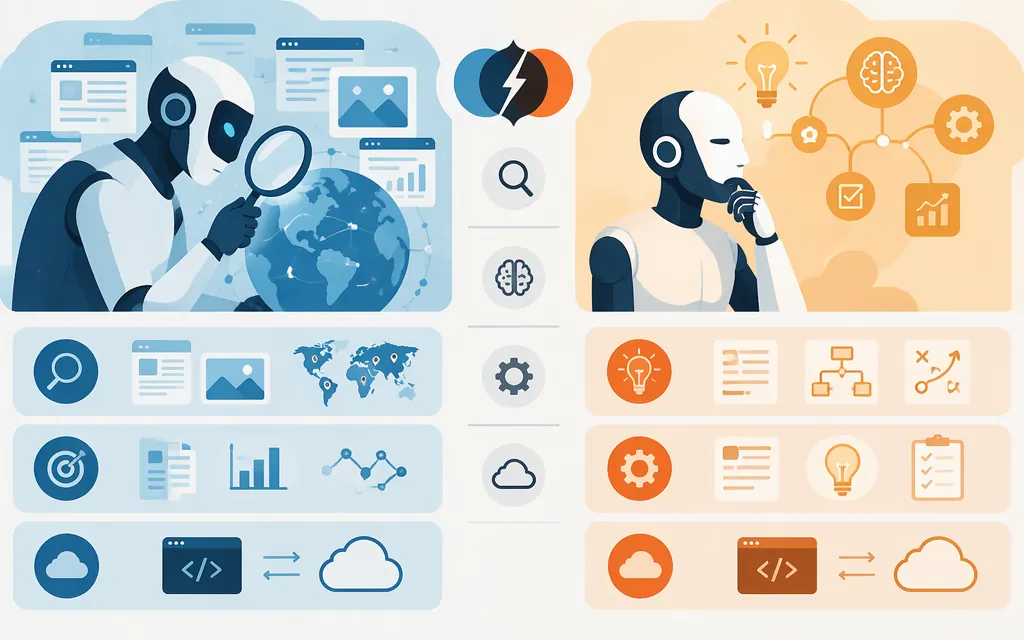
Short answer: For the Grok 3-era comparison, Think is the clearer documented reasoning capability: xAI announced Grok 3 (Think) as a beta reasoning model that could backtrack, refine problem-solving strategies, and consider multiple approaches. DeepSearch is described by third-party sources as research-oriented and web-browsing, but the xAI announcement cited here does not define DeepSearch or establish exactly how it related to Think in the Grok app. So, treat “DeepSearch = search” as a useful, attributed description—not a verified head-to-head product distinction or proof that Think cannot search. (xAI’s Grok 3 announcement; SourceForge listing; CometAPI article)
For developers, the current API documents a concrete combination for reasoning with web access: grok-4.7 on the Responses API with the web_search tool enabled. That is a documented API model-and-tool setup, not evidence that the API exposes the Grok 3 app labels “DeepSearch” or “Think” as selectable model IDs, or that it reproduces either app experience. (xAI Web Search documentation; Grok 4.7 guide)
At a glance
| Question | Grok 3 DeepSearch | Grok 3 (Think) |
|---|---|---|
| What the available sources establish | A third-party listing calls it “Grok 3 DeepSearch” and describes a focus on deep search and iterative reasoning; another third-party article says it browses the web. The cited xAI announcement does not define DeepSearch. | xAI announced Grok 3 (Think) as a beta reasoning model and describes backtracking, refining approaches, and considering multiple approaches. |
| Practical interpretation | Investigate this label when a task needs external research, but regard that description as third-party reporting rather than a confirmed xAI specification. | A documented Grok 3-era option for reasoning-focused tasks, based on xAI’s announcement. |
| Same-app comparison confirmed? | Not by the sources cited here. They do not establish the exact app interface or how the labels were paired. | Not by the sources cited here. xAI’s announcement establishes the reasoning model, not its precise app relationship to DeepSearch. |
| Current API takeaway | Current API docs show web search as a tool; they do not establish “DeepSearch” as a current API model ID. | Current API docs show reasoning-capable models; they do not establish “Grok 3 Think” as a current API model ID. |
This is a comparison of what the sources document about the labels—not a controlled test. The available sources do not show that either option is more accurate, faster, or generally better.
What Grok 3 (Think) means
On February 19, 2025, xAI announced Grok 3 (Think) and Grok 3 mini (Think) as beta reasoning models. xAI said Grok 3 (Think) learned to refine its problem-solving strategies, correct errors through backtracking, simplify steps, and consider multiple approaches. These statements describe the announced Grok 3 version; they do not establish the behavior of every later Grok model or product. (xAI’s Grok 3 announcement)
For a self-contained problem where the main challenge is working through multiple steps—such as analyzing assumptions or debugging logic—Think’s announced reasoning focus is relevant. That is a task-based interpretation of xAI’s description, not evidence of superior performance against DeepSearch.
What Grok 3 DeepSearch means
The available primary xAI announcement cited here does not define DeepSearch. Instead, a SourceForge listing describes Grok 3 DeepSearch as focused on “deep search and iterative reasoning,” and a CometAPI article describes it as browsing the web to compile responses. Those are third-party descriptions, and neither source provides a direct comparison with Grok 3 (Think). (SourceForge listing; CometAPI article)
The distinction matters: the evidence supports describing DeepSearch as third-party-reported research and web-search oriented. It does not establish its exact product classification, prove that it was paired with Think in the same app experience, or show what sources or citations it returned. Nor does it establish that Think could not use external information.
Which should you choose?
- If your task depends on current external information: Look for a workflow with web search enabled, and check the source material it returns. The DeepSearch label is associated with research in the cited third-party descriptions, but those descriptions are not enough to verify the exact Grok app behavior. (SourceForge; CometAPI)
- If the task is self-contained and reasoning-heavy: Grok 3 (Think) is the better-documented label to investigate; xAI described it as a reasoning model that could refine approaches and backtrack. This is not proof that it outperforms DeepSearch. (xAI)
- If you need both research and analysis: Do not assume the app labels are mutually exclusive or that either label alone guarantees the needed behavior. For API use, xAI documents a model-plus-web-search configuration; see the concrete example below. That configuration is not documented as an exact reproduction of DeepSearch.
Example: a recently changed rule
For a question such as “What changed in this rule, and how does it affect our process?”, a search-enabled API request can retrieve external information for a model to analyze. Verify the original source and its date before relying on the answer. This is a suggested workflow based on documented API functionality, not a reported test of DeepSearch against Think.
Can you use DeepSearch or Think through a production API?
The current xAI API documentation provides a specific model-and-tool combination: grok-4.7 with the web_search tool on the Responses API. xAI describes grok-4.7 as a reasoning-capable model, and its Web Search documentation provides this request pattern: (Grok 4.7 guide; Web Search documentation)
curl https://api.x.ai/v1/responses \
  -H "Content-Type: application/json" \
  -H "Authorization: Bearer $XAI_API_KEY" \
  -d '{
    "model": "grok-4.7",
    "input": "Find current source material about the rule change and summarize the implications.",
    "tools": [{ "type": "web_search" }]
  }'
This documents a production API path, a model identifier, and the search-enabling tool declaration. The model catalog says realtime information requires server-side search tools to be enabled. This setup combines a reasoning-capable model with web search; it is not documentation that “DeepSearch” or “Grok 3 Think” is a current API model ID, or that this configuration duplicates the Grok app’s DeepSearch behavior. (xAI model catalog; Web Search documentation)
Before deployment, confirm the model and tool availability for your account and review the applicable API limits and charges. The documentation also notes that not every model accepts Batch API requests, so check the selected model’s page if you plan to use Batch. (xAI model catalog)
Access and pricing: a listing is not API pricing
The SourceForge listing displays $30/month for Grok 3 DeepSearch and marks a free version and free trial as supported. It does not specify enough billing or subscription detail to confirm current terms, whether the listing amount applies to current access, or whether it includes API usage. It provides no corresponding Grok 3 (Think) price. Treat the amount as a third-party listing, not a verified current xAI price or API rate. (SourceForge listing)
API charges are separate from an app or subscription listing. xAI’s model catalog publishes pricing for API models; compare costs only after identifying the exact model and tools your workflow will use. Do not transfer the SourceForge DeepSearch listing price to Think or to API use. (xAI model catalog)
Bottom line
For the Grok 3-era labels, Think has a primary-source description as a reasoning model; DeepSearch is characterized as web-research oriented by third-party sources. The cited material does not establish a definitive same-app comparison, show whether Think can also search, or support a performance winner. For developers, xAI documents grok-4.7 with web_search on the Responses API as a reasoning-plus-search configuration—but not as an API version of either Grok 3 label.
Sources
Grok 3 Beta — The Age of Reasoning Agents
Grok 3 DeepSearch vs. Kimi K2 Thinking Comparison