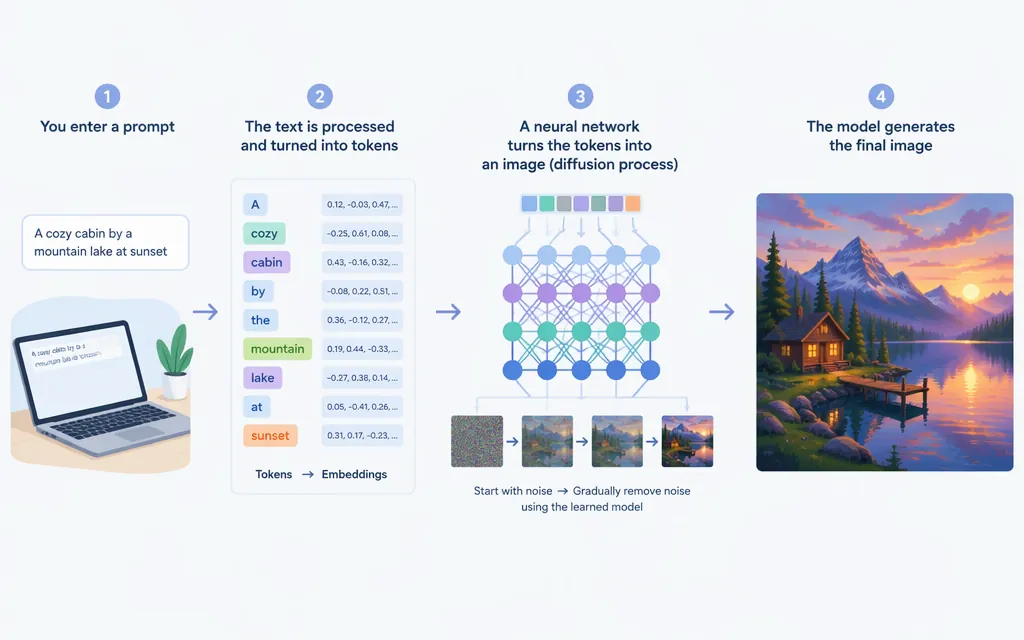
An AI image generator uses patterns learned during training to create an image from an input such as a text prompt. In a diffusion model, a common approach is to start with noise and repeatedly refine it toward an image guided by the prompt. But not every image generator works this way: a GAN, for example, is trained through competition between a generator and a discriminator. The details depend on the model. (arxiv.org)
From prompt to image
A useful high-level picture is:
- You provide an input. This might be a text description, an image, or both, depending on the model.
- The model uses that input as guidance. During training, the model has learned patterns in data. At generation time, prompt information helps steer the output toward the requested subject or qualities. Exactly how the prompt is represented and applied varies between systems.
- The model generates an image. In a diffusion system, generation involves repeated denoising steps. The resulting image may be decoded from an internal representation, depending on the model’s design.
- The output is returned. An API may return image data or another documented output format; check the specific API rather than assuming all services return images the same way.
This is a conceptual map, not a universal list of internal steps. Diffusion research describes generation as a sequence of denoising operations. Latent diffusion moves that work into a compressed representation and uses cross-attention to support conditioning inputs such as text. (arxiv.org)
A simple prompt example
A prompt such as “A red bicycle leaning against a brick wall on a rainy evening, warm window light” gives the model several details to use as guidance: subject, setting, weather, and lighting. This illustrates how a prompt can specify an intended image; it does not guarantee that every detail will appear correctly.
Diffusion and GANs use different mechanisms
Diffusion models generate an image by iteratively refining a noisy state. In latent diffusion, that process occurs in a compressed image representation, which is decoded into an image afterward. These are descriptions of particular model approaches—not steps to attribute automatically to every image generator. (arxiv.org)
Generative adversarial networks (GANs) use a different training setup: a generator tries to produce samples resembling training data, while a discriminator tries to tell generated samples from real ones. The original GAN paper describes the two models being trained together in an adversarial process. That training distinction is not a claim about which architecture is best for a particular current API or task. (arxiv.org)
The practical point is simple: an architecture label can help explain how a model was designed, but it does not by itself establish what an API can do or whether it suits your application.
What to verify when evaluating an image-generation API
Start with the image task your application needs, then compare candidates against their official, model-specific documentation:
- Task and inputs: Does the model support your intended task, such as generating from text or editing with an image input?
- Controls: Are the options you need—such as image dimensions, quality settings, or editing controls—documented for that model?
- Outputs: What format does the API return, and does it meet your application’s requirements?
- Request and response behavior: Check the documented request fields, response structure, and any handling your application must implement.
- Operational constraints: Verify the applicable limits, availability, and any region or channel restrictions that matter for your use case.
For example, OpenAI’s API documentation describes image generation with text prompts and optional image inputs, and documents its own supported models and response behavior. That is an example of the kind of product-specific detail to check—not a general specification for other providers or a recommendation to choose one API. (developers.openai.com)
If you are comparing products commercially, verify the applicable currency, billing unit, commitment, relevant plan differences, and whether API use is billed separately from a consumer subscription. The sources cited here do not establish pricing across providers.
Bottom line: an image generator uses learned patterns and user-provided guidance to produce visual output; diffusion is one important way to do that, not the only one. For production selection, compare documented capabilities and constraints of the specific model and API—not architecture names or broad performance claims alone.
Sources
Denoising Diffusion Probabilistic Models
High-Resolution Image Synthesis with Latent Diffusion Models