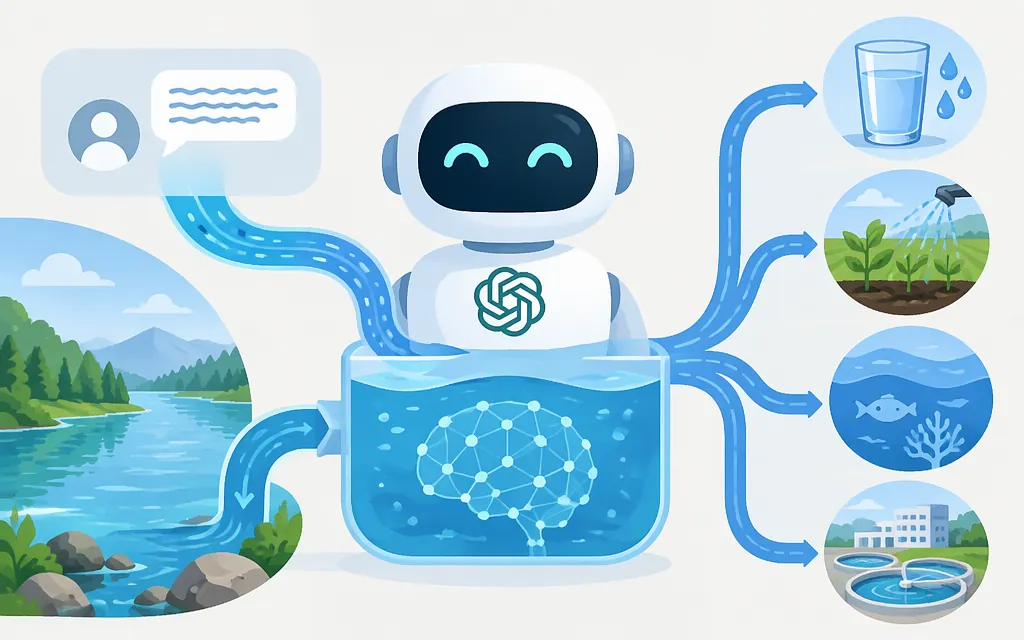
ChatGPT doesn’t physically handle or treat water. It generates text in response to prompts. When people talk about ChatGPT’s “water use,” they mean water associated with the data centers and electricity that power the service—not water passing through the software itself. One estimate says an average ChatGPT query uses about 0.000085 U.S. gallons, or roughly one-fifteenth of a teaspoon. That figure is an estimate, not a universal measurement: its source doesn’t define the query, model, location, or calculation method. (blog.samaltman.com)
So “ChatGPT with water” can mean two different things: water associated with running the service or ChatGPT answering questions about water. Those are separate topics.
Where does water use associated with ChatGPT come from?
AI models run on computers in data centers. Those machines use electricity and produce heat. Depending on the facility, water may be used in cooling systems; water can also be associated with generating the electricity that data centers consume. Researchers studying AI’s water footprint describe both cooling and electricity generation as relevant pathways, and emphasize that estimates can vary across locations and operating conditions. (arxiv.org)
The exact setup is not the same everywhere. For example, OpenAI says one data-center project will use closed-loop, air-cooled cooling that recirculates water rather than relying on cooling towers that continuously consume water for cooling. That is a description of that project—not proof that every facility supporting ChatGPT uses the same system. (openai.com)
That difference matters: a water-footprint estimate needs a clear boundary. It should say whether it counts water used at the data center, water associated with electricity generation, or both. The Sam Altman estimate below doesn’t specify those details, so it shouldn’t be read as a complete or independently audited accounting of ChatGPT’s water use.
How much water does one ChatGPT query use?
Sam Altman’s blog gives an estimate of 0.000085 gallons per average ChatGPT query, described as about one-fifteenth of a teaspoon. It also gives an electricity estimate, but neither figure comes with a detailed method in the post. It does not specify a model, prompt length, data-center location, or accounting boundary for the water figure. Treat it as an attributed estimate—not a precise amount for every prompt or a current, independently verified measurement. (blog.samaltman.com)
You may also see a different comparison: a Washington Post calculation, cited in a TechTimes report, said a 100-word email composed with GPT-4 would require more than one water bottle’s worth of water. That is a different task and model description; the TechTimes report does not give the bottle volume or calculation method. The two figures therefore shouldn’t be treated as directly comparable or combined into a single per-query number. (techrepublic.com)
Practical takeaway: the available figures show that water-footprint estimates depend on what task and infrastructure are counted, but they do not establish one reliable, universal water amount for a ChatGPT query.
Can ChatGPT answer questions about water?
Yes: it can generate written explanations about water topics. That is different from physically testing, treating, sensing, or controlling water—and generated text is not automatically reliable technical guidance.
For example, Water Nuggets published a ChatGPT response explaining conventional drinking-water treatment. It described coagulation and flocculation, sedimentation, filtration, and disinfection. The article’s authors noted that the response omitted pretreatment. This is an example of one generated explanation, not a verified treatment procedure or proof that ChatGPT’s answer is complete. (waternuggets.com)
For decisions about drinking-water safety, treatment operations, or other consequential work, have qualified people check the answer against appropriate technical sources. If you are considering an API for a water-related task, first define what it must do, what inputs it will receive, and whether it depends on external measurements, sensors, or controls. The information available here does not support recommending a particular API model for an unspecified use case.
Bottom line
ChatGPT can write about water, but it does not itself treat or handle water. Water associated with providing the service comes from the infrastructure behind it, and published per-query figures are estimates whose methods and boundaries may differ. Use them with attribution and caveats—not as a fixed water cost for every prompt.
Sources
The Gentle Singularity — Sam Altman
Making AI Less “Thirsty”: Uncovering and Addressing the Secret Water Footprint of AI Models
Making AI Less ‘Thirsty’ — Communications of the ACM
OpenAI joins PORTS-Pike project
How Much Water and Energy Does ChatGPT Use? Sam Altman Breaks Down the Numbers
We asked ChatGPT to explain the conventional water treatment process