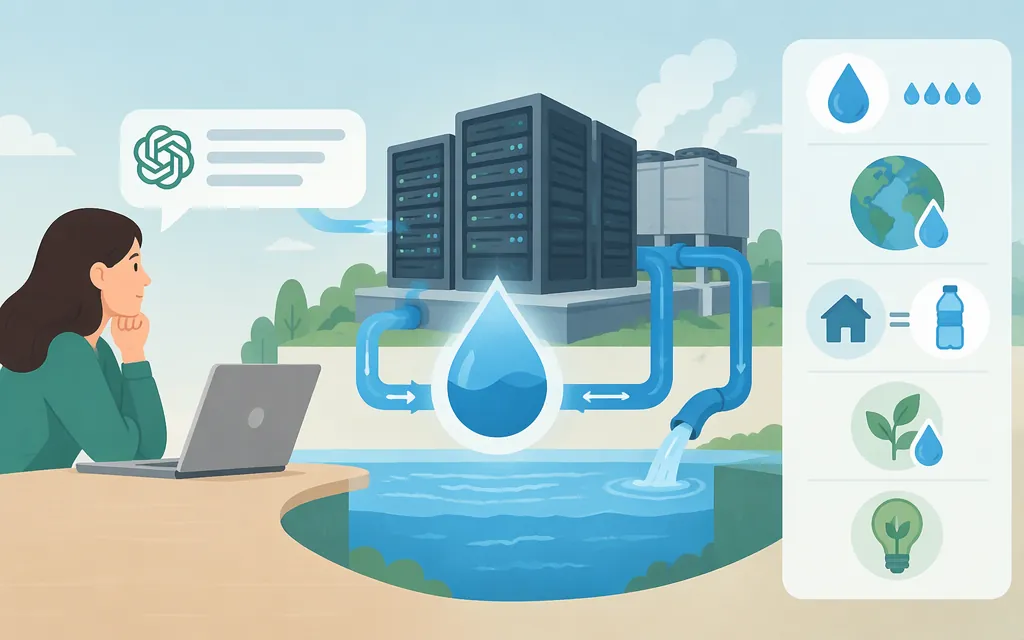
There is no single verified water-use figure for every ChatGPT query. Sam Altman wrote in 2025 that an average ChatGPT query uses about 0.000085 US gallons—roughly 0.32 milliliters. A separate estimate, reported by The Washington Post for a GPT-4 task, put the water footprint of generating a 100-word email at about 500 milliliters. These figures describe different estimates and conditions; neither should be treated as a meter reading for your prompt or API call. (blog.samaltman.com)
Reported estimates—and what they describe
| Estimate | What it refers to | How to interpret it |
|---|---|---|
| About 0.32 mL per query | Sam Altman’s stated average for a ChatGPT query, posted in June 2025. | An attributed average; the post does not specify a query definition or provide a calculation method. It is not an API-specific figure. (blog.samaltman.com) |
| About 500 mL per email | A reported estimate for GPT-4 generating a 100-word email. | A task-specific estimate, not a claim that every prompt uses a bottle of water. The Washington Post’s coverage says the amount can vary with data-center location and cooling conditions. (savethe.ai) |
| About 2 L for 10–50 queries | A figure reported by Save the AI. | The page does not define “query” or give enough calculation details to convert this reliably into a universal per-query amount. (savethe.ai) |
| 0.58–12.76 mL per query | A separate page’s scenario calculations, using an assumed 2.9 Wh per query and water-intensity inputs of 0.2–4.4 L/kWh. Its middle scenario is 5.22 mL. | These are results of the page’s stated assumptions, not measured values for a particular ChatGPT or API workload. (cometapi.com) |
Don’t merge these into one range. They use different tasks, assumptions, and possibly different accounting boundaries. The available sources do not establish that they measure the same thing, so they cannot tell you a definitive amount for an arbitrary prompt.
Why the estimates differ
“Water use” can refer to different things. Withdrawal is water taken from a source; some of it may later be returned. Consumption is water that is evaporated or otherwise not returned to the immediate water environment. A data center may use water directly for cooling, while electricity generation can also have an associated water footprint. Which components an estimate counts matters. (arxiv.org)
The reported numbers also concern different activities. The per-query statements refer to routine use, or inference. Model training is a separate activity: a 2023 study by Li and colleagues estimated that training GPT-3 in U.S. data centers could directly evaporate about 700,000 liters of freshwater. That is a study estimate for a specific training scenario—not water used by one query, and not a measurement of training a current ChatGPT model. (arxiv.org)
Location and infrastructure matter too. The Washington Post article notes that water and electricity needs can vary with data-center location and cooling choices. As a result, a figure from one task or facility should not automatically be applied to a different model, place, or workload. (rsn.org)
Can you calculate water use for a production API workload?
Not from these general ChatGPT estimates alone. The sources here do not provide a verified, API-specific water measurement or establish that consumer ChatGPT figures transfer to a production API workload. Multiplying your API call count by a general per-query estimate may look precise, but it would not establish the actual footprint of your service.
To make a defensible estimate:
- Define the workload. Record the provider, model and version, reporting period, and how you count requests. Note relevant differences in prompt and response size or request type.
- Define what “water” means for your report. Decide whether you need on-site consumption, withdrawal, water associated with electricity, training allocation, or a clearly described combination.
- Ask for applicable provider data. Look for workload-relevant energy and water figures, the facilities or regions they cover, and the accounting method. A number for ChatGPT generally is not automatically a number for an API workload.
- Calculate only when the inputs match your chosen boundary. For example, one reported scenario calculates 0.0029 kWh × 1.8 L/kWh = 0.00522 L, or 5.22 mL per query. At 1,000 queries, that arithmetic gives 5.22 L—but only under those assumed inputs. It is an illustration, not a measurement or defensible API total. (
cometapi.com) - If the provider-specific inputs are missing, report the gap. State which data and assumptions you lack rather than presenting an unsupported API-specific total.
Bottom line
A published estimate says about 0.32 mL per average ChatGPT query; another widely reported estimate puts a 100-word GPT-4 email at about 500 mL. Because their methods and boundaries are not shown to be comparable, neither settles how much water a particular ChatGPT prompt—or a production model API workload—uses. For an API estimate, you need applicable provider and workload data, plus a clear definition of what water use includes. (blog.samaltman.com)
Sources
The Gentle Singularity — Sam Altman
Sam Altman: ChatGPT queries consume 0.34 watt-hours of electricity and 0.000085 gallons of water
A bottle of water per email: the hidden environmental costs of using AI chatbots
Making AI Less “Thirsty”: Uncovering and Addressing the Secret Water Footprint of AI Models