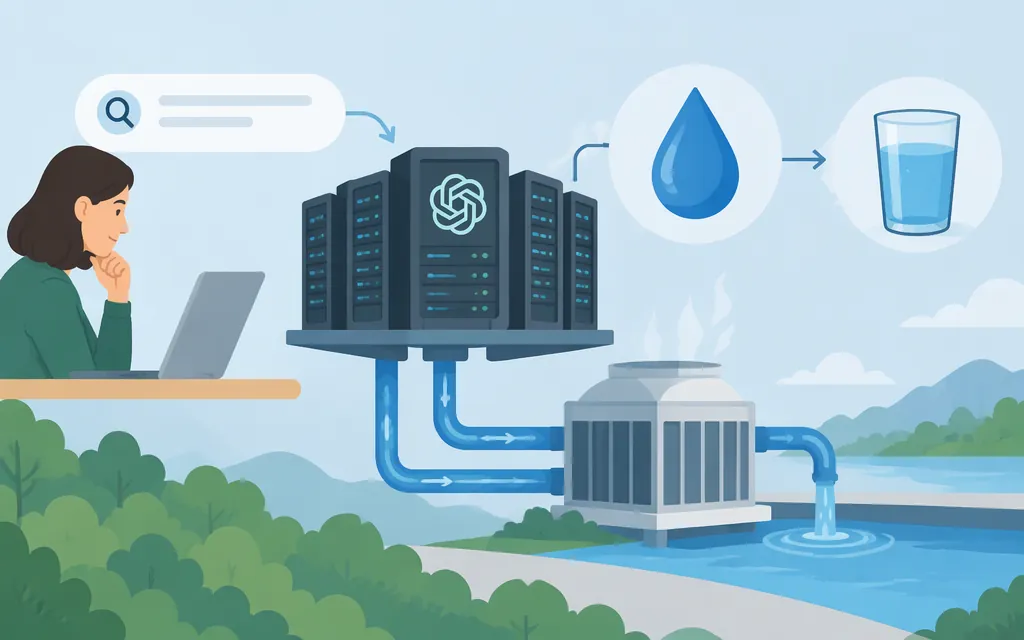
The sources reviewed here do not establish a reliable water amount for one ChatGPT Search specifically. Sam Altman has given an estimate of about 0.32 milliliters (mL) per average ChatGPT query. That is a query-level estimate, not a measurement identified as specific to Search. The source excerpt available for this article does not explain how the figure was calculated or define its water-accounting boundary. (Sam Altman, “The Gentle Singularity”)
Other sources give different estimates for a ChatGPT query or prompt. They do not establish how much water a search-enabled request uses, or which figure applies to it.
What the published numbers actually say
| Figure | What it refers to | How to interpret it |
|---|---|---|
| About 0.32 mL (0.000085 US gallons) | An average ChatGPT query, according to Sam Altman | An attributed query-level estimate, not a Search-specific measurement. The source excerpt available here does not explain its calculation or water-accounting boundary. (Sam Altman) |
| About 2 mL | A ChatGPT query, according to Benjamin Todd’s November 2025 commentary | Todd’s article does not show a calculation or specify whether the estimate covers Search, ordinary chat, or a particular water-use metric. Treat it as an attributed secondary estimate, not a verified figure. (Benjamin Todd) |
| About 0.58–12.76 mL | Illustrative query-level scenarios in a CometAPI article | Calculated using an assumed 2.9 watt-hours per query and water-use-effectiveness (WUE) assumptions of 0.2–4.4 liters per kilowatt-hour. Its middle scenario is 5.22 mL. These are assumption-based calculations, not measured ChatGPT Search results. (CometAPI) |
The figures should not be averaged into a “best” number. The sources reviewed do not provide enough comparable methodological detail to determine why they differ or which one best represents a particular request. Keep the 0.32 mL estimate attributed to Altman, and distinguish it from the scenario calculations.
Why “water used” can mean different things
A water-footprint estimate depends on what it counts. It may refer to water consumed on-site, such as water evaporated for cooling; water withdrawn and later returned; or water used indirectly to generate electricity. A broader lifecycle calculation may include more categories than a cooling-only estimate. Research on AI’s water footprint discusses both consumption and withdrawal and notes that runtime water efficiency can vary by time and location. (Li et al., “Making AI Less ‘Thirsty’”)
Estimates can also vary with assumed electricity use per request, data-center cooling and location, and whether training water is allocated across later requests. For example, CometAPI’s central scenario multiplies 2.9 Wh per query by an assumed 1.8 L/kWh WUE: 0.0029 kWh × 1.8 L/kWh = 5.22 mL per query. That is arithmetic based on stated assumptions—not a measurement of a ChatGPT search. (CometAPI)
For scale, applying Altman’s 0.32 mL estimate to 10 requests gives 3.2 mL. That is arithmetic based on an average-query estimate, not a measurement of 10 searches. (Sam Altman)
Can you use these estimates to choose a production model or API?
Not to determine which API or model uses less water. OpenAI’s API documentation describes a web-search tool that can be enabled in the Responses API, with a search integration also available in some Chat Completions cases. That establishes product capability, not the water footprint of an individual search-enabled request. The estimates above do not provide comparable, per-request water data for API models or search configurations. (OpenAI API documentation)
A meaningful comparison would need evidence for equivalent requests that identifies the model and search workflow and specifies whether the water figure counts on-site consumption, withdrawal, indirect electricity-related water, or training. Without matched, comparable data, these estimates cannot establish a lower-water API choice.
Bottom line: The sources reviewed here do not establish a water-use figure specific to one ChatGPT Search. Altman’s estimate of about 0.32 mL per average ChatGPT query is one point of reference, not a Search-specific measurement; other query-level estimates use different assumptions.
Sources
The Gentle Singularity — Sam Altman
The environment is a terrible reason to avoid ChatGPT
How many gallons of water does ChatGPT use?
Making AI Less “Thirsty”: Uncovering and Addressing the Secret Water Footprint of AI Models