Short answer: OpenAI described Sora as a diffusion model: it starts with video-like noise and progressively removes noise to create a video guided by an input prompt. In its 2024 technical report, OpenAI also explained that the original Sora represented visual data as compressed latent codes, divided into patches across space and time, for a transformer to process. Those are high-level descriptions—not a complete implementation specification. As of November 12, 2026, Sora is no longer available as a product, and its API has been discontinued, so it is not an option for a new production integration. (openai.com)
How Sora turns a prompt into video
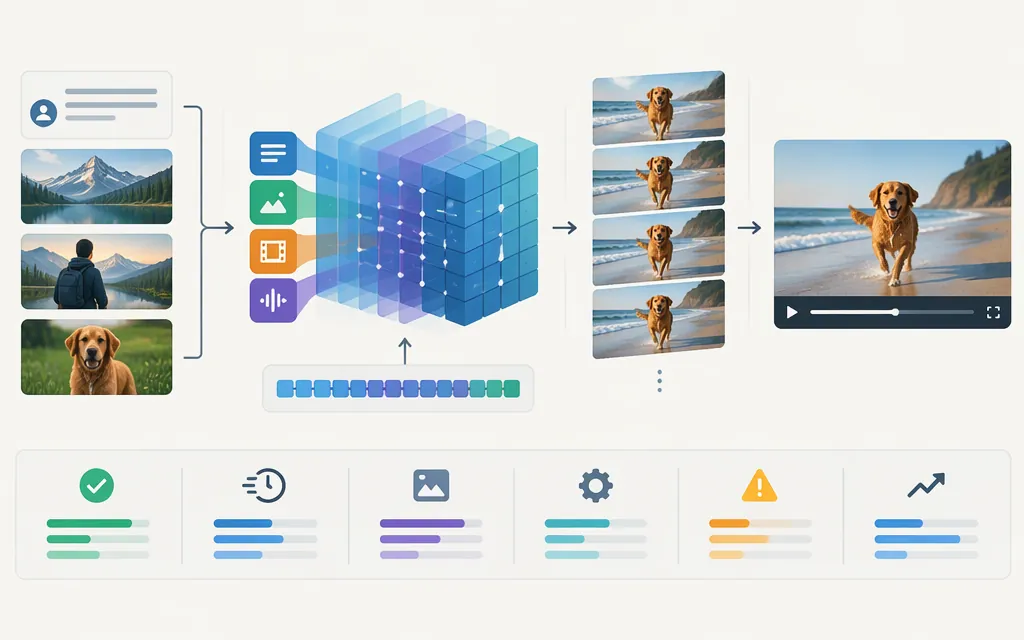
A useful simplified picture is:
- The user provides a direction. Sora was presented as a text-to-video model; OpenAI’s original system card also described text, image, and video inputs for generating new video. The precise inputs and constraints depended on the product and version. (
openai.com) - The model represents visual content compactly. In the original Sora technical report, OpenAI described compressing video into a lower-dimensional latent representation, then dividing it into “spacetime patches”—pieces representing information across image regions and time. (
openai.com) - A transformer processes those patches as a diffusion model generates the video. OpenAI’s overview explains diffusion in intuitive terms: generation begins with noise and progressively removes it over multiple steps. The technical report describes the transformer operating on spacetime patches, but does not disclose the model’s full implementation. (
openai.com) - The result is decoded into video. The report says a decoder maps generated latent representations back into pixel space. Put simply, the compact internal representation is converted into visible frames. (
openai.com)
This is a conceptual account, not a guarantee that every Sora version used an identical pipeline. OpenAI’s 2024 report explicitly says it does not include model and implementation details. It therefore supports explaining the broad approach, not claims about hidden layers, exact denoising steps, or a complete production architecture. (openai.com)
What changed in Sora 2?
OpenAI described Sora 2 as a video-and-audio generation model built on the foundation of Sora, with synchronized dialogue and sound effects among its introduced capabilities. That supports distinguishing Sora 2 from the original model, but it does not establish that every technical detail in the original Sora report applies unchanged to Sora 2. (cdn.openai.com)
Can you use Sora’s API in production now?
No. OpenAI says the Sora web and app experiences were discontinued on April 26, 2026, and the Sora API was discontinued on September 24, 2026. That means there is no current Sora API request path to recommend for a new service, and historical API examples should not be treated as working integration instructions. (help.openai.com)
For a team evaluating a video-generation workflow, the practical decision is therefore not whether Sora’s former API accepts a particular payload: it is whether a currently available product or model supports the required inputs, outputs, controls, and operational constraints. This article does not assume a replacement or claim that another model matches Sora’s behavior.
Is Sora a fit for a production use case?
For a new production integration: no, because the Sora API has been discontinued. For understanding the technology or reviewing old Sora work, the documented diffusion-and-patch description is useful background. It is not enough to infer quality, consistency, reliability, or suitability for a current workflow.
For an archived Sora project, separate two questions:
- How was the output generated? The official material supports a high-level account of diffusion, compressed visual representations, and spacetime patches for the original Sora.
- Can the workflow still be run through OpenAI’s Sora service? No; OpenAI’s discontinuation notice gives the API shutdown date as September 24, 2026. (
openai.com)
Bottom line: Sora generated video through a diffusion-based process, with OpenAI’s original technical report describing compressed visual latents and transformer-processed spacetime patches. But as of November 12, 2026, Sora is historical technology rather than a production API choice: both the consumer experiences and API have been discontinued. (openai.com)
Sources
Video generation models as world simulators — OpenAI
Sora: Creating video from text — OpenAI
What to know about the Sora discontinuation — OpenAI Help Center