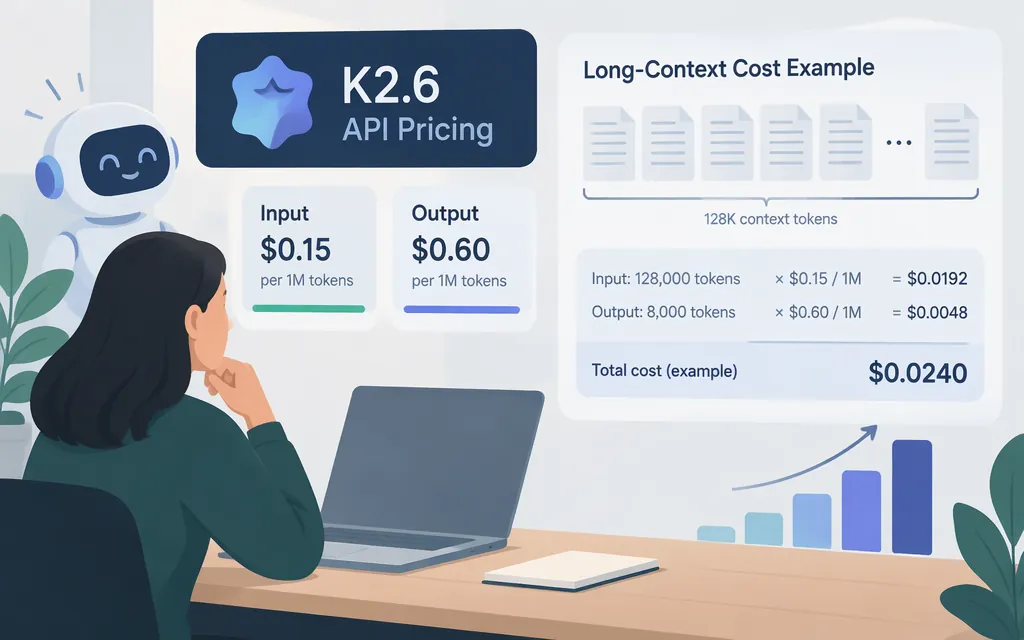
Kimi API prices at a glance
For the Kimi Platform API, the published rate card lists Kimi K2.6 at ¥6.50 per million uncached input tokens, ¥1.10 per million cached input tokens, and ¥27.00 per million output tokens. The Kimi-hosted K2.6 pricing page displays an update date of October 26, 2026 and says applicable taxes are excluded. Confirm the applicable rates for your account before budgeting; the displayed update date is not a guarantee that prices remain unchanged.
| Model and price card | Uncached input / 1M tokens | Cached input / 1M tokens | Output / 1M tokens | Context window |
|---|---|---|---|---|
Kimi Platform kimi-k2.6 |
¥6.50 | ¥1.10 | ¥27.00 | 262,144 tokens |
Published K2.7 Code kimi-k2.7-code card |
$0.95 | $0.19 | $4.00 | 262,144 tokens |
Published K2.7 Code kimi-k2.7-code-highspeed card |
$1.90 | $0.38 | $8.00 | 262,144 tokens |
The K2.6 figures are in Chinese yuan; the K2.7 Code page lists its figures in US dollars. The K2.7 page was updated October 27, 2026 and says its prices exclude applicable taxes. The available pages do not establish why these cards use different currencies or specify the regional applicability of the K2.7 USD card. Check which price card applies to your API account rather than treating either card as a currency conversion of the other. The K2.7 prices are for the named variants and do not establish K2.6 pricing.
How cached and uncached tokens affect the bill
Calculate each billed token category separately:
Estimated API charge = (uncached input tokens ÷ 1,000,000 × uncached-input rate) + (cached input tokens ÷ 1,000,000 × cached-input rate) + (output tokens ÷ 1,000,000 × output rate)
The lower cached-input rate applies only to input the API bills as cached; it does not discount output. Kimi’s caching documentation describes prefix reuse and notes that changes to a prefix affect whether later content can be reused. Don’t assume a cache hit just because prompts look similar—check the usage reported for your API calls.
Worked long-context example: Kimi K2.6
Illustration, not a measured bill: assume a request has 180,000 uncached input tokens, 60,000 input tokens billed as cached, and 12,000 output tokens. Using the K2.6 Kimi Platform rates above:
- Uncached input: 0.18 × ¥6.50 = ¥1.17
- Cached input: 0.06 × ¥1.10 = ¥0.066
- Output: 0.012 × ¥27.00 = ¥0.324
- Estimated total: ¥1.56, before applicable taxes
If all 240,000 input tokens were billed as uncached, the same output would bring the estimate to ¥1.884. Under these assumptions, 60,000 cached input tokens reduce the estimated model charge by ¥0.324.
K2.6’s listed context window is 262,144 tokens. That is a capacity figure, not a charge by itself. This example totals 252,000 input and output tokens, but it should not be read as a guarantee that a request of that size fits under every context-accounting rule. Leave headroom and check the applicable API documentation before planning close to the limit. The cited rate card does not establish a separate context-length surcharge.
Before budgeting for K2.6
- Keep API and membership charges distinct. Kimi’s documentation describes Kimi Platform as pay-as-you-go and Kimi Code as membership-based. Membership prices or quotas are not per-token API rates.
- Check the price card for your product and account. The available K2.7 Code USD card does not specify regional applicability or explain its currency relationship to the Kimi Platform CNY card. Confirm the applicable model, product, currency, and rate before using it in a budget.
- Check model availability before starting an integration. Availability can change. Confirm that the model is currently offered to your account and review current migration information before committing.
- Treat this as a model-charge estimate. The K2.6 pricing page says applicable taxes are excluded. Use API usage records for actual token counts and cache billing.
Sources
Kimi API Platform: Model Inference Pricing
Kimi K2.6 Pricing: API Costs and Plans
Kimi K2.7 Code Pricing: API Costs and Plans