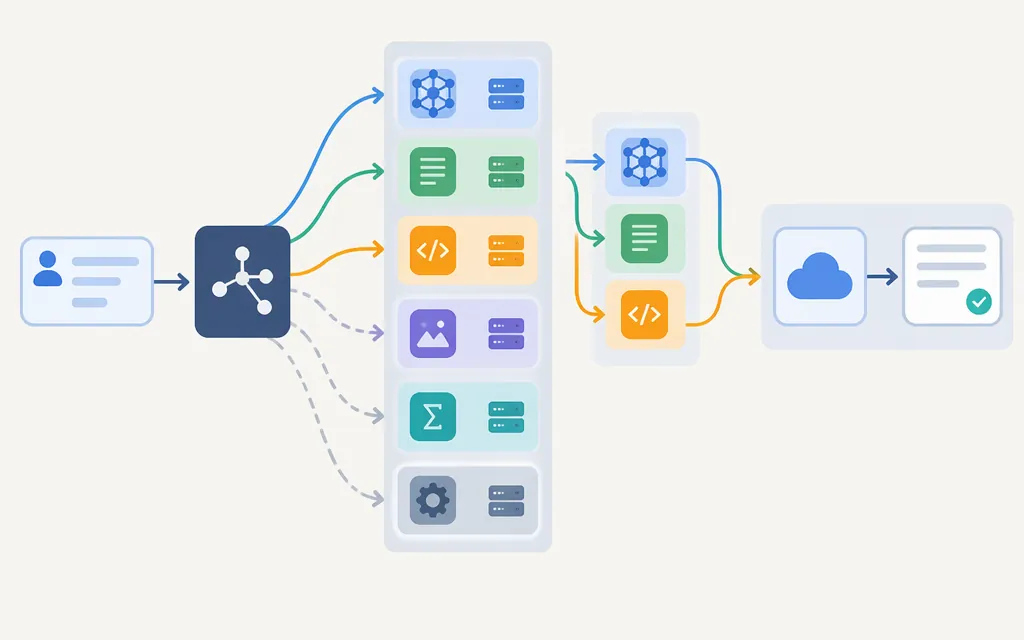
Kimi K2 is a Mixture-of-Experts (MoE) Transformer: Moonshot AI’s model materials describe it as having about 1 trillion total parameters, with 32 billion activated parameters. The official Kimi K2 model summary further lists 384 experts, 8 selected experts per token, Multi-head Latent Attention (MLA), and 61 layers. Those specifications describe the model’s design—not guaranteed latency, cost, or performance in your application. (github.com)
That architecture may make Kimi K2 worth evaluating for coding, reasoning, or tool-using workflows. Whether it is a good production choice depends on the exact K2 version and API provider, plus results on your own workload. The architecture documentation does not establish a provider’s current model availability, endpoint, limits, or price.
Kimi K2 architecture at a glance
| Reported specification | Kimi K2 figure |
|---|---|
| Architecture | Mixture-of-Experts Transformer |
| Total parameters | 1T |
| Activated parameters | 32B |
| Number of layers | 61, including one dense layer |
| Experts | 384 |
| Selected experts per token | 8 |
| Attention | MLA, 64 heads; attention hidden dimension 7,168 |
| MoE hidden dimension | 2,048 per expert |
| Context length | 128K in the original model summary; 256K for K2-Instruct-0905 |
These figures come from Moonshot AI’s model materials. The early overview describes 1T total parameters, while a secondary page reports approximately 1.04T; use about 1T unless a specific version’s authoritative specification calls for greater precision. (github.com)
How the experts are activated
In a dense model, the whole network participates in processing each token. In Kimi K2’s reported sparse MoE design, a subset of experts is selected instead. Moonshot’s model summary says 8 of 384 experts are selected per token, while reporting 32B activated parameters against 1T total. Put simply, K2’s total parameter count describes the model’s overall capacity; the active-parameter figure describes the much smaller portion engaged for a token. (github.com)
Moonshot also reports MLA, 64 attention heads, one shared expert, and a 2,048-dimensional MoE hidden dimension per expert. The model summary does not, by itself, give a complete account of the routing implementation or show how these specifications translate into serving performance. (github.com)
Do not treat 32B active parameters as a direct measure of inference cost. That number alone does not tell you the deployed system’s latency, throughput, memory use, or price. Those outcomes depend on the particular model version, serving hardware and software, provider, request length, output length, and workload. The architecture suggests why sparse activation can be an efficiency strategy; it does not establish a performance guarantee for a particular deployment.
K2 versions matter for context and selection
The Kimi K2 family includes different checkpoints. Moonshot’s materials distinguish Kimi-K2-Base, a foundation checkpoint, from Kimi-K2-Instruct, a post-trained model intended for general-purpose chat and agentic use. The original model summary lists a 128K context length. The K2-Instruct-0905 model card reports the same core MoE dimensions but a 256K context length, updated from 128K. Confirm the exact checkpoint and provider-exposed model identifier before relying on either figure. (github.com)
This distinction is important if your application has long prompts, large codebases, or multi-step tool interactions. A model-card context limit does not necessarily mean an API provider exposes that entire limit under every model name or account; check the provider’s documentation for the specific model you plan to call.
What the architecture means for real workloads
Moonshot positions Kimi K2 for tool use, reasoning, and autonomous problem-solving. Its model materials also include evaluations for coding and tool-use tasks. These are reasons to consider testing K2 on coding assistants, tool-calling agents, or other workflows that combine generation with external actions—not proof that it will outperform another model on your task. (github.com)
A practical evaluation should use a representative set of your own tasks and score the outcomes that matter to your application. For a tool-using coding assistant, for example, track:
- Task success: Did the model produce a correct, usable result?
- Tool behavior: Did it choose the right tool, supply valid arguments, and recover from errors?
- Latency: How long did the request take, including tool execution where relevant?
- Token use: How much input and output did comparable tasks require?
- Reliability: How often did it fail, need a retry, or return an unusable answer?
Compare models under the same prompts, tools, test cases, and success criteria. This is a proposed evaluation method, not a test result for Kimi K2. It helps reveal the trade-off that parameter counts cannot: whether a model’s quality and tool behavior justify its actual response time and operating cost in your setup.
What to verify before choosing a production API
The Kimi K2 architecture materials establish model-design details, but are not a complete production API specification. Before adopting a hosted API, verify these items in the documentation for the provider that will serve your traffic:
- Model availability and identifier: Is the specific K2 checkpoint you evaluated currently offered, and what exact model name should requests use?
- Request interface and authentication: Which endpoint and authentication method apply? What request and response formats are supported?
- Capabilities: Does this version support the input types, tool or function calling, and other features your application needs?
- Limits: Check the provider’s context, output, rate, and concurrency limits against your expected workload.
- Price: Confirm current input, output, and any other applicable charges from that provider. Historical prices quoted in older articles are not reliable current rates.
- Operational requirements: Verify availability, data handling, region, and service commitments if they matter to your production environment.
Do not infer current Kimi K2 API availability, pricing, or regional support from the model’s architecture or downloadable weights. The official Kimi API quickstart surfaced in the research uses a K3 example; that does not, on its own, establish whether a particular provider currently offers K2. Check the provider and model version you actually intend to use. (platform.kimi.ai)
Bottom line
Kimi K2 is an MoE Transformer with about 1T total parameters and 32B activated parameters; Moonshot’s model summary specifies 384 experts, with 8 selected per token. Those numbers explain the model’s sparse design, not its guaranteed serving speed, memory footprint, cost, or suitability for your workload. K2-Instruct-0905 also differs from the original summary in its reported context length, so version selection matters. (github.com)
Consider evaluating Kimi K2 when your workload aligns with its stated focus on coding, reasoning, or tool use. Choose it for production only after comparing representative task results and verifying the exact model, capabilities, limits, and current terms with the API provider you plan to use.
Sources
MoonshotAI/Kimi-K2: official repository and model summary
Moonshot AI: Kimi-K2-Instruct-0905 model card