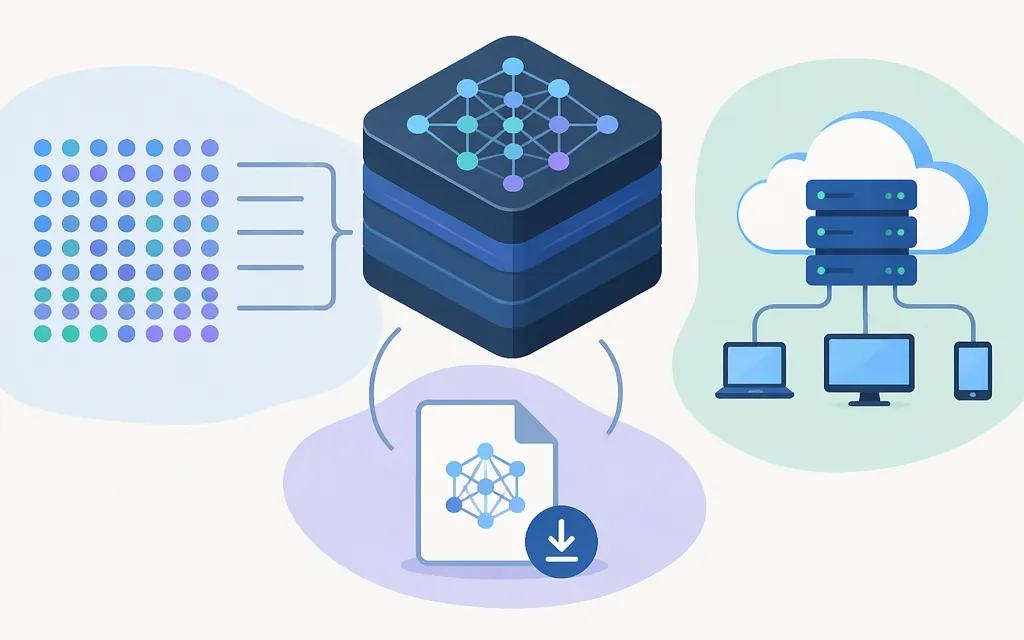
How large is Kimi K2?
Kimi K2 has 1 trillion total parameters and 32 billion activated parameters. It is a mixture-of-experts (MoE) model, so the total parameter count describes the model’s overall weight set, while the activated count describes the parameters used during a forward pass. The model card lists 384 experts, with 8 selected per token. (Moonshot AI repository; Hugging Face model card)
For a downloadable-file reference, the Hugging Face listing shows the Kimi-K2-Instruct repository at 1.03 TB. That is a specific Instruct checkpoint listing—not a universal file-size guarantee for every Kimi K2 variant, quantization, or package. (Hugging Face file listing)
Parameters and file size are different measures
- 1T total parameters describes the model’s overall parameter count.
- 32B activated parameters describes the active count per forward pass; it does not mean the full model file contains only 32 billion parameters.
- 1.03 TB is the size shown for the Kimi-K2-Instruct repository on Hugging Face. Use it as a practical download/storage reference for that listing, not as a measure of the model’s active parameters or its complete runtime memory needs. (Hugging Face file listing)
A third-party Composio article gives an approximate Kimi K2 size of 960 GB, but does not identify the precision, packaging, or measurement method behind that number. The Hugging Face listing is a more concrete reference for the named Instruct repository; the two figures should not be treated as a verified like-for-like comparison. (Composio; Hugging Face file listing)
What the reported size means for self-hosting
Composio estimates roughly 10–12 H100 GPUs or 16 A100 GPUs for hosting and running Kimi K2, and 3 H100 GPUs or 10 RTX 4090 GPUs for a 4-bit quantized model. These are third-party estimates, not guaranteed minimums: the article does not specify GPU memory, serving software, context length, batch size, or operational headroom. Treat them as rough orientation, not a production capacity plan. (Composio)
To assess self-hosting, first pin down the exact checkpoint and format you plan to serve, then size for your context length, concurrency, and serving configuration. Weight-file size alone does not establish how much hardware a production workload needs.
What it means if you use a production API
If you call Kimi through a hosted API, you generally do not need to download or store the 1.03 TB checkpoint yourself; the provider operates the model infrastructure. Token Forge Cloud describes its API offering as providing access to Kimi among other models, but the available evidence here does not identify a specific Kimi K2 model ID or establish which K2 version is selectable. Confirm the exact model/version and its capabilities with the provider before building around it. (Token Forge Cloud)
Selection takeaway: the headline model size is 1T total / 32B activated parameters. For storage planning, the more concrete reference is the 1.03 TB Kimi-K2-Instruct repository listing. For deployment choices, distinguish self-hosting the checkpoint from using a provider’s API—and verify the precise model version before committing.
Sources
MoonshotAI/Kimi-K2 — official repository
moonshotai/Kimi-K2-Instruct — Hugging Face model card