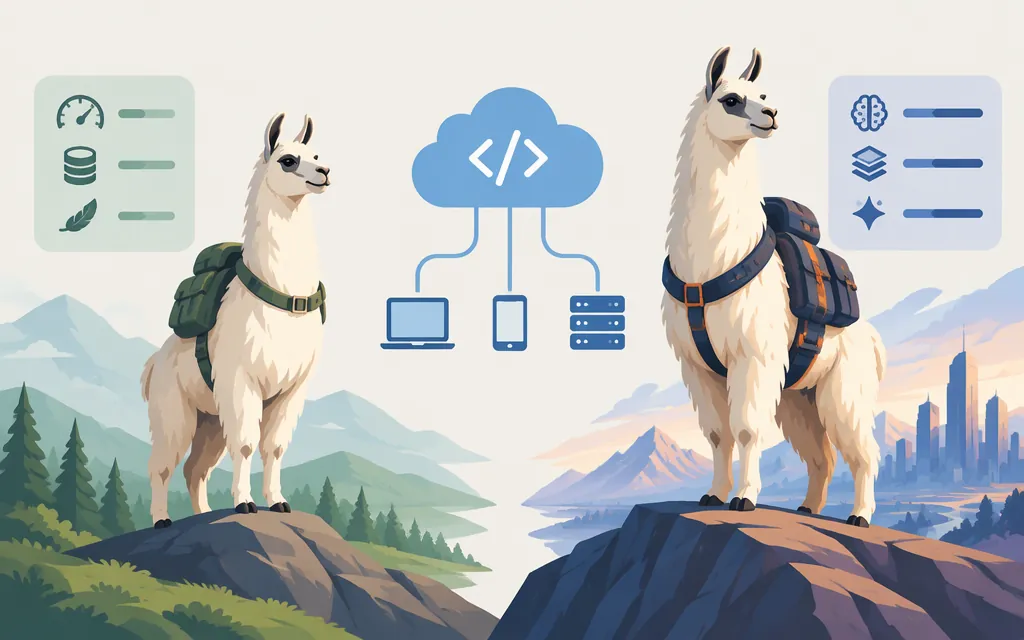
Direct answer: Which Llama 4 model should you choose?
For a workload where very long context is a key requirement, start by evaluating Llama 4 Scout: Meta’s model documentation lists a maximum context length of 10 million tokens, compared with 1 million for Llama 4 Maverick. If one million tokens is sufficient, compare Maverick and Scout on your actual tasks rather than assuming that a larger model or expert count guarantees better results. Meta’s documentation identifies both as released models; Behemoth was announced as a model still in training, not as a released option.
TokenForgeCloud’s Llama 4 production API availability is unconfirmed. Its public materials refer to Managed Model APIs, but I could not confirm a production model catalog or API reference listing Scout or Maverick, or verify their provider IDs or production status. The general API material is not confirmation that these models are available. (tokenforgecloud.com)
| Model | What the available primary documentation supports | Practical selection starting point |
|---|---|---|
| Llama 4 Scout | Released model; 17B active and 109B total parameters; 10M-token maximum context. Meta’s model documentation lists text and image input and text-only output. | Evaluate first when a long context window is central to the use case. Test the actual documents, prompts, latency, and serving limits you expect in production. |
| Llama 4 Maverick | Released model; 17B active and 400B total parameters; 1M-token maximum context. Meta’s model documentation lists text and image input and text-only output. | Evaluate when its 1M-token limit is adequate and you want to compare its results against Scout on your own workload. Do not infer a quality or cost winner from parameter counts alone. |
| Llama 4 Behemoth | Meta introduced it as a model still in training and said it was not releasing it at that time. The sources here do not establish a later release or current availability. | Do not treat it as a production choice without current release and provider documentation. |
What distinguishes Scout and Maverick?
Both released models are mixture-of-experts models, but their documented context limits differ: Scout is listed at 10M tokens; Maverick at 1M. Meta’s model card reports 17B active parameters for each, with 109B total for Scout and 400B total for Maverick. Those architecture figures are specifications, not a direct prediction of your application’s quality, response time, or serving cost.
Meta’s documentation lists text and image input and text-only output for both models. That is a more useful basis for an initial API integration check than broad claims that the Llama 4 family handles video or audio: the cited model card does not establish video or audio input support for Scout or Maverick. Check the precise provider implementation and any image limits before relying on a modality in production.
A practical selection test
Suppose your application summarizes large document collections. If the prompts and source material may exceed one million tokens, Scout’s documented 10M context makes it the natural first candidate to test. If your requests fit within one million tokens, run the same representative requests through Scout and Maverick and compare the results against your acceptance criteria. Measure completion quality, latency, failure rate, and total cost using the specific serving provider; the model card alone cannot settle those operational comparisons.
For image understanding, both models’ documentation lists image input. Confirm how your intended API accepts images, whether it applies limits on image count or size, and whether those limits differ from Meta’s model-level specifications. A capability listed for a model does not by itself confirm that a particular hosted API exposes it.
Is Llama 4 available through TokenForgeCloud’s production API?
I could not confirm a production listing or exact TokenForgeCloud model ID for Scout or Maverick. Before deployment, ask TokenForgeCloud to confirm whether either model is available for production and check the exact model ID, supported inputs and formats, context and output limits, applicable price and billing unit, rate limits, and any availability qualifications. Do not assume another provider’s identifiers, prices, or limits apply.
Meta’s model documentation can guide which model to evaluate; provider availability and service terms must be confirmed separately. Until then, evaluate Scout for its longer documented context window, compare Maverick when one million tokens is enough, and do not assume either is available through TokenForgeCloud’s production API.
Sources
Llama 4 Model Cards and Prompt Formats — Meta
Llama 4 Model Card — Meta Llama GitHub
The Llama 4 Model Collection — Meta