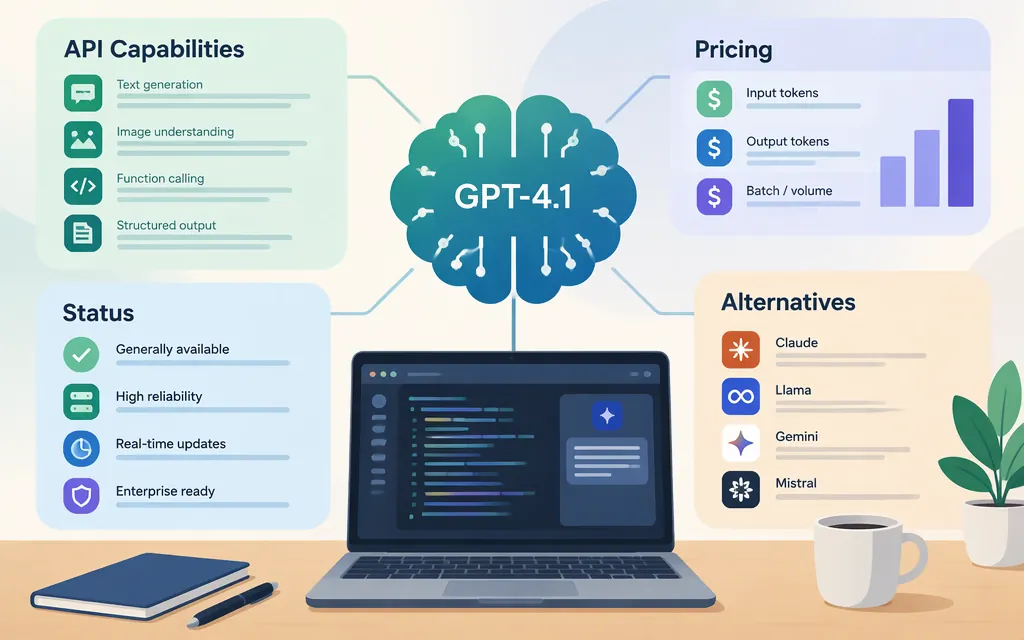
Short answer: GPT-4.1 is an OpenAI API model introduced for instruction following, coding, tool use, and long-context work. OpenAI marks GPT-4.1 deprecated. Its fine-tuning documentation lists January 14, 2027 as the shutdown date for the gpt-4.1-2025-04-14 snapshot and its fine-tuned versions. That deadline applies to the named snapshot and fine-tuned versions; check the model record for the status of a particular alias or deployment. For a new integration, evaluate a currently listed model rather than treating GPT-4.1 as a long-term choice. [1][2]
What GPT-4.1 does
OpenAI’s model documentation lists text and image input, text output, a 1,047,576-token context window, a 32,768-token maximum output, and support for the Responses API and Chat Completions. These capabilities can be relevant to applications involving code, images, tools, or large prompts, but a context limit or benchmark does not predict performance on your own workload. [1]
OpenAI’s 2025 launch post described coding and instruction-following improvements. Any launch-era benchmark claims should be read in that historical context, not as a guarantee of present-day results or a reason to choose a deprecated model. [4]
Is GPT-4.1 a good choice for a new production API?
Generally, no. GPT-4.1 is marked deprecated, and OpenAI documents a shutdown date for the named gpt-4.1-2025-04-14 snapshot and its fine-tuned versions. If you already use GPT-4.1, inventory the exact model IDs in your application and plan a tested migration. Do not assume that every alias or deployment has the same confirmed deadline: OpenAI says you can call GET /v1/models and check a model record’s optional shutdown_date. [1][2][3]
OpenAI does not identify a one-to-one GPT-4.1 replacement in the cited snapshot shutdown notice. Its current model guide provides a practical evaluation shortlist: GPT-6.1 Sol for complex coding and professional work, and GPT-6 Luna for focused, high-volume workloads. These are candidates to test—not guaranteed drop-in replacements. [5][6][7]
GPT-4.1 variants and current evaluation candidates
GPT-4.1 launched as a family of GPT-4.1, GPT-4.1 mini, and GPT-4.1 nano. OpenAI’s fine-tuning documentation lists shutdown dates for specific snapshots and their fine-tuned versions: gpt-4.1-nano-2025-04-14 on October 23, 2026 (a date that has passed), and both gpt-4.1-2025-04-14 and gpt-4.1-mini-2025-04-14 on January 14, 2027. These dates do not establish blanket shutdown dates for every alias or deployment; check the relevant model record. The snapshot lifecycle information—not an unverified quality or latency ranking—is why this guide focuses new-work evaluation on current candidates. [2][3][4]
| Model | Officially documented positioning and relevant limits | Standard API text-token rates per 1M tokens | When to evaluate |
|---|---|---|---|
| GPT-4.1 | Deprecated. The model page lists a 1,047,576-token context window and 32,768-token maximum output. The fine-tuning guide gives snapshot-specific shutdown dates. | Input $2; cached input $0.50; output $8; cache-write rate not shown in the cited listing | Avoid as the default for a new integration. If already deployed, identify the exact snapshot and check its model record. |
| GPT-6.1 Sol | Text and image input; 1,050,000-token context window; 128,000-token maximum output. OpenAI positions it for complex coding and professional work; tool calling requires the Responses API. | Input $2; cached input $0.10; cache write $2.50; output $10 | Evaluate for code-heavy or complex work where you want a current candidate and can test output quality, tool behavior, and cost. |
| GPT-6 Luna | Text and image input; 1,050,000-token context window; 128,000-token maximum output. OpenAI positions it for focused, high-volume tasks; use the Responses API for built-in tools and function calling. | Input $0.10; cached input $0.01; cache write $0.125; output $0.50 | Evaluate for cost-sensitive, high-volume workloads, provided it meets your quality and tool-use requirements. |
The prices are OpenAI’s listed standard rates in USD per million tokens. For GPT-6.1 Sol only, prompts with more than 272,000 input tokens have higher listed input/cache and output rates for the full request. No corresponding long-input threshold is established here for GPT-6 Luna. The model pages also list cache-write rates for Sol and Luna; check the current pricing details to confirm whether cache-write billing applies to your requests and under what conditions. [1][6][7]
The shortlist reflects OpenAI’s model guidance, not a claim that either candidate reproduces GPT-4.1’s behavior exactly. GPT-6.1 Sol is the more directly relevant first test for complex coding; GPT-6 Luna is the lower-priced candidate for high-volume work. Both accept image input, but tool calling uses the Responses API as described on their model pages. For image, tool, or long-context workloads, test the actual request path and limits you need. [5][6][7]
GPT-4.1 API pricing
OpenAI lists GPT-4.1 at $2 per 1 million input tokens, $0.50 per 1 million cached input tokens, and $8 per 1 million output tokens. At the uncached rates, 100,000 input tokens plus 10,000 output tokens would cost $0.28: (0.1 × $2) + (0.01 × $8). That is an illustrative token-charge calculation, not a full application quote. API usage is billed separately from ChatGPT subscriptions. Since GPT-4.1 is deprecated, confirm current access and applicable prices before relying on it. [1]
Migration checks for production
- Inventory model usage. Find GPT-4.1 aliases and dated snapshots in code, configuration, and deployment settings.
- Check the affected snapshot. Use GET
/v1/modelsand inspect the model’s optionalshutdown_date; do not infer an alias’s deadline from a snapshot-specific notice. [3] - Choose a candidate by workload. Start with GPT-6.1 Sol for complex coding or GPT-6 Luna for cost-sensitive volume, based on OpenAI’s model guidance—not as assumed drop-in replacements.
- Run a representative comparison. Use the same real inputs and tool calls; assess quality, latency, image handling, and token cost.
- Stage the change. Validate the candidate before routing production traffic, and keep a rollback plan for the rollout.
Bottom line: GPT-4.1’s documented capabilities and listed prices remain useful context, but its deprecated status makes it a poor default for new production work. The GPT-4.1 family’s published snapshot dates also differ: the nano snapshot’s listed date has passed, while the flagship and mini snapshots are listed for January 14, 2027. For a current shortlist, evaluate GPT-6.1 Sol for complex coding and GPT-6 Luna for high-volume, cost-sensitive tasks. Verify access, pricing, limits, and behavior on your own workload before migrating. [1][2][5][6][7]
Sources
[1] GPT-4.1 Model | OpenAI API
[2] Supervised fine-tuning | OpenAI API
[3] Deprecations | OpenAI API
[4] Introducing GPT-4.1 in the API | OpenAI
[5] Models | OpenAI API
[6] GPT-6.1 Sol Model | OpenAI API
[7] GPT-6 Luna Model | OpenAI API
Sources
Supervised fine-tuning | OpenAI API
Introducing GPT-4.1 in the API | OpenAI