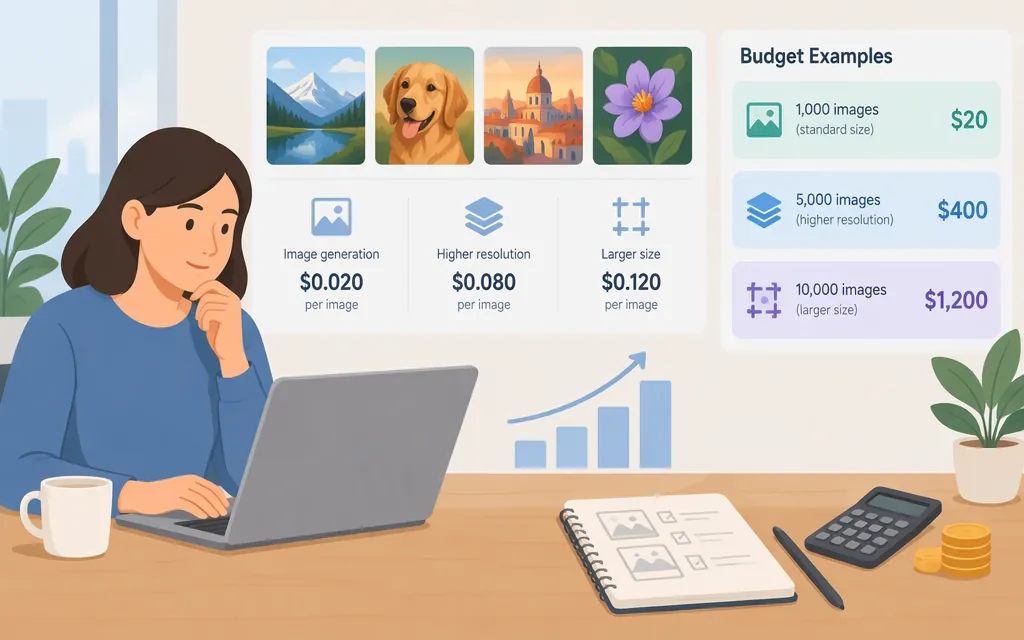
Pricing snapshot: November 12, 2026. OpenAI lists standard rates for GPT Image 2.6 Flare and Sunburst of $30 per million image-output tokens, $8 per million image-input tokens, and $5 per million text-input tokens. These are token rates, not a flat price per image; the amount billed depends on the tokens used by each request.
Current listed rates for GPT Image 2.6
| Model | Standard image input | Standard image output | Standard text input |
|---|---|---|---|
| GPT Image 2.6 Flare | $8 / 1M tokens | $30 / 1M tokens | $5 / 1M tokens |
| GPT Image 2.6 Sunburst | $8 / 1M tokens | $30 / 1M tokens | $5 / 1M tokens |
Rates are in U.S. dollars. OpenAI’s pricing table lists the same standard rates for both variants and directs readers to its image-generation guide for cost estimates. OpenAI describes Flare as an option for fast iteration and Sunburst for detailed visual work. That positioning is not a price difference: the listed standard token rates are the same.
Estimate production costs without treating them as a fixed image price
For a request using standard rates, calculate each token category separately:
Estimated request cost = (standard image-input tokens × $8 + image-output tokens × $30 + standard text-input tokens × $5) ÷ 1,000,000
Use the image-generation calculator in OpenAI’s guide to estimate image-generation costs for the model and output settings you plan to use. The cost depends on the image-token usage for those settings, so do not assume a universal token count or per-image price. Add the text and image inputs for your route, and count every billed attempt—including outputs you reject.
Scaling a measured pilot to accepted images
For a reproducible budget, first record a pilot using the intended model, API route, quality, and dimensions. Then use the billed token counts from those requests. For example, if a pilot averages two attempts per accepted image, budget the input and output usage from both attempts for each accepted image. Multiply that measured per-accepted-image usage by your planned accepted-image volume.
This method does not assume that a particular quality or size always produces a fixed token count. Your calculator estimate is a starting point; actual usage records from your production settings are the better basis for a forecast. Include reference-image inputs when the workflow edits images, and identify any costs not included in the estimate.
What changes the bill?
- Image settings: Choose the quality and dimensions you intend to ship, then use OpenAI’s image-generation calculator for an estimate. Do not transfer a per-image estimate from another model or a third-party host as if it were a GPT Image 2.6 tariff.
- Reference images and edits: Include image-input tokens when your request supplies images. The applicable amount depends on billed input usage.
- Prompt text: Text input has its own rate. Include the request’s billed text tokens in the calculation.
- Retries: Count input and output usage for each billed attempt, not only the image you keep.
- Model choice: Flare and Sunburst have the same listed standard rates. Choose between them based on your workflow, and compare actual results and usage in a pilot.
Cached-input rates: check model and route
The pricing table lists cached-input amounts for GPT Image 2.6, but the image-generation guide’s explicit route qualification names GPT-Image-2 and GPT-Image-2.5: cached input pricing applies to the image-generation tool in the Responses API, not direct Images API requests, including /v1/images/edits. That guidance does not establish that GPT Image 2.6 requests qualify. To avoid assuming a discount, this estimate uses standard rates; confirm current documentation for the exact model and route before applying any cached rate. When eligible, price cached and uncached tokens as separate categories rather than adding both rates to the same tokens.
What about Batch pricing?
OpenAI lists separate Batch rates for GPT Image 2: $4 per million image-input tokens, $15 per million image-output tokens, and $2.50 per million text-input tokens. This is a distinct pricing row for GPT Image 2, not GPT Image 2.6 Flare or Sunburst; do not apply it to those variants based on that row alone.
Batch is asynchronous: OpenAI says requests are processed within 24 hours, images are supported, and eligible models receive a 50% discount versus synchronous API pricing. Model eligibility is not universal, so check the model reference before budgeting around Batch. It is not a fit when your workflow requires an immediate response.
Is API image generation included in a ChatGPT subscription?
No. OpenAI says ChatGPT and the API platform have separate billing systems. If you are building an application or automating image generation, estimate API usage separately rather than treating a ChatGPT subscription as API credit.
Production budget checklist
Before forecasting monthly spend, record:
- Model and route: Flare or Sunburst, and the API route used.
- Output settings: Quality and dimensions used in production; use the official image-generation calculator for an estimate.
- Inputs: Billed prompt-text tokens and any reference-image or edit inputs.
- Attempts per accepted image: Include rejected outputs and retries.
- Observed usage: Use API usage and cost records from a representative pilot to update the forecast.
- Discount eligibility: Apply cached or Batch rates only when current documentation confirms eligibility for the exact model and route.
The useful budget number is total billed usage for all attempts and inputs divided by the images your workflow accepts. Start with the listed rates, make assumptions visible, and replace estimates with observed usage before committing to a production budget.