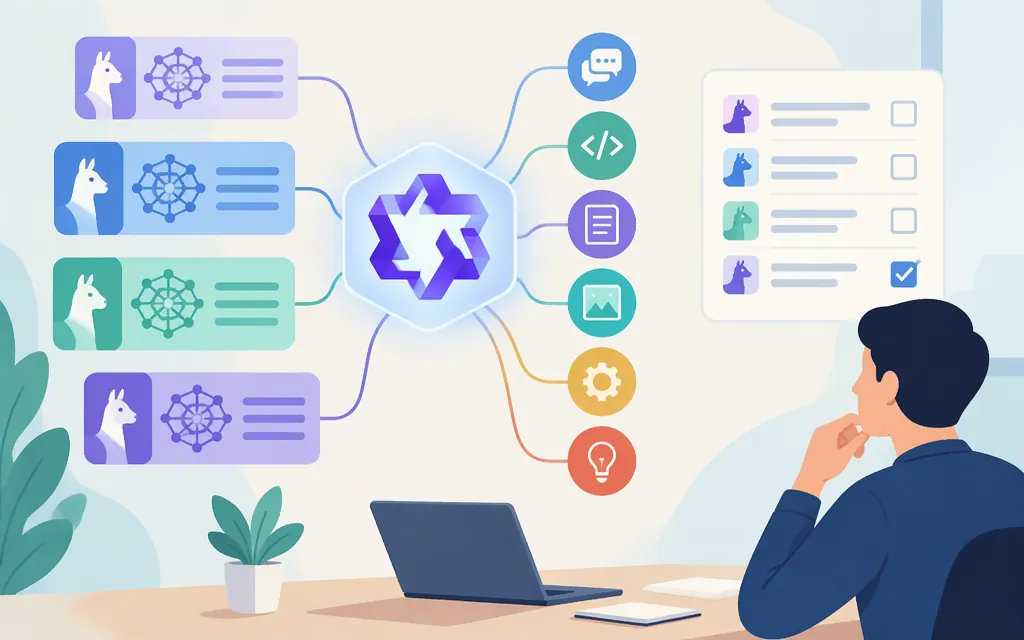
Qwen2.5 is a family of models, not one interchangeable AI product. It includes general-purpose, coding-focused, and math-focused open-weight models; hosted API products have separate names and terms. For a first evaluation, match the model family to your workload, test the exact model and access route you plan to use, and verify current provider documentation before building a production integration. Qwen’s model announcements and specifications describe capabilities, but they do not by themselves establish today’s hosted API price, limits, or availability. (qwen.ai)
What does “Qwen 2.5 AI” refer to?
Qwen2.5 generally refers to a generation of language models developed by the Qwen team. The Qwen announcement describes general Qwen2.5 models and separate Qwen2.5-Coder and Qwen2.5-Math families. It also describes hosted API products separately: the Qwen2.5 technical report names Qwen2.5-Turbo and Qwen2.5-Plus as hosted options through Alibaba Cloud Model Studio. A hosted model name should not be assumed to identify the same thing as a downloadable checkpoint such as Qwen/Qwen2.5-7B-Instruct. (qwen.ai)
The Qwen team’s September 2024 announcement lists general-model sizes from 0.5B to 72B parameters, plus separate Coder and Math sizes. Treat that as a historical lineup description, not a guarantee that every listed model is currently available through a particular provider. Check the exact model card or provider catalog for the model ID you intend to use. (alibabacloud.com)
Which Qwen2.5 model should you evaluate?
| If your workload is… | Start by evaluating… | What to keep in mind |
|---|---|---|
| General chat, instruction following, text analysis, or structured responses | An instruction-tuned general Qwen2.5 checkpoint, such as Qwen/Qwen2.5-7B-Instruct |
The model card reports support for long context and structured outputs, including JSON. Confirm the limits and output quality for your chosen checkpoint and runtime. (huggingface.co) |
| Code generation, explanation, or debugging | Qwen2.5-Coder | The Qwen team positions this family for coding. Test it on your languages, repository conventions, and actual debugging or code-generation tasks. (huggingface.co) |
| Mathematical problem solving | Qwen2.5-Math | The Qwen announcement positions it as a math-focused family. Check answers against known solutions or a trusted calculator; a specialist label is not a correctness guarantee. (qwen.ai) |
| Image, audio, or video inputs | Investigate the relevant Qwen2.5 multimodal family, such as Qwen2.5-VL or Qwen2.5-Omni | These are distinct from a text-only language checkpoint. Verify supported inputs and the API or runtime that exposes them. (huggingface.co) |
The Qwen team reported that Qwen2.5 models support up to 128K tokens of context and up to 8K generated tokens, along with improvements in instruction following, structured data, and JSON output. Those are model-team claims from the Qwen2.5 generation—not guaranteed limits or behavior for every checkpoint, provider, or serving setup. For example, the Qwen2.5-7B-Instruct model card specifies a 131,072-token context length and 8,192-token generation length; use the exact model card and provider documentation for your candidate rather than assuming a family-wide number applies everywhere. (qwen.ai)
The Qwen2.5 technical report includes benchmark comparisons, but benchmark results do not settle whether a model will perform well on your prompts, languages, documents, or codebase. Avoid treating broad claims such as “best” or “outperforms” as a current ranking unless you have comparable model versions, benchmark versions, dates, and evaluation conditions. The Qwen documentation also has a Qwen3-focused quickstart, so teams choosing a model today should compare Qwen2.5 with current alternatives instead of assuming that Qwen2.5 is automatically the right or newest choice. (arxiv.org)
A practical evaluation before committing
Create a small, fixed test set from real tasks—for example, 30 support questions, 20 representative code changes, or 25 structured-extraction records. Run the same prompts and input data against each candidate. Score task success, factual or code correctness, valid JSON rate if relevant, latency, and the cost quoted by the provider for that same workload. These are suggested evaluation measures, not published Qwen test results. Keep prompts and scoring rules unchanged between candidates so that differences are easier to interpret.
Do not choose by parameter count alone. Larger models may have different serving requirements, but the cited model descriptions do not establish your deployment’s hardware needs, latency, or total cost. For self-hosting, use the exact model’s deployment guidance and measure resource use in your own environment. Qwen’s vLLM documentation shows how to serve a Qwen2.5-7B-Instruct checkpoint locally with an OpenAI-compatible interface; that example is a deployment option, not a hosted API offer. (qwen.readthedocs.io)
Hosted API or self-hosted Qwen2.5?
Hosted API: A provider operates the model endpoint. Before integrating, confirm the provider’s current model ID, endpoint, authentication method, request and response format, availability for your account or region, rate limits, context and output limits, and price—including currency and billing unit. Also check the provider’s data-handling and service terms. The Qwen2.5 announcements identify Alibaba Cloud Model Studio as a route for hosted Qwen products, but the captured announcements do not establish a current endpoint, authentication flow, pricing, or operational limits. Do not copy these details from a different API provider or assume that an OpenAI-compatible interface uses the same URL or terms. (arxiv.org)
Self-hosted checkpoint: You download model weights and run them using a serving framework. Qwen’s Qwen2.5 vLLM guide demonstrates a local server for Qwen/Qwen2.5-7B-Instruct at http://localhost:8000/v1/chat/completions. That is an endpoint on your own server—not an Alibaba Cloud Model Studio endpoint. Check the specific checkpoint’s license and your hardware and operating requirements before deploying. For example, the 7B Instruct model card labels that checkpoint Apache-2.0; do not assume that label applies to every Qwen2.5 variant. (qwen.readthedocs.io)
Decision shortcut: Choose a hosted API when managed access fits your integration and commercial requirements; choose self-hosting when you need to control the serving environment and can operate it. Either way, make the decision using the exact model, route, terms, and workload you have tested—not the family name alone.
Production API checklist
Before shipping, confirm these items in the documentation for the provider you will actually use:
- Model identity: Exact model ID and whether it is a hosted model or a self-hosted checkpoint.
- Integration: Endpoint, authentication, supported request fields, response format, and any SDK or compatibility requirements.
- Capacity: Context and output limits, rate limits, concurrency, and account or regional availability.
- Commercial terms: Price, currency, billing unit, and any differences between API usage and subscriptions or other access plans.
- Operational fit: Latency and quality on your own test set, plus data-handling terms relevant to your application.
- Self-hosted use: Exact repository license and deployment resource requirements.
The sources here do not verify current Token Forge Cloud availability, supported Qwen2.5 model IDs, or prices. Check the provider’s live catalog and API documentation before relying on it for a production integration.
Bottom line
Qwen2.5 is worth shortlisting when its general, coding, math, or multimodal options fit the task you need to evaluate. Use the family descriptions and published specifications as starting points, not guarantees. Then test a specific model against your workload and confirm the current terms and technical details for the exact hosted API or self-hosted route you plan to ship.
Sources
Qwen2.5: A Party of Foundation Models!
Qwen2.5-7B-Instruct model card
Qwen2.5-Coder-7B-Instruct model card