Quick answer
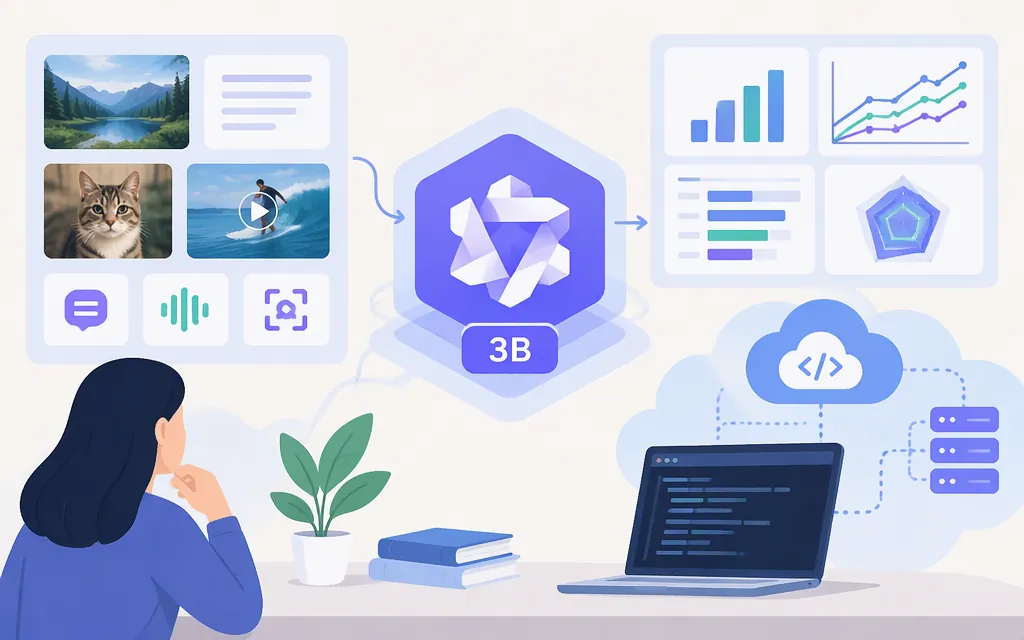
Qwen2.5-VL-3B-Instruct is an instruction-tuned vision-language model for analyzing images and video alongside text. Qwen describes visual tasks including reading text and charts in images, visual localization, structured outputs, and identifying events in video. These are documented capabilities, not a guarantee of accuracy on your data. (Qwen model card)
Token Forge Cloud’s public pages do not confirm access to this exact checkpoint. The available public information does not establish a Qwen2.5-VL-3B-specific price or request format. Confirm the exact model ID and API contract with the provider before building around it.
What is Qwen2.5-VL-3B?
The checkpoint name is Qwen/Qwen2.5-VL-3B-Instruct. “3B” identifies its model-size tier. This standard Instruct checkpoint is distinct from Qwen/Qwen2.5-VL-3B-Instruct-AWQ, a quantized variant, and from third-party fine-tunes. Check the full model ID: variant-specific behavior, packaging, and provider support should not be assumed to apply to the standard checkpoint. (Qwen model card)
What can it do?
Qwen’s model documentation describes visual understanding alongside text, including:
- Image understanding: analyzing objects, text, charts, graphics, and layouts.
- Structured visual outputs: extracting the contents of items such as invoice, form, and table scans into structured outputs.
- Visual localization: generating bounding boxes or points, with coordinates and attributes.
- Video understanding: identifying events and relevant video segments.
These are model-level capabilities described by Qwen; they do not guarantee that every hosted API accepts every media format or exposes every feature. Check the selected provider’s supported inputs and payload format before relying on them. (Qwen model card)
What do the 3B benchmark results say?
Qwen’s model card reports these image-benchmark results for Qwen2.5-VL-3B. The table identifies the benchmark splits; the cited results do not specify the evaluated precision.
| Benchmark | Split | Reported result |
|---|---|---|
| MMMU | Validation | 53.1 |
| AI2D | Test | 81.5 |
| DocVQA | Test | 93.9 |
| InfoVQA | Test | 77.1 |
These are publisher-reported results on named splits. They can help identify tasks to test, but do not predict accuracy on your documents, image quality, languages, or workflow. They also do not measure an API’s latency, throughput, price, or effective input limits. (Qwen model card)
Practical selection rule: consider the 3B tier when a smaller vision-language model is a plausible fit and your workload resembles its target tasks. Compare candidate models on representative examples from your own workload. For document extraction, check whether required fields are captured correctly and whether the output follows your schema—not only whether the answer sounds fluent.
Can you use it through a production API?
Token Forge Cloud’s public pages do not establish that it currently serves this exact model. A general Qwen API offering is not confirmation of Qwen2.5-VL-3B availability. Ask Token Forge to confirm the exact model ID, supported image or video inputs, endpoint, authentication, request and response formats, limits, and price before implementation.
For self-hosting, the Hugging Face model page provides usage guidance for Transformers, vLLM, and SGLang, including examples of OpenAI-compatible requests to locally served instances. These are local-serving instructions; they do not establish Token Forge availability or a third-party provider’s API contract. (Hugging Face model page and usage guidance)
No Qwen2.5-VL-3B-specific Token Forge price is established by the public information reviewed here, so there is no supported price-per-token estimate to give. Confirm current billing units and rates with the provider before estimating cost.
Commercial licensing and a short evaluation
The standard checkpoint’s Hugging Face repository labels its license qwen-research and links a license file. The terms of that exact linked license have not been confirmed here, so whether commercial use is permitted—and whether separate permission or other conditions apply—remains unconfirmed. Review the license linked from the exact checkpoint before commercial deployment. Model-weight licensing is separate from a hosted provider’s service terms. (Qwen model card and license link; linked license file)
Before choosing a deployment route—local checkpoint, quantized variant, or hosted API—run a pilot with representative images and videos. Record:
- Task quality: field-level accuracy for documents, or answer and localization accuracy for images.
- Output reliability: whether structured responses match your schema and how often they need correction.
- Operational behavior: end-to-end latency, failures, and provider-reported input or context limits.
- Cost: actual billed input and output units using that provider’s current price sheet.
This is a suggested evaluation plan, not a reported test result. Recheck the exact model version, variant, linked license, and effective serving limits for your chosen route; model configuration values alone do not establish what a hosted deployment allows.
Sources
Qwen/Qwen2.5-VL-3B-Instruct — Hugging Face model card
Qwen/Qwen2.5-VL-3B-Instruct — raw model card
Qwen/Qwen2.5-VL-3B-Instruct — Hugging Face model page and usage guidance