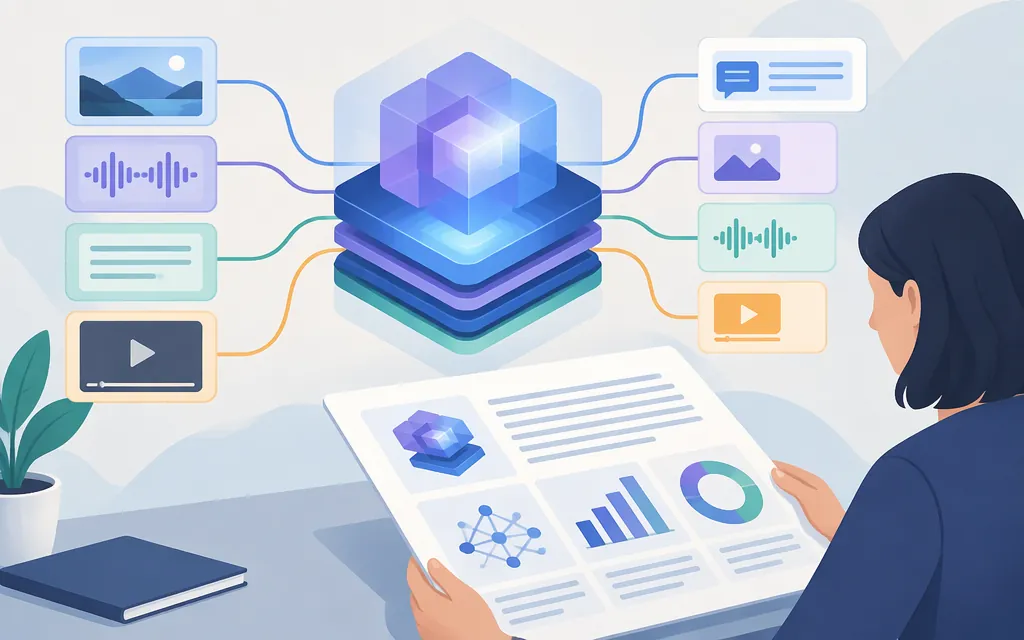
The Qwen Team’s Qwen3.5-Omni Technical Report describes Qwen3.5-Omni as using a Hybrid Attention Mixture-of-Experts (MoE) framework for both its Thinker and Talker components. The abstract says this design enables efficient long-sequence inference.
That is a high-level description of Qwen3.5-Omni—not evidence that every Qwen 3.5 model or API variant uses the same architecture. The abstract also does not explain the attention patterns, number of experts, routing method, layer layout, or how Thinker and Talker interact. Those details should not be inferred from the architecture label alone.
What the reported capabilities may mean for model selection
The report abstract gives several figures that may help identify workloads worth testing. They are research-report claims, not guaranteed API quotas or endpoint specifications.
| If your workload involves… | What the report claims | What to verify for the API you plan to use |
|---|---|---|
| Long inputs | A 256k context length | How that context is counted across text and media, and what limit applies to the exact model and endpoint |
| Long audio | Over 10 hours of audio understanding | Supported audio formats, upload or request limits, and whether the endpoint handles your input and processing pattern |
| Video | 400 seconds of 720P video at 1 frame per second | Supported video inputs, duration and size limits, and how the endpoint samples or processes video |
| Speech generation or streaming conversation | ARIA dynamically aligns text and speech units; the abstract says this is intended to improve stability and prosody with minimal latency impact | Whether your endpoint offers the relevant speech behavior, and measured latency and output quality on your own use case |
| Multilingual speech or structured video captions | The abstract claims understanding and speech generation across 10 languages, plus temporally synchronized structured captions and scene segmentation | Which languages and output formats are supported, and whether the endpoint returns the structure your application needs |
Treat these as reasons to evaluate, not reasons to assume a production fit. The abstract does not name the 10 languages, define the output schemas, establish modality-specific context accounting, or provide endpoint request limits. Its qualitative claims also do not substitute for testing your own prompts, media, and quality requirements.
How to check a production API before choosing
- Write down the task and inputs. Specify whether you need text, audio, video, speech output, or a combination—and the typical and maximum input sizes in your workload.
- Confirm the provider and exact model ID. Distinguish Qwen3.5-Omni from other Qwen 3.5 models and from Omni variants such as
qwen3.5-omni-plusorqwen3.5-omni-flash. Qwen’s MM Plugins cookbook lists those names for Omni tools, but directs users to the relevant Model Studio catalog for supported models and input limits; a name in a tool’s configuration is not, by itself, proof of availability or terms for your chosen endpoint. (qwenlm.github.io) - Read documentation for that specific endpoint. Check supported inputs and outputs, context and media limits, streaming behavior, availability, and any rate limits that affect your application. The research-report abstract does not provide these API specifications.
- Compare performance and cost for your workload. Where latency, reliability, or price matters to the decision, use current provider documentation and comparable tests on representative requests. Do not treat abstract-level capability or benchmark claims as a production guarantee.
Bottom line: the disclosed architecture is Hybrid Attention MoE for the Thinker and Talker in Qwen3.5-Omni. It can help you decide whether that report merits a closer look for multimodal or long-sequence work, but the exact production model and endpoint documentation—and workload-specific evaluation—must settle whether it fits.