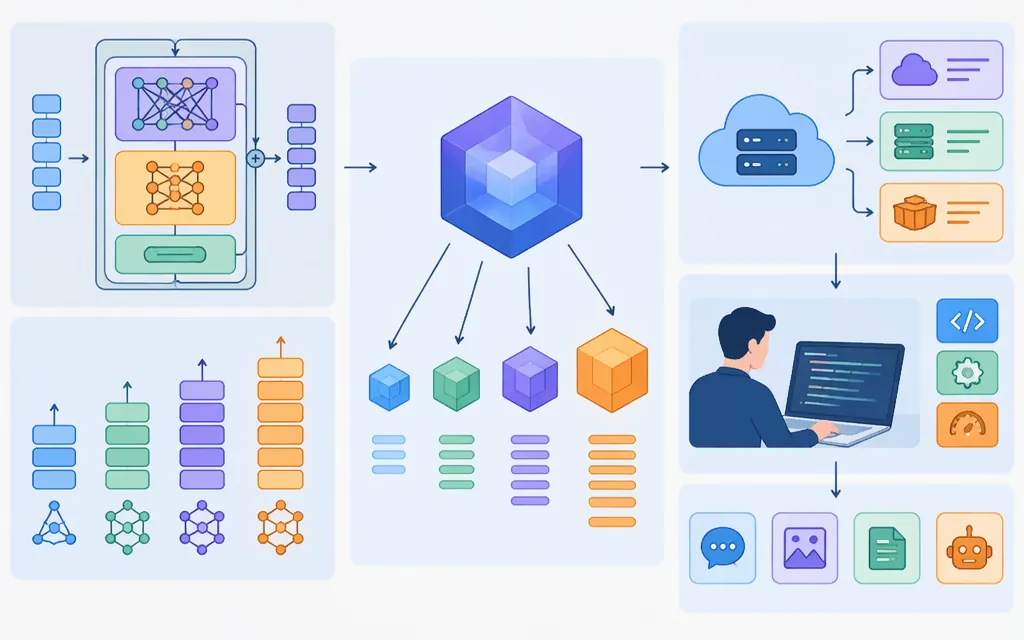
What does “Qwen architecture” mean?
Qwen is a family of models, not one fixed architecture. “Architecture” can mean the model’s internal design—such as dense or mixture-of-experts (MoE)—or the production system around it: the API or inference service, application, data sources, and tools. Those are related decisions, but they are not the same thing.
A concrete example: the Qwen3 technical report describes both dense and MoE models, with model sizes spanning 0.6B to 235B parameters. The Qwen3-VL report describes a separate vision-language family with dense and MoE variants, designed for text, images, and video. So a detail about one Qwen version or variant should not be assumed to apply to the whole family. (Qwen3 technical report)
Which Qwen architecture differences matter?
For model selection, start with the workload and modality, then compare the specific variants available through your intended provider.
| If the workload is… | First capability to investigate | What to verify |
|---|---|---|
| Text, coding, or reasoning | A text-oriented Qwen variant suited to the task | Quality on your prompts, latency, and whether the model supports the reasoning or tool-use behavior you need |
| Image or video understanding | A vision-language variant, such as a Qwen3-VL model | Supported inputs and provider-specific limits; the Qwen3-VL report describes interleaved text, image, and video contexts, but API offerings may differ |
| A production application with variable request difficulty | Compare available model variants and, where supported, reasoning modes | Response quality, latency, usage limits, and whether the provider exposes the behavior you intend to use |
The Qwen3 report describes thinking and non-thinking modes within its model series. That is a model behavior distinction, not a deployment architecture or a guarantee that every provider exposes the modes identically. (Qwen3 technical report)
Dense and MoE describe how a model uses its parameters. A dense model activates essentially all its parameters for each token. An MoE model has multiple expert subnetworks and routes each token through a subset of them. So an MoE model’s total parameter count can exceed the number of parameters active for a given token; neither the architecture label nor total parameter count alone predicts workload-specific performance.
For named examples, the Qwen3-VL report lists dense variants 2B, 4B, 8B, and 32B, and MoE variants 30B-A3B and 235B-A22B. These are examples from that reported family, not a universal Qwen blueprint. (Qwen3-VL technical report) The AWS community article also explains the dense-versus-MoE distinction and describes the difference as one between model capacity and active computation. (AWS Builder Center community article)
Choose by task, then validate in your provider
- Identify the input and output. Is the job text-only, coding, or image/video understanding?
- Set quality and latency requirements. Decide what a useful answer looks like and how quickly it must arrive.
- Check production constraints. Confirm traffic expectations, data-handling needs, supported input types, context limits, and request limits for the exact API offering.
- Evaluate with representative examples. Compare candidate models on your real prompts and measure answer quality, latency, errors, and usage.
This keeps the decision focused: select a capability category first, then select a provider-listed model whose documented features and measured results fit your use case. Qwen’s model documentation describes families and variants; the provider determines which models and API features are actually available through its service. (QwenLM’s Qwen3 repository)
Production API or self-hosting?
With a managed API, the provider operates model inference, so your team can focus more on the application and evaluation. With self-hosting, you can have more control over the runtime and infrastructure, but your team takes on serving and operations. An AWS community article describes this trade-off for its Bedrock and AWS-compute paths; it is an AWS-specific comparison, not a description of Token Forge Cloud’s service. (AWS Builder Center community article)
Token Forge Cloud describes its offering as production APIs for Qwen, with managed model access and a Neo Cloud marketplace path for workloads that have been proven. (Token Forge Cloud) Before building against any provider, verify the exact Qwen model identifier, endpoint, authentication method, accepted inputs, tool or structured-output support, limits, and data-handling terms. The product material surfaced for this article does not establish those details for a particular Qwen API offering, so they should not be inferred from the model’s technical report or from another provider’s documentation.
Bottom line: Qwen has multiple model architectures and capability families. Choose by task and modality, verify the exact variant’s documented design, and treat API availability and behavior as provider-specific. Model architecture tells you what a model is; production architecture tells you how your application accesses and operates it.
Sources
Qwen3 — Official QwenLM GitHub repository
Qwen Models on AWS: Building Production AI Applications with Amazon Bedrock and AWS Infrastructure