Short answer
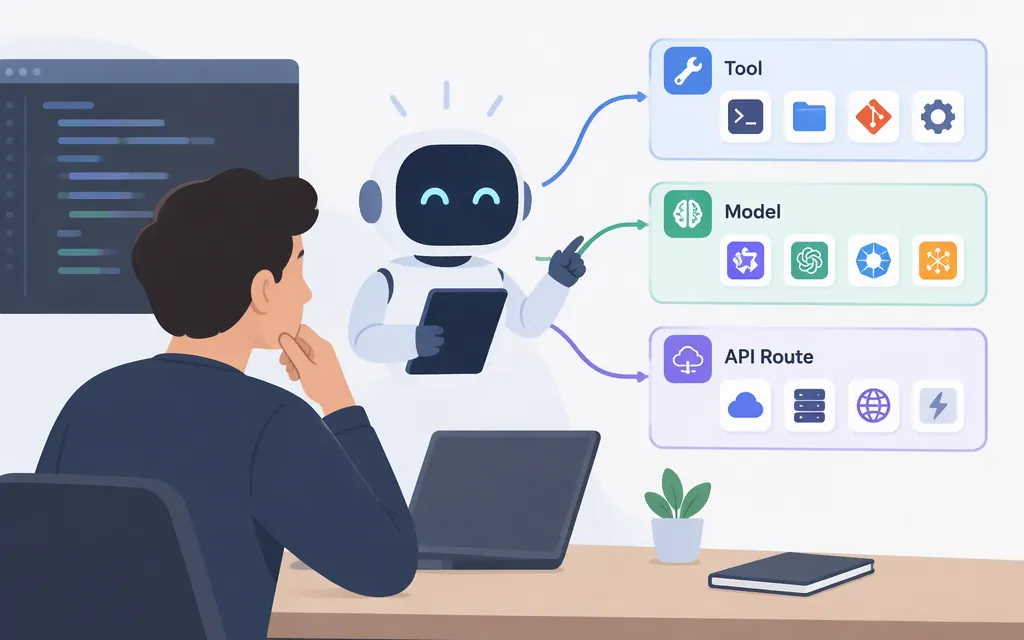
If you mean Qwen’s coding agent, start with Qwen Code: it is the agentic coding tool, while Qwen-Coder is a family of models you can call through an API. Qwen-Agent is a separate framework for building LLM applications and agents—not another name for Qwen Code. The official projects describe those distinct roles. (github.com)
For production, choose the API model and region based on your actual coding and tool-use requirements—not the product name alone. Alibaba Cloud Model Studio’s Qwen-Coder documentation currently shows qwen3-coder-next in an API example, but also recommends considering its latest general-purpose models. Test both routes if you are deciding between a coder model and a general model. (help.aliyun.com)
Qwen Code vs. Qwen-Coder vs. Qwen-Agent
| Name | What it is | Consider it when… |
|---|---|---|
| Qwen Code | An agentic coding tool that runs in a developer workflow; its official docs cover terminal use and features such as subagents, headless mode, MCP, and IDE integrations. | You want an interactive coding agent to work with a project. |
| Qwen-Coder | A model/API option for coding tasks, including code generation, completion, and tool interaction. | You are selecting a model for an API-backed application or agent. |
| Qwen-Agent | A framework for developing LLM applications, with example applications including Browser Assistant, Code Interpreter, and Custom Assistant. | You want to build an agent application and integrate tools or other components. |
These categories can be combined in an architecture, but they are not interchangeable: a model is not the agent interface, and a framework is not the same product as the coding CLI. Official project descriptions support these distinctions. (qwenlm.github.io)
What coding work should you evaluate?
Qwen Code’s documentation presents it as a coding tool with terminal workflows and additional capabilities such as subagents, skills, MCP, and headless operation. Those features describe workflow options, not a guaranteed success rate or proof that every model/provider combination supports every capability. Confirm the feature and provider combination in the current documentation before rolling it out. (qwenlm.github.io)
For model selection, use a small, representative evaluation rather than relying on a feature list:
- Choose a few real tasks—for example, explain an unfamiliar module, make a change across multiple files, or fix a failing test.
- Run each task with the same repository context, instructions, and acceptance criteria.
- Check whether the result builds, passes the relevant tests, follows project conventions, and uses tools appropriately.
- Compare the model/API combinations on quality, latency, and actual usage cost. This is a proposed evaluation method, not a reported Qwen Code test.
Alibaba’s Qwen-Coder documentation describes coding, completion, and tool interaction, but also advises users to consider newer general-purpose models. So a coder-branded model is a candidate to evaluate—not automatically the best choice for every coding workflow. (help.aliyun.com)
Production API: verify the exact route
The official Model Studio example uses the model ID qwen3-coder-next, a region-specific workspace endpoint, and a Model Studio API key. It demonstrates a Chat Completions request that asks the model to write a Python function. The example is a basic API smoke test; it does not by itself establish that a particular Qwen Code agent workflow or tool-calling setup is production-ready. (help.aliyun.com)
A shortened version of that documented pattern is:
import os
from openai import OpenAI

client = OpenAI(
    api_key=os.getenv("DASHSCOPE_API_KEY"),
    base_url="https://{WorkspaceId}.cn-beijing.maas.aliyuncs.com/compatible-mode/v1",
)

result = client.chat.completions.create(
    model="qwen3-coder-next",
    messages=[
        {"role": "user", "content": "Write a Python function that returns primes below n."}
    ],
)
print(result.choices[0].message.content)
This is specifically a China (Beijing) workspace endpoint example. Replace {WorkspaceId} with the ID for the matching Beijing workspace and use the API key applicable to that region and workspace. The cn-beijing part of the host identifies the endpoint region; changing only the workspace ID does not switch regions. For another region, use that region’s documented endpoint and matching API key rather than editing only the placeholder. Alibaba Cloud’s guidance notes that regions have their own dedicated endpoints and that API keys are region-specific. (help.aliyun.com) Expected outcome: a generated function in the response; production suitability still depends on your own integration tests and requirements.
Before choosing an API route, confirm:
- Model ID and region: availability and endpoint must match the provider region you intend to use.
- Agent features: verify function/tool calling and any structured-output requirements for that model in that region. Model capability can vary by region. (
help.aliyun.com) - Limits: check current input/output limits, rate limits, and account quotas against your workload.
- Cost: price the exact model, region, and billing route. Keep API inference charges separate from the coding tool or framework’s software license.
- Operations: test errors, retries, timeouts, logging, and tool permissions with representative tasks before production use.
A concrete price example—with a region caveat
The official Model Studio page lists Qwen3-Coder-Flash in China (Beijing) at CNY 1 per 1 million input tokens and CNY 4 per 1 million output tokens for standard, uncached API calls; cached-token rates are listed separately. On those listed rates, a hypothetical request using 1 million input tokens and 100,000 output tokens would cost CNY 1.40, before any applicable promotions or other charges. This is a Beijing-region example, not a US-region quote and not a price for qwen3-coder-next; check the current price for the exact model and region you plan to use. (help.aliyun.com)
Which should you choose?
- Choose Qwen Code if you want an agentic coding tool for a developer workflow. Use its official quickstart and provider documentation for current installation and configuration instructions. (
qwenlm.github.io) - Choose a Qwen-Coder API model if your application needs a coding model behind its own software. Verify its model ID, region, feature support, limits, and price; compare it with a current general-purpose model on your task. (
help.aliyun.com) - Choose Qwen-Agent if you are building an LLM application framework with agent components, rather than looking for the Qwen Code coding tool itself. (
github.com)
Bottom line: “Qwen code agent” most likely points to Qwen Code, but production model selection is a separate decision. Identify the tool you need, select the API model and region, then validate the complete workflow against your own acceptance criteria and budget.
Sources
Qwen Code — official GitHub repository
Qwen Code overview — official documentation
Qwen Code Quickstart — official documentation
Qwen-Agent — official GitHub repository
Qwen-Coder model capabilities — Alibaba Cloud Model Studio
qwen3-coder-flash model information and pricing — Alibaba Cloud Model Studio
Model Studio model pricing — Alibaba Cloud