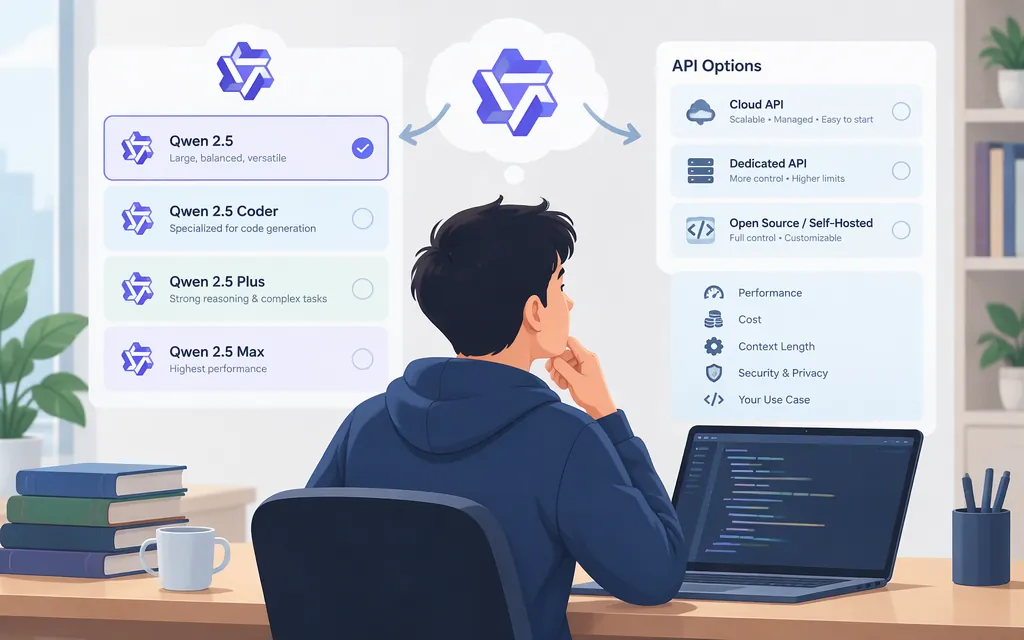
Short answer
Qwen is worth evaluating for coding, but no model is a reliable winner for every codebase. For routine coding assistance or a first hosted-API trial, start with Qwen3.8-Flash (qwen3.8-flash). For harder coding tasks or longer agent workflows, compare it with Qwen3.8-Max (qwen3.8-max). Alibaba Cloud describes Flash for coding and agent workflows, and Max for coding and long-horizon planning and iteration. Those are provider descriptions—not proof of results on your repository. (Flash model information; Max model information)
If you want to experiment with open weights and local coding agents, Qwen3-Coder-Next is another candidate: Qwen describes it as an open-weight model designed for coding agents and local development. Local deployment has different hardware, setup, and cost considerations from a hosted API. (Qwen3-Coder repository)
Treat these as candidates to test, not a universal ranking. Your workload—completion, debugging, repository questions, tests, or tool-using agents—should determine the comparison.
Which Qwen model should you evaluate for coding?
| Workload | Candidate to try | What the documentation supports—and what to test |
|---|---|---|
| Routine coding help or an initial hosted-API evaluation | Qwen3.8-Flash (qwen3.8-flash) |
Alibaba Cloud describes it for coding and agent workflows and lists a 1-million-token context window. Its Model Studio page lists function calling as supported. Confirm features and limits for your exact deployment; a large context window does not guarantee accurate or economical repository analysis. (Flash model information) |
| More difficult coding tasks or longer-running agent work | Qwen3.8-Max (qwen3.8-max) |
Alibaba Cloud describes coding capability and autonomous planning and iteration for long-horizon tasks, and lists function calling. Compare it with Flash on your own tasks; “Max” does not establish better value for every request. (Max model information) |
| Open-weight experiments with a coding agent or local development | Qwen3-Coder-Next | Qwen’s repository identifies it as open-weight and designed for coding agents and local development. Test the checkpoint and runtime you intend to use; hosted model features and prices do not automatically apply to self-hosting. (Qwen3-Coder repository) |
These are different access choices as well as different model candidates. A model generates responses; Qwen Code is a coding tool; Model Studio is a hosted API provider. Qwen Code’s authentication documentation lists QwenCloud options—with an explicit China or International selection—and separate Alibaba Cloud Model Studio options. Check the current setup instructions for the exact provider and plan you intend to use. (Qwen Code authentication)
Choose a coding workflow: Qwen Code or a hosted API
Choose a coding tool such as Qwen Code if you want an agent-style workflow working with a project. The current Qwen Code quickstart offers installation options and lists Node.js 22 or later for manual npm installation. Its provider setup distinguishes services and plans, so confirm the provider, model, and plan shown in your own setup before relying on them. (Qwen Code quickstart; Qwen Code authentication)
Choose a hosted API if your application or service needs to send coding requests directly to a model. This gives your application control over prompts and evaluation, while you manage keys, usage, retries, and safeguards around generated code. OpenAI-compatible syntax does not make provider endpoints, credentials, prices, or data terms interchangeable.
Example: call Qwen3.8-Flash through Model Studio
This is a conditional US (Virginia), pay-as-you-go compatibility example for Alibaba Cloud Model Studio. The Virginia DashScope base URL is https://dashscope-us.aliyuncs.com/compatible-mode/v1. The official endpoint guidance describes the DashScope domain as available for existing-business compatibility; it recommends a workspace-dedicated domain for production. A DashScope-domain key must be from the same region, and this domain accepts a key from any workspace in that region. By contrast, a workspace-dedicated endpoint requires a key belonging to the target workspace. Do not assume the endpoint and API key are interchangeable across regions or billing plans. (Base URL overview; Virginia region and endpoints)
The Flash model page lists US (Virginia) as a supported region, and the Virginia region documentation describes Global and US inference scopes. The example below uses the Virginia regional API key and qwen3.8-flash; confirm the model and deployment scope available in your account before use. (Flash model information; Virginia region and endpoints)
export DASHSCOPE_API_KEY="YOUR_VIRGINIA_REGION_API_KEY"
export OPENAI_BASE_URL="https://dashscope-us.aliyuncs.com/compatible-mode/v1"

curl "$OPENAI_BASE_URL/chat/completions" \
  -H "Authorization: Bearer $DASHSCOPE_API_KEY" \
  -H "Content-Type: application/json" \
  -d '{
    "model": "qwen3.8-flash",
    "messages": [
      {"role": "system", "content": "You are a careful coding assistant. Explain assumptions and propose a small, testable change."},
      {"role": "user", "content": "Given this function and its tests, identify one likely edge case and suggest a regression test."}
    ]
  }'
For a new production deployment, check whether the workspace-dedicated Virginia endpoint is the better fit: it uses the workspace ID in the hostname and requires an API key from that target workspace. Model Studio says endpoint and key must also match the billing plan. The official endpoint pages distinguish the shared DashScope and workspace-dedicated patterns; they do not establish a migration or deprecation of the Virginia DashScope endpoint. (Base URL overview; Virginia region and endpoints)
Cost and request limits for the example
Model Studio documents pay-as-you-go API billing by default and says its published price table contains standard prices. I could not establish the exact Qwen3.8-Flash US (Virginia) input and output rates from the applicable public pricing material. The model page lists a 1-million-token context window, but the material available here does not establish separate maximum input and output lengths for this Virginia route. Virginia rate limits also vary by model and are aggregated at the Alibaba Cloud account level. Check the current console and model-specific limits before estimating production spend or setting request sizes. (Model inference pricing; Flash model information; Virginia region and endpoints)
Do not substitute another model’s price or another provider’s terms for this Virginia Flash route. A million-token context limit is a maximum capability, not a recommendation to send a million tokens on every request.
Production checks before you integrate
For the specific provider, region, model, account, and billing plan you plan to use, verify:
- Model and regional availability: confirm the exact model ID, region, and inference scope in the current Model Studio documentation or console. The Flash model page lists
qwen3.8-flashand US (Virginia). (Flash model information) - Endpoint and key pairing: choose the appropriate endpoint type. The Virginia DashScope endpoint is available for existing-business compatibility and accepts a key from any workspace in the same region; a workspace-dedicated endpoint requires a key from its target workspace. Pair the key with the same region and billing plan. (Base URL overview; Virginia region and endpoints)
- Features and limits: if your application needs function calling, structured output, or a particular context length, check support and request limits for the exact model and deployment. Flash’s Model Studio page lists function calling and a 1-million-token context window; the separate Virginia input/output bounds were not established here. (Flash model information)
- Cost and throttling: confirm the current input/output rates, any cache charges, and account-specific rate limits before forecasting spend. The exact Virginia Flash prices and separate request bounds were not established here; do not substitute another model’s price. (Model inference pricing; Virginia region and endpoints)
- Data terms and permissions: review the selected provider’s applicable data handling, retention, security, and contractual terms. API compatibility by itself does not establish those terms.
- Review and tool permissions: inspect generated diffs, run your tests, and keep consequential shell, deployment, or security-sensitive actions behind appropriate approvals. An agent’s security review is not a substitute for your own checks.
Test Qwen on your codebase before choosing
Public model descriptions cannot settle whether a candidate will help with your repository. Compare candidates on the same small set of representative tasks, with the same context, tools, and time budget:
- Repository question: ask which service owns a particular endpoint, then verify the answer against the code.
- Bug fix: provide a real issue and request a minimal patch plus a regression test.
- Refactor: choose a bounded function or module and require existing behavior to remain unchanged.
- Agent task, if relevant: ask it to run an approved test or linter, inspect failures, and propose a fix.
For each task, record correctness, test results, human correction required, tool-call success where relevant, elapsed time, and token cost where you can measure it. Use a clean branch, inspect the diff, and run tests and security checks yourself. Don’t send secrets or sensitive source code until you have reviewed the selected provider’s data terms.
Bottom line
Start with Qwen3.8-Flash for a hosted coding-assistance trial; compare Qwen3.8-Max if your work demands harder reasoning or longer agent workflows. Consider Qwen3-Coder-Next when open weights and local coding-agent experiments matter. Choose Qwen Code for a coding-tool workflow or a hosted API for direct application integration, but verify that the specific provider, region, plan, and endpoint support your chosen model. Make the final choice using repository tests and provider-specific limits, costs, and terms—not model labels or generic compatibility claims.
Sources
qwen3.8-flash model information — Alibaba Cloud Model Studio
qwen3.8-max Model Info — Alibaba Cloud Model Studio
Model Studio Base URL — API endpoints by region and plan
Virginia region and endpoints — Alibaba Cloud Model Studio