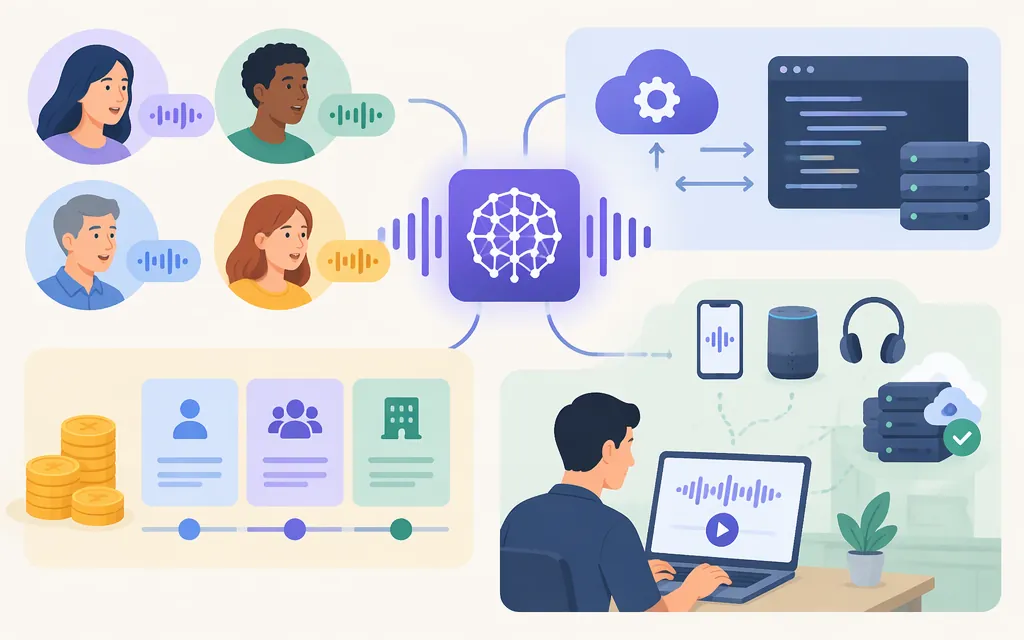
Qwen TTS refers to text-to-speech models and APIs, and the name covers multiple model identifiers. As of November 10, 2026, Alibaba Cloud documents qwen3-tts-flash for non-real-time synthesis and qwen3-tts-flash-realtime for real-time synthesis. Choose based on whether your application sends complete text for synthesis or needs a real-time interaction; confirm the model identifier, region, voice, and API route for your deployment. (help.aliyun.com)
For complete-text synthesis followed by audio retrieval, evaluate qwen3-tts-flash. For real-time generation, evaluate qwen3-tts-flash-realtime, which has a separately documented WebSocket API. These are distinct identifiers; do not assume capabilities or integration details carry across them without checking the relevant documentation. (help.aliyun.com)
Which Qwen TTS model should you evaluate?
The 2025 Qwen-TTS announcement used qwen-tts-latest and qwen-tts-2025-05-22 for the update it described. Those historical names do not establish which identifier is current today. Current Model Studio pages document qwen3-tts-flash and qwen3-tts-flash-realtime. (help.aliyun.com)
| Requirement | Model to evaluate | Why |
|---|---|---|
| Send complete text and retrieve audio after synthesis | qwen3-tts-flash |
The current model page identifies it as the offline (non-real-time) text-to-speech model. (help.aliyun.com) |
| Generate speech in a real-time interaction | qwen3-tts-flash-realtime |
Alibaba documents a separate real-time model and WebSocket integration path. (help.aliyun.com) |
| Compare options across the wider speech catalog | Review relevant Qwen-Audio TTS models too | The broader catalog lists separate models; do not treat them as aliases for Qwen3-TTS. |
Voices, languages, and speech behavior
For qwen3-tts-flash, Qwen’s model-specific announcement describes 17 speaker options, each supporting 10 languages: Chinese, English, German, Italian, Portuguese, Spanish, Japanese, Korean, French, and Russian. It also lists support for Mandarin, Hokkien, Wu, Cantonese, Sichuanese, Beijing, Nanjing, Tianjin, and Shaanxi dialect synthesis. These are product claims in Qwen’s announcement; audition the required voice and language combination before selecting it. (qwen.ai)
For qwen3-tts-flash-realtime, Alibaba’s voice list explicitly identifies Cherry and lists Chinese (Mandarin), English, French, German, Russian, Italian, Spanish, Portuguese, Japanese, and Korean as supported languages for that voice. The same list includes other named voices, but check the entry for the specific voice you plan to use rather than assuming every voice has identical coverage. (help.aliyun.com)
An earlier Qwen-TTS announcement described Chinese-English synthesis and named Cherry, Ethan, Chelsie, Serena, Dylan, Jada, and Sunny; it associated Dylan with Pekingese, Jada with Shanghainese, and Sunny with Sichuanese. It also made qualitative claims about text-responsive prosody, pacing, and emotional inflection. These historical details do not establish that the same voice set or behavior applies to every current Qwen3-TTS model. The announcement’s captured benchmark table is difficult to map reliably, so it is not a sound basis for ranking individual voices.
Practical fit check: verify the exact voice and language combination for your chosen model, then audition representative scripts—not only short demo sentences. Include names, numbers, abbreviations, punctuation, code-switching, and pronunciation-sensitive phrases. Compare intelligibility, pronunciation, pacing, and expressive consistency by listening to the generated output. This is a suggested evaluation, not a test performed for this article.
Calling Qwen TTS through the API
Alibaba’s documented non-real-time example uses the DashScope Python SDK’s client.audio.tts.http.synthesize method with text, a model identifier, and a voice. Its example response exposes an audio URL, audio ID, and expiry value.
result = client.audio.tts.http.synthesize(
    "Hello. This is a short speech synthesis test.",
    model="qwen3-tts-flash",
    voice="Cherry",
)

print(result.audio_url, result.audio_id, result.expires_at)
This demonstrates the synthesis call, not a complete, copy-paste client setup. The example alone does not establish the exact client constructor, whether a workspace argument is required, or a specific SDK version. Follow the current API reference for client initialization, credentials, and region settings. Check the relevant response and output documentation for audio encoding and URL validity; do not infer a file format from a filename.
For real-time synthesis, Alibaba documents a separate WebSocket API using qwen3-tts-flash-realtime. This is a different integration path from the non-real-time synthesis call above. (help.aliyun.com)
Published pricing and production checks
The model pages list API prices in CNY per 10,000 characters. Their pricing tables show the China (Beijing) rate first and the Singapore rate under Scope: International: qwen3-tts-flash is CNY 0.80 and CNY 0.733924, respectively; qwen3-tts-flash-realtime is CNY 1.00 and CNY 0.954101. The pages say these are original API prices and exclude limited-time promotions. Confirm the current console price and whether the listed region and scope apply to your deployment before budgeting. (help.aliyun.com)
As a rate-card calculation, 1,000,000 characters equals 100 units of 10,000 characters. At the listed rates, that is CNY 80 for non-real-time synthesis at the Beijing rate or CNY 73.3924 at the International-scope rate. For real-time synthesis, it is CNY 100 or CNY 95.4101, respectively. These are arithmetic estimates from the published rates—not a quote or a statement about taxes or account-specific terms. (help.aliyun.com)
Before production, verify the items that can affect implementation or cost:
- Region and access: confirm that your intended region supports the chosen model and API route, and follow the matching credential and client-configuration instructions.
- Voice and language: check the voice entry for your exact model and audition your own scripts. The documented Cherry language list is specific to the real-time voice-list entry; do not assume it proves coverage for every voice or model. (
help.aliyun.com) - Output handling: confirm audio format, sample rate, streaming behavior, and URL or file-handling details in the relevant API documentation.
- Capacity and reliability: check current rate limits and account- or deployment-specific conditions. Validate latency, error handling, and availability terms against your workload; the cited model pages do not establish those production outcomes. (
help.aliyun.com) - Cost: estimate expected character volume using the rate for the actual model and deployment scope, then confirm the current rate card and any promotions in the console. (
help.aliyun.com)
Bottom line: Qwen3-TTS is a candidate when its documented language and voice options match your requirements and its API route fits your application. Start with qwen3-tts-flash for non-real-time synthesis and qwen3-tts-flash-realtime when your use case needs real-time generation. Before deciding, verify the exact voice, region, integration requirements, relevant limits, and current price—and run your own representative-script evaluation. (help.aliyun.com)
Sources
Time to Speak Some Dialects, Qwen-TTS!
Qwen3-TTS-Flash: Multi-timbre & Multi-lingual & Multi-dialect Speech Synthesis
qwen3-tts-flash-realtime Model Info
Qwen-TTS speech synthesis API reference