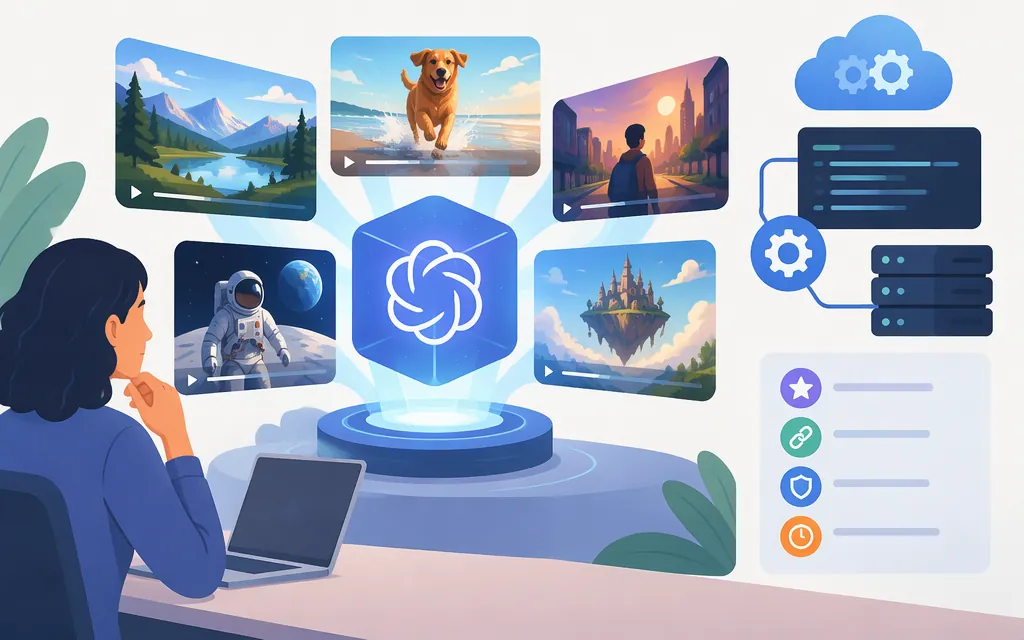
Sora 2 was OpenAI’s video-and-audio generation model, but it is no longer available as a production API. OpenAI says the Sora web and app experiences ended on April 26, 2026, and the Sora API was discontinued on September 24, 2026. As of November 9, 2026, don’t select Sora 2 for a new API workflow or rely on older integration instructions. (help.openai.com)
What was the Sora 2 model?
OpenAI introduced Sora 2 on September 30, 2025, describing it as a video-generation model with synchronized dialogue and sound effects. OpenAI also highlighted more realistic motion, physics, and control over instructions spanning multiple shots. Those descriptions explain the model’s intended strengths; they are not a guarantee that every generation would meet a production requirement. (openai.com)
For model selection, the main reported capabilities were:
- Text-to-video and image-to-video: A third-party MindStudio article described generating video from prompts or images. Treat that as an attributed report, not a current API specification. (MindStudio’s Sora 2 overview)
- Synchronized audio: OpenAI’s launch announcement described synchronized dialogue and sound effects. (OpenAI’s Sora 2 announcement)
- Physics and instruction following: OpenAI described improved physical realism and controllability, including following detailed instructions over multiple shots. These are product claims, not comparative benchmark results. (
openai.com)
Keep Sora 2 separate from Sora 2 Pro. A separate MindStudio listing for Sora 2 Pro describes character-reference video inputs and selectable duration and output size. Those are third-party listing details for that variant, not evidence that the same inputs or settings applied to every Sora 2 model. The listing also gives conflicting signals about status, so it should not be used to establish current availability. (MindStudio’s Sora 2 Pro listing)
Can you use Sora 2 in a production API now?
No—not as a currently available OpenAI API model. OpenAI’s current discontinuation information states that the API was discontinued on September 24, 2026; its API deprecations page records that the Videos API and Sora 2 model aliases and snapshots were scheduled for removal on that date. (help.openai.com)
That means a new implementation should not be built around Sora 2, and existing applications should be migrated rather than assuming the service will continue to work. The official notices establish the discontinuation; they do not, in the captured material, provide a Sora 2 replacement API or current Sora pricing.
Reported strengths, constraints, and historical pricing
A third-party article characterized Sora 2 as useful for short-form ideation and concept development, citing prompt following, physics simulation, and synchronized audio as strengths. It also reported limitations involving long-form video, consistency between separate generations, fine hand or facial detail, and readable text. These are qualitative observations from that article, not independently verified results from a shared model comparison. (MindStudio’s overview)
The same article reported historical API prices of $0.10–$0.50 per second, depending on model and resolution; a separate Sora 2 Pro listing reported $0.30–$0.50 per second. Those were third-party historical figures, and the article itself warns its pricing and availability details are no longer current. They are not usable as current pricing or a basis for a purchasing decision. (MindStudio’s overview; Sora 2 Pro listing)
What production integration details are missing?
A third-party article outlined a generic asynchronous video workflow: submit a request, receive a job ID, poll for completion, and retrieve the video. But that description does not supply a current, supported Sora 2 API interface. It is not enough to implement or operate a production integration. (MindStudio’s overview)
The captured material does not establish a current Sora 2 endpoint or model identifier, authentication method, request and response schemas, output handling, error and retry behavior, rate limits, or current terms. Since OpenAI says the API has been discontinued, those historical implementation details should not be turned into new instructions.
Bottom line
Sora 2 was OpenAI’s video-generation model, with reported text/image video generation and synchronized audio. But it is not a suitable choice for a new production API workflow: OpenAI discontinued the API on September 24, 2026. Treat third-party capability and pricing details as historical, and assess any replacement against current documentation, pricing, and tests for your own requirements. (help.openai.com)
Sources
What to know about the Sora discontinuation — OpenAI Help Center