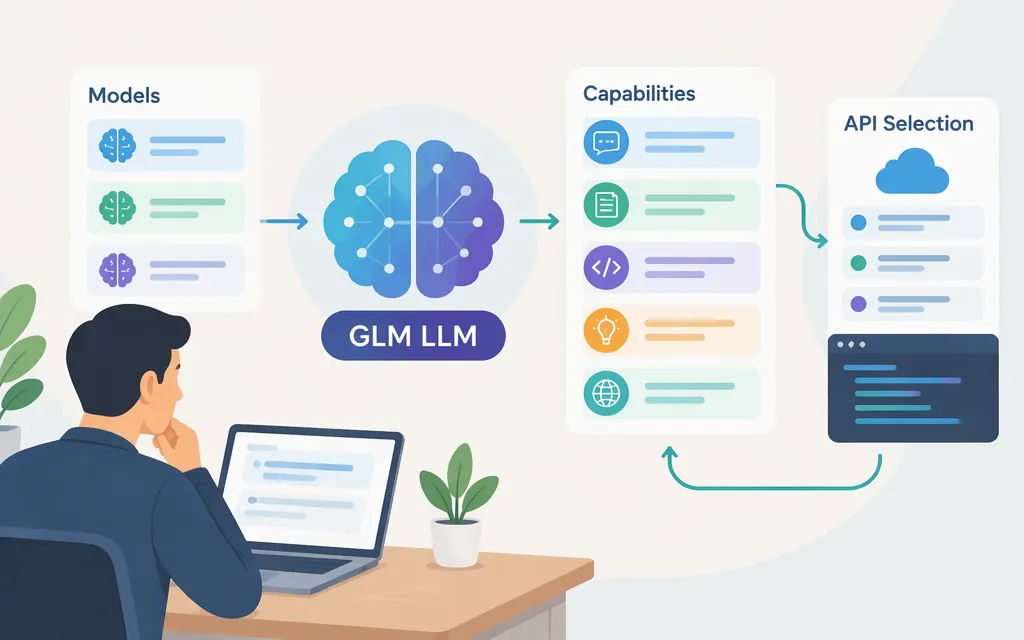
What is a GLM LLM?
GLM is a family of large language models—not one specific model. The initials are commonly expanded as “General Language Model” in secondary descriptions. One source calls that the historical expansion associated with the earliest releases; Z.ai’s official documentation confirms that GLM is a model family, but the official pages reviewed here do not confirm whether “General Language Model” is its current formal expansion. (Z.ai)
A specific name such as GLM-4.5 or GLM-5.3 identifies a release within that family. Do not assume that versions share the same input types, context limits, reasoning settings, API availability, or price. For example, Z.ai’s documentation describes GLM-5.3 as text-only, with a 1-million-token context window and up to 128,000 output tokens. Those are GLM-5.3 specifications, not family-wide guarantees. (GLM-5.3 documentation)
What can GLM models do?
Capabilities depend on the release and on how you access it. Z.ai describes GLM-4.5 as a reasoning, coding, and agent-oriented model, with tool invocation. (GLM-4.5 documentation)
For GLM-5.3, the cited documentation describes text-only inputs and the model’s context and output limits. The material reviewed here does not establish whether reasoning can be disabled through a particular API, or which reasoning-effort settings that endpoint supports. If those controls matter for your use case—especially latency—check the documentation for the exact model and endpoint you plan to use. (GLM-5.3 documentation)
One important distinction: a model proposing a tool call is not the same as the model executing an action. A production application typically needs to provide the tools, decide whether a proposed call is permitted, execute it, and return the result to the model. Z.ai documents tool-calling capabilities for supported models; confirm which tools and streaming behavior are supported by the specific model and endpoint you plan to use. (Function-calling documentation)
How to decide whether a GLM model fits
Start with the job, then select a particular release and provider. For instance, if you are considering GLM for a coding assistant, test a representative task that requires it to understand a change request, propose edits, and respond to test results. If you need tool use, separately check that the API supports the required tool-call format and that your application can safely execute and review those calls.
A practical pilot could use one realistic task from your own workload and record:
- Task quality: Did the answer or code meet your acceptance criteria?
- Integration fit: Did the API return the content and tool calls your application expects?
- Latency and reliability: How long did requests take, and did they fail or need retries?
- Usage cost: What did the actual input and output volume cost at your expected workload?
These checks produce workload-specific evidence; broad capability descriptions or benchmark claims alone do not establish that a model will suit your application. If latency is critical, test it directly rather than assuming a reasoning-focused configuration will be fast enough.
What to verify before choosing a GLM production API
Use the provider’s documentation for the exact model and service you intend to use. Check:
- Model and availability: Is the exact model identifier available through this provider, in your intended region and account type?
- Supported behavior: Which input modalities, context and output limits, reasoning settings, and tool-calling features are exposed through that API?
- Integration requirements: Which endpoint, authentication method, request format, and response format does the provider document?
- Limits and reliability: What rate limits, quotas, service terms, and relevant data-handling conditions apply?
- Commercial terms: Confirm current prices, currency, billing unit, and whether you are comparing token-based API usage with a subscription plan.
Z.ai’s pricing page states that prices are in USD and lists them per 1 million tokens. Its GLM-5.3 row lists $1.40 for input tokens and $4.40 for output tokens; it separately lists cached input at $0.26 per million tokens and cached-input storage as limited-time free. These are Z.ai’s listed rates, not another provider’s prices, and the cached-input terms are distinct from standard input pricing. Recheck the provider’s current terms when making a purchasing decision. (Z.ai pricing)
Token Forge Cloud’s site describes production APIs for GLM among other model families. That broad statement does not by itself establish which GLM release is available, its endpoint, or its price. Confirm those details with the provider before designing a production integration around a particular model. (Token Forge Cloud)
Bottom line: GLM refers to a family of LLMs; choose and evaluate a named release, not the family label. Verify its capabilities and terms through the intended API provider, then test it on a representative task before committing.
Sources
GLM-4.5: Reasoning, Coding, and Agentic Abilities
GLM-4.5 Overview — Z.AI Developer Documentation
GLM-5.3 Overview — Z.AI Developer Documentation
Pricing — Z.AI Developer Documentation