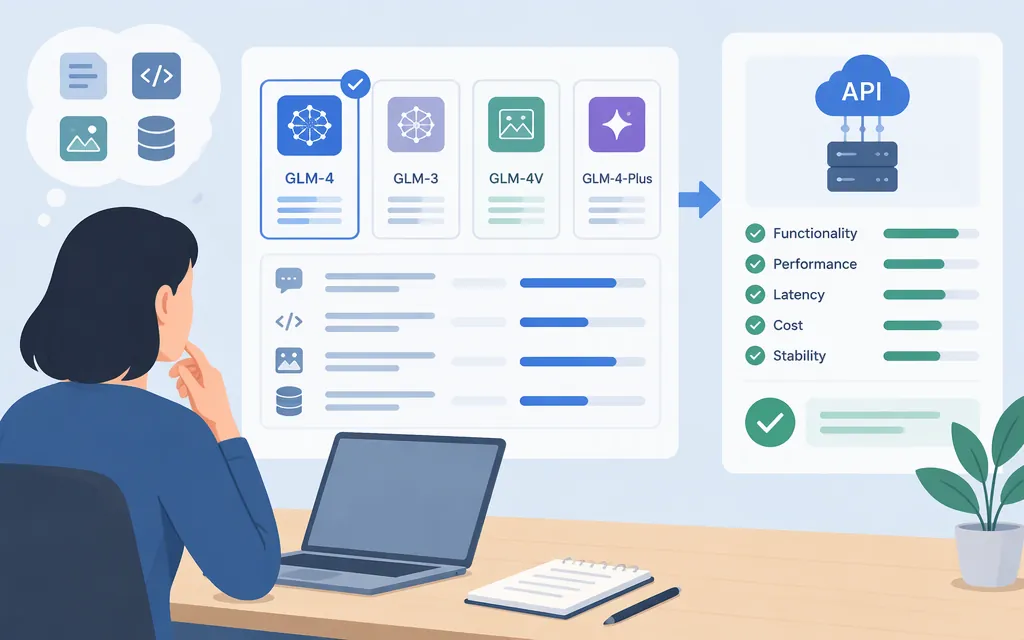
“Zhipu model” usually refers to a model in the GLM family from Zhipu AI, also known as Z.ai. The available Z.ai documentation excerpts name GLM-5.3, GLM-5.3-Flash, and other GLM models, but do not establish that list as a complete, universally available catalog. Treat the specifications and prices below as details reported in the supplied documentation excerpts—not as confirmation of live account availability—and check the linked provider documentation before choosing or budgeting.
What does “Zhipu model” mean?
Zhipu AI and Z.ai are names for the company; GLM is its model family. The available official-documentation excerpts identify GLM-5.3 and GLM-5.3-Flash among the featured options and also name models such as GLM-5.2, GLM-5.1, GLM-5, GLM-4.7, and GLM-4.6. This is not enough to establish a complete catalog, model status, or availability for every account or API product. [1]
Older reporting can provide context, but should not be mistaken for a current catalog: a November 2025 interview discussed GLM 4.5 and 4.6 in connection with coding, reasoning, and agentic tool use; an August 2025 report covered GLM-4.5 and GLM-4.5-Air. Those are dated examples, not current performance evidence. [6] [7]
Guide reference date: November 10, 2026. The model distinctions below are limited to details contained in the documentation excerpts available for this guide; confirm the live documentation and your account’s access before implementation.
GLM model shortlist by workload
| If your workload is… | Candidate to evaluate | What the available documentation supports | What to check in your own evaluation |
|---|---|---|---|
| Text-based tasks where you need a large documented context or output allowance | GLM-5.3 | The supplied model-specific documentation excerpt describes text-only input, a 1-million-token context window, and up to 128,000 output tokens. It does not establish the reasoning-effort settings mentioned in an earlier draft, so no such settings are specified here. [3] | Test your actual prompts and output sizes, including long inputs. A stated maximum context is not proof that performance is uniform across that length. |
| Comparing a lower-listed-price option with GLM-5.3 | GLM-5.3-Flash | It is named in the supplied overview excerpt, and the supplied pricing excerpt lists lower per-token rates than GLM-5.3. The available excerpts do not establish its input modalities or context limit, so do not assume it supports image or other media input. [1] [4] | Verify the model-specific input types and limits, then compare quality, latency, and cost on representative tasks. |
| Programming and multi-step reasoning/execution | GLM-4.7 | Z.ai’s supplied model-specific excerpt positions the GLM-4.7 series around enhanced programming and more stable multi-step reasoning/execution. The available excerpt does not establish the context or output limits for the named model, so confirm those in its live documentation. [5] |
Compare it with your other candidates on a fixed set of representative coding or reasoning tasks; include retries and regressions in your assessment. |
| Image or video understanding | Confirm a specific vision model before shortlisting | The available excerpts do not establish the exact vision-model names and supported modalities needed to recommend a particular candidate. Do not infer media support from a pricing-list entry or a family name. | Check the model-specific documentation for accepted media, limits, and API request format before testing. |
These are candidate-evaluation prompts, not independent benchmark conclusions. For coding, use representative repository tasks and check whether changes pass tests and follow project conventions. For an agent, measure task completion, tool-call accuracy, latency, and retries. For long-context work, test retrieval and instruction-following at the input lengths you expect.
A historical benchmark caution: DeepLearning.AI’s August 2025 article says GLM-4.5 at 64.2% on SWE-bench Verified “outperformed” Kimi K2 at 65.4%. The stated ranking conflicts with the numbers, so do not use that comparison as valid evidence. More generally, dated third-party benchmark results do not substitute for comparable tests on your own workload. [7]
What do the supplied Z.ai pricing details show?
The supplied pricing-documentation excerpt states that prices are in USD per 1 million tokens and distinguishes input, cached input, and output. It supports the two rows below. Because the available material does not independently confirm live prices or billing conditions, check the provider’s pricing documentation before budgeting. [4]
| Model | Input | Cached input | Output |
|---|---|---|---|
| GLM-5.3 | $1.40 | $0.26 | $4.40 |
| GLM-5.3-Flash | $0.15 | $0.03 | $0.50 |
Worked estimate: If a request uses 10,000 uncached input tokens and produces 2,000 output tokens, the arithmetic at the listed GLM-5.3 rates is 0.01 × $1.40 + 0.002 × $4.40 = $0.0228. This is an illustrative token-cost calculation, not a quote; it assumes those tokens are billed in the stated categories and excludes any other charges.
The earlier draft included more model prices and a web-search charge, but the available pricing excerpt did not support those details, so they are not reproduced here. Compare cost alongside task success, quality, latency, retries, and any separately documented tool charges.
What should you verify before production API use?
For the standard Z.ai model API, the supplied HTTP-documentation excerpt gives the general base URL as https://api.z.ai/api/paas/v4/ and shows Bearer authentication with an API key. It does not establish that these settings apply to every product or plan. [2]
Before integrating, check the live documentation for the specific model and account:
- Model ID and features: Confirm the exact API model ID, supported input modalities, tool or function calling, structured output, streaming, and any reasoning controls.
- Requests and responses: Confirm payload format, output limits, response behavior, and error handling in the API reference. The supplied standard API excerpt shows a chat-completions example, but does not establish that other products use identical configuration. [2]
- Limits and operations: Check context and output limits, rate limits, concurrency, availability, and expected latency; then test under your anticipated traffic pattern.
- Data and deployment terms: Decide whether a hosted API meets your requirements or whether another deployment route is needed. Verify current processing, retention, residency, security, and contractual terms for the actual service and region. A November 2025 interview said overseas services were hosted in Singapore at that time; that historical statement does not establish current data location or binding terms. [6]
- Product-specific setup: Do not assume a Coding Plan or other plan uses the standard API endpoint or key configuration. Confirm the applicable endpoint and credentials in that product’s current documentation; the available excerpt does not establish the precise distinction. [2]
This is a model-selection overview, not a replacement for the endpoint-specific implementation reference. Do not rely on the historical interview or third-party reporting for current API setup, licensing, or data-handling terms.
Bottom line
Start with a documented GLM candidate that fits the task, then evaluate it on representative examples. Compare quality, reliability, latency, and the currently applicable input, cached-input, and output costs together. Before production, confirm the exact model ID, endpoint, account or plan configuration, technical limits, and relevant data terms in live Z.ai documentation. The available evidence does not establish one universal best Zhipu model.
Sources
Z.AI Developer Documentation: Overview
Z.AI Developer Documentation: HTTP API Calls
Z.AI Developer Documentation: GLM-5.3
Z.AI Developer Documentation: Pricing